Andrew of Cicala (died 17 May 1246), known in Italian as Andrea di Cicala or Andrea Cicala, was a nobleman and administrator in the Kingdom of Sicily under the king-emperor Frederick II. He was the lord of Golisano from before 1231 and the lord of Polizzi from 1236.
Andrew served as captain of the northern half of the kingdom from 1239 until 1246 and master justiciar of the same from 1240. He was for a brief period in 1242–1243, captain over the whole kingdom. His energetic administration in the period 1239–1241, when he was facing the a papal invasion, can be traced in detail. In May 1242, he led an attack on Rieti. A loyal servant of the crown, whose counsel in military matters was sought after, he seems to have experienced a crisis of confidence in Frederick II following the latter's deposition by the Council of Lyon in 1245. He joined a conspiracy against the emperor's life and was killed during its suppression.
The Cicala family was originally from Castelcicala in the Campania. [a] They were resolutely royalist. [1] Andrew's father, Paul, was the count of Alife in Campania and Golisano on the island of Sicily. His mother was Sica Musca. Andrew was raised on the family's Sicilian estates. He is recorded for the first time in June 1216 in Palermo, when he and his brothers Simon and Matthew witnessed their father's donation of the Sicilian castle of Roccella to the Campanian monastery of Montevergine. Andrew married Margaret, a sister of Arduin, count of Ischia Maggiore, which brought him connections at the royal court. [2] [3]
Andrew succeeded his father in Golisano, but without the title of count. As lord of Golisano, he had to remit the royal tithe to the diocese of Cefalù annually. In February 1231, he persuaded Bishop Arduin of Cefalù to cede the diocese's rights in the church of Saint Philip in Golisano to the monastery of Montevergine. In November 1234, his brother-in-law drew up his will, in which he named Andrew the guardian of his daughters and the administrator of his estates in Sicily. In 1236, King Frederick enfeoffed Andrew with the lordship of Polizzi, which also paid the royal tithe to Cefalù. [2] [3]
In early October 1239, Frederick appointed Andrew captain [b] of the entire kingdom north of Calabria, from Porta Roseti to the mouth of the Tronto. This was a new office with administrative and military functions, designed to put all the resources of the mainland under a single command for the war against the Papacy. Andrew also took control of vacant dioceses. He assigned diocesan revenues to certain Roman nobles, like Manuel Frangipane, in order to undermine the Papacy. In November, Frederick also placed the University of Naples and its students under Andrew's protection. [2] [3]
Andrew worked energetically to increase the number of castles under royal control and improve their readiness for war. He appointed new castellans in the fortresses of Bari, Trani, Popoli and Monticello; improved the fortifications and increased the garrisons of Montecassino, Rocca Ianula and Castel Volturno; confiscated castles from feudatories in the Marsica and Abruzzo; and occupied castles in the papal duchy of Spoleto. [2] [3] [4] He took new oaths of fealty from the port officials (portulani) of Apulia, Abruzzo and Campania. He requisitioned mercenaries from the provincial justiciars to garrison the castles under his command. [2] [3] He proposed the destruction of some castles in the county of Fondi to improve the kingdom's strategic position. Frederick at first reserved judgement until he could see Andrew's list. [2] [5]
In December 1239, Andrew brought his wife over from Sicily and set her up in the castle of Teano, which was also his residence. [2] [6] That same month, a plot he hatched with the comune of Rieti nearly captured the pope's nephew for use as a hostage during negotiations. He received instructions from Frederick to attack papal Benevento. Without instructions, he sent a force of knights, archers and Saracens of Lucera to assist Frederick's son, King Enzo of Sardinia, in northern Italy. [2] [3]
Andrew became Frederick's most important military advisor, often offering independent advice. [2] [3] [7] In January 1240, he created the office of visitator castrorum (visitor of castles). Each visitator was charged with inspecting his castles twice a week and every castle in the kingdom had a visitator. That same month, Frederick assigned Andrew the responsibilities of the Magna Curia (Great Court) on the mainland and appointed two judges from the Curia, Simon and Robert of Tocco, to assist him. In February, after having begun to collect the collecta generalis (general tax), Andrew ordered an inquest into the tax collection of 1239 and into certain persons of doubtful loyalty in Abruzzo, Molise and the county of Fondi. Andrew ordered the arrest of all citizens of Terni living within the kingdom to put pressure on the comune to submit to Frederick, who had invaded the Papal State. [2] [3]
In March 1240, Andrew charged the procurators and castellan of Pettorano with maladministration. Later that year, he enforced the ban on the export of horses, replaced William of Spinosa as castellan of Rocca Ianula with John of Trentenaria and assembled an army of knights at San Germano. In April, he attended the imperial diet at Foggia, where he discussed with Frederick the rebellion in Rocca Alberici and two unresolved lawsuits concerning the cathedral of Aversa and two Abruzzese noblewomen. On 3 May, Frederick appointed him master justiciar of the same territory over which he was captain, effectively giving him complete viceregal authority from Porta Roseti to the Tronto. One of his first duties was to put into effect the new laws concerning judges, notaries and physicians promulgated at Foggia. He summoned the procurators of the royal domain to inspect their accounts. [2] [3]
In 1241, Frederick ordered a levy of church property to pay for the war. Andrew informed the prelates at an ecclesiastical assembly at Melfi in June. To collect the church's treasures, he dispatched as emissaries Peter of Melfi to Basilicata, Martin of Airola to Montevergine, John Capuanus of Naples to Molise [c] and Thomas Castulus to the diocese of Valva. The confiscated treasure was deposited at San Germano in August. Some of it was redeemed (i.e., bought back) by the churchmen, but the rest was sent to the emperor at Grottaferrata. [2] [3]
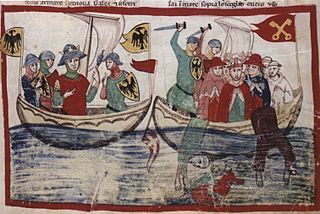
In July 1241, Andrew took charge of the high-profile prisoners, including Cardinals Otto of Tonengo and James of Pecorara, who had fallen into Frederick's hands at the naval battle of Giglio in May. Taking custody of them at Naples, he had them imprisoned in Salerno. He then sent a troop of knights to Frederick's camp at Rieti, as the emperor had requested, before joining the emperor himself. Towards the end of 1241, he was once again charged with collecting the collecta generalis for the war. [2] [3]
In 1242–1243, the captain of Sicily and Calabria, Roger de Amicis, was sent on a diplomatic mission to Abbasids in Baghdad and the Ayyubids in Cairo. During his absence, Andrew for a time exercised the captaincy over the whole kingdom with the title capitaneus regni. [2] [3]
In the spring of 1242, Frederick granted Andrew the castles of Acri and Corigliano and several fiefs in Calabria as a reward for his services. In May 1242, Andrew led a group of knights in an attack on Rieti and its environs. Although it was feared he would attack Rome, he spared the city. In September, he was in Salerno, where he decided a lawsuit brought by the monastery of Santa Maria Mater Domini against the crown in favour of the former. In February 1243, he attended another diet at Foggia. Afterwards, he arranged the administration of various properties confiscated by the crown in Taranto. Towards the end of 1244, in response to the defection of Viterbo to the papal side in September, [d] he was once again charged with collecting the collecta generalis for the war. In August 1245, he held an inquest in the territory of Montecassino. [2] [3]
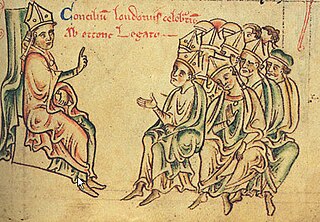
Despite years of loyal service, [e] by early 1246 Andrew had joined a conspiracy against Frederick's life. It is most likely that the deposition of Frederick II by Pope Innocent IV during the Council of Lyon in July 1245 affected his own sense of legitimacy as Frederick's viceroy. [2] [3] He was in contact with one of the leading conspirators, Tebaldo Francesco. [8] After the plot was discovered, he opened the castles of Scala [f] and Capaccio to the conspirators. At Capaccio they were besieged for three months until July 1246. [2] [3] [9]
Andrew died on 17 May 1246, during the first confrontations between the conspirators and Frederick's forces before the final stand at Capaccio. The day of his death is recorded in the necrology of Montevergine, which also records that his wife died on 19 June without specifying the year. It is corroborated by royal records showing that the fief of Casalrotto, which Andrew had acquired from the monastery of La Cava in return for an annual payment, had escheated to the crown by 21 May 1246. [2] [3] The office of captain was left vacant after his death. [10]
Andrew had only one daughter, Constance, who inherited the lordships of Golisano and Polizzi, as confirmed by Innocent IV in 1254. She was married twice. In 1277 or 1278, she married Hugh of Conches. Widowed, she married Mauger de Brussoes of France in 1279 or 1280. [2] [3]
Pope Gregory IX was head of the Catholic Church and the ruler of the Papal States from 19 March 1227 until his death in 1241. He is known for issuing the Decretales and instituting the Papal Inquisition, in response to the failures of the episcopal inquisitions established during the time of Pope Lucius III, by means of the papal bull Ad abolendam, issued in 1184.

Pope Innocent IV, born Sinibaldo Fieschi, was head of the Catholic Church and ruler of the Papal States from 25 June 1243 to his death in 1254.
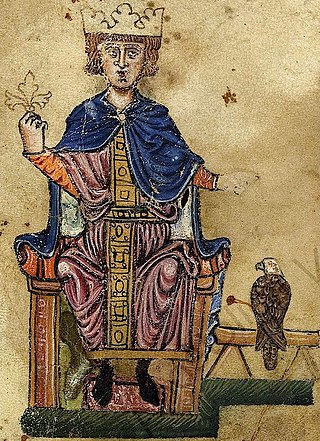
Frederick II was King of Sicily from 1198, King of Germany from 1212, King of Italy and Holy Roman Emperor from 1220 and King of Jerusalem from 1225. He was the son of Emperor Henry VI of the Hohenstaufen dynasty and Queen Constance I of Sicily of the Hauteville dynasty.
The Battle of Parma was fought on 18 February 1248 between the forces of Holy Roman Emperor Frederick II and the Lombard League. The Guelphs attacked the Imperial camp when Frederick II was away. The Imperial forces were defeated and much of Frederick's treasure was lost.
Richard of San Germano was a notary in San Germano in the Latin Valley not far from the monastery of Monte Cassino between February 1186 and March 1232. He wrote a chronicle of the Mezzogiorno from the death of William II of Sicily in 1189 to 1243. It is the fullest source of information on the Hohenstaufen in Italy.
Otto of Tonengo was an Italian papal diplomat and cardinal, first as deacon of San Nicola in Carcere from 1227 and then as bishop of Porto e Santa Rufina from 1244.
The War of the Lombards (1228–1243) was a civil war in the Kingdom of Jerusalem and the Kingdom of Cyprus between the "Lombards", the representatives of the Emperor Frederick II, largely from Lombardy, and the Eastern aristocracy led first by the Ibelins and then by the Montforts. The war was provoked by Frederick's attempt to control the regency for his young son, Conrad II of Jerusalem. Frederick and Conrad represented the Hohenstaufen dynasty.
Richard (Riccardo) Filangieri (c.1195–1254/63) was an Italian nobleman who played an important part in the Sixth Crusade in 1228–9 and in the War of the Lombards from 1229–43, where he was in charge of the forces of Frederick II, Holy Roman Emperor, battling forces on the other side, local barons first led by John of Ibelin, Old Lord of Beirut. During the first half of his career Richard was a Ghibelline, but during the second a Guelph. He was a member of the Filangieri family of Sicily.
Constance of Babenberg, a member of the House of Babenberg, was Margravine of Meissen from 1234 until her death, by her marriage with Margrave Henry the Illustrious.

The 1243 papal election elected Cardinal Sinibaldo Fieschi of Genoa to succeed Pope Celestine IV. The conclave began after the Holy See had been vacant for 18 months and six days, therefore ca. May 16, 1243. There were nine cardinals present. Six votes were needed, therefore, for a canonical election. It took some five weeks for the cardinals to agree on an acceptable candidate. Fieschi took the name Innocent IV.
The first invasion of the Kingdom of Hungary by the Mongol Empire started in March 1241. The Mongols started to withdraw in late March 1242.
Mongol incursions in the Holy Roman Empire took place in the spring of 1241 and again in the winter of 1241–42. They were part of the first Mongol invasion of Europe.
Thomas I of Aquino, usually known as Thomas of Aquino, was Count of Acerra from 1220 and a follower of Holy Roman Emperor and King of Sicily, Frederick II. The son of Adenolfo d'Aquino, Thomas came from a noble family from Aquino which included the famous theologian Thomas Aquinas.
James of Pecorara or Giacomo da Pecorara was an Italian monk, cardinal and diplomat.
Aldoin, also spelled Arduin or Harduin, was the bishop of Cefalù from 1217 until his death. He is best known for his three exiles and his trial for maladministration in 1223–1224.
Ruggero de Amicis was a Sicilian high administrator and diplomat under the Emperor Frederick II. He served as justiciar of western Sicily between 1239 and 1240, then as captain and master justiciar of all Sicily and Calabria from 1240 until 1241. He was Frederick's ambassador to Ayyubid Egypt from 1241 until 1242. He was also active as a vernacular lyric poet, one of the earliest members of the Sicilian school. In 1246, he joined a conspiracy against the emperor and was arrested. He died in prison.
John of Cicala was the bishop of Cefalù from 1195 until his death. He owed his rise to his family's alliance with the Staufer. Although he flirted with pro-papal politics in his early years, he was generally a close ally of the Staufer kings Henry VI and Frederick II. He was entrusted with a diplomatic mission to the Ayyubid Sultanate in 1213.
The crusade against the Hohenstaufen was a series of wars launched against the rulers of the Hohenstaufen dynasty with the support and encouragement of the Papacy between 1240 and 1268. The campaigns followed the excommunication of Frederick II, Holy Roman Emperor, in 1239 and ended with the death of his grandson Conradin, a claimant to the Kingdom of Sicily.