
Parnassius eversmanni, or Eversmann's parnassian, is a high-altitude butterfly which is found in eastern Russia, Mongolia, Japan, Alaska, and the Yukon. It is a member of the snow Apollo genus (Parnassius) of the swallowtail family, Papilionidae. The species was named to honour Eduard Friedrich Eversmann.
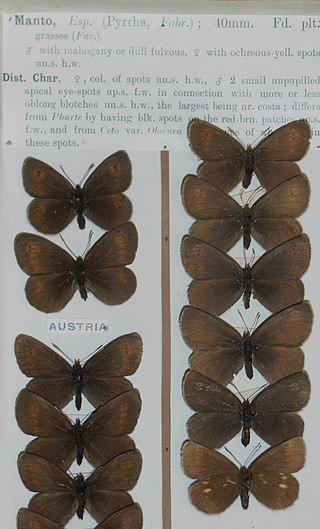
The yellow-spotted ringlet is a member of the subfamily Satyrinae of the family Nymphalidae. It is associated with (sub)alpine meadows at 900–2,500 m above sea level. It is found in the Alps, the Pyrenees, the Cantabrian Mountains, the Massif Central, the Vosges Mountains, the Carpathian Mountains and the mountains of Herzegovina.

The water ringlet is a member of the subfamily Satyrinae of family Nymphalidae. It is a high altitude butterfly found in the Alps, Bavaria, Styria, Pyrenees, Carpathians and Bulgaria.

Parnassius maximinus is a high-altitude butterfly which is found in western ranges of the Tien Shan Mountains. It is a member of the snow Apollo genus (Parnassius) of the swallowtail family (Papilionidae). Previously it was regarded as conspecific with P. delphius.

Parnassius staudingeri is a high-altitude butterfly which is found over a vast area - Pamirs, Altay Mountains, Hindu Kush, Karakorum and west Kuen-Lun.

Pararge xiphioides, the Canary speckled wood, is a butterfly of the family Nymphalidae. It is found in the Canary Islands on La Gomera, La Palma, Tenerife and Gran Canaria.

Sedina buettneri, or Blair's wainscot, is a moth of the family Noctuidae. The species was first described by Eduard von Hering in 1858. It is found in the Palearctic realm. Outside of Europe, it is occasionally found in temperate Asia, the coast of the Black Sea, the base of the Caucasus mountains, the Caspian Sea, Iran, Russia east to the Urals, Lake Baikal and Altai regions, and in Japan and the Kuril Islands.

Euxoa recussa is a moth of the family Noctuidae. The nominate form is found in mountainous areas in Southern Europe as well as the Alps. Euxoa recussa tetrastigma is found Northern Europe, east to Russia, Western Siberia, the Altai Mountains and Amur.

Cosmia diffinis, the white-spotted pinion, is a moth of the family Noctuidae The species was first described by Carl Linnaeus in 1767. It is found in central and southern Europe, to the north it is found up to central England and the southern parts of the Netherlands. There is a disjunct population in Gotland. To the south, it is found down to Spain, Italy, Russia, northern Greece and Bulgaria. In the east, it is found as far as Lithuania and the Black Sea.

Agrotis graslini, or Woods's dart, is a moth of the family Noctuidae. The species was first described by Jules Pierre Rambur in 1848. It is known from coastal dunes in the western Mediterranean region. It was found on Jersey in 2001. Further investigations revealed that the species had been present there since at least 1995.

Barrett's marbled coronet is a species of moth of the family Noctuidae. It is found from France through south-eastern Europe to Central Asia. In the north it is found up to the Baltic region. It is also present in North Africa.

Chloantha hyperici, the pale-shouldered cloud, is a moth of the family Noctuidae. It is found in southern Central Europe and from southern Europe to the Near East and Anatolia, Israel, Iraq, the Persian Gulf and the Caucasus, as well as northern Denmark, southern Sweden, southern Norway and south-western Finland.

Cucullia xeranthemi is a species of moth of the family Noctuidae. In southern Europe, it is found locally from northern Spain, Italy and southern France to the Balkans. In the east, it is found from Lower Austria and Hungary to southern Russia and western Siberia.

Lithophane furcifera, the conformist, is a moth of the family Noctuidae. The species was first described by Johann Siegfried Hufnagel in 1766. It is found from central Europe, east to the Black Sea region, the Caucasus and western Siberia. In the mountains, it is found up to elevations of 1,800 meters.
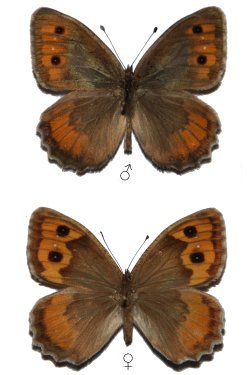
Pseudochazara mniszechii, the tawny rockbrown, is a species of butterfly in the family Nymphalidae. It is confined to Greece, Turkey, northern Iran, Balochistan, and the Caucasus.
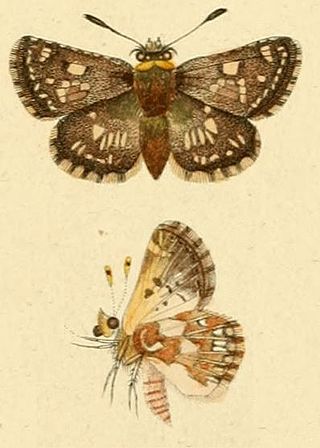
Spialia therapne, the Corsican red-underwing skipper, is a butterfly in the family Hesperiidae. It is found on the Mediterranean islands of Corsica and Sardinia.
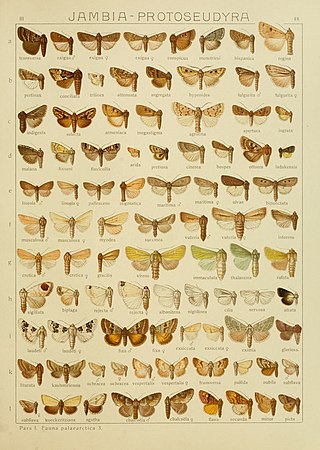
Aegle semicana is a moth of the family Noctuidae. It was described by Eugenius Johann Christoph Esper in 1798. It is found in Austria, Italy, Hungary, former Yugoslavia, Romania, Bulgaria, Albania, Greece, Turkey, Russia, Libya, Egypt, Syria, Iraq, Iran and Israel, as well as on Sardinia, Sicily, Malta and Cyprus.

Tomares nogelii is a small butterfly found in the Palearctic that belongs to the blues family.
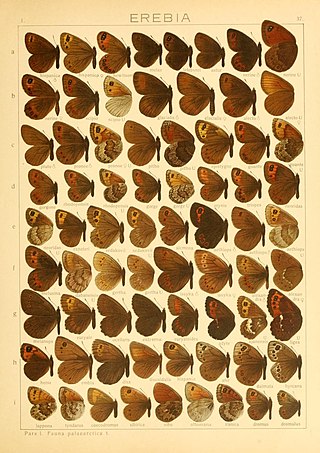
Erebia ottomana is a small butterfly found in the East Palearctic that belongs to the browns family.
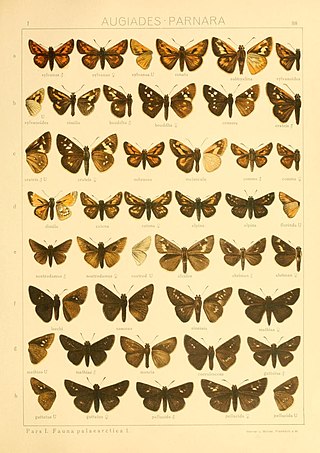
Eogenes alcides is a butterfly found in the East Palearctic Asia Minor to Iran, Afghanistan to Pakistan, West China. that belongs to the skippers family. Subspecies E. a. ahriman is found in Turkestan.


