
Warhammer 40,000 is a miniature wargame produced by Games Workshop. The first edition of the rulebook was published in September 1987. The latest edition is the eighth, which was published in June 2017. Warhammer 40,000 is the most popular miniature wargame in the world; it is most popular in Britain.
In the fictional setting of Warhammer 40,000, the Eldar are a race of aliens and playable army in the tabletop miniatures wargame. They are patterned after the High Elves of fantasy fiction; long-lived, arrogant, and possessing great psychic powers. The Eldar once ruled the galaxy and seek to reclaim their old dominions from humanity and the other Warhammer 40,000 races.

Games Workshop Group PLC is a British manufacturer of miniature wargames, based in Nottingham, England. Its best-known products are Warhammer Age of Sigmar and Warhammer 40,000. It is listed on the London Stock Exchange and is a constituent of the FTSE 250 Index.
Warhammer Fantasy is a fictional fantasy universe created by Games Workshop and used in many of its games, including the table top wargame Warhammer Fantasy Battle, the Warhammer Fantasy Roleplay (WFRP) pen-and-paper role-playing game, and a number of video games: the MMORPG Warhammer Online: Age of Reckoning, the two Total War: Warhammer strategy games Total War: Warhammer and Total War: Warhammer 2 and the two first-person shooter games in the Warhammer Vermintide series, Warhammer: End Times - Vermintide and Warhammer: Vermintide 2.
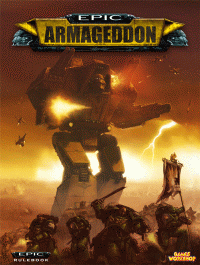
Epic is a tabletop wargame set in the fictional Warhammer 40,000 universe. Whereas Warhammer 40,000 involves small battles between forces of a few squads of troops and two or three vehicles, Epic features battles between armies consisting of dozens of tanks and hundreds of soldiers. Due to the comparatively larger size of the battles, Epic miniatures are smaller than those in Warhammer 40,000, with a typical human being represented with a 6mm high figure, as opposed to the 28mm minis used in Warhammer 40,000.

Mordheim is a tabletop game published by Games Workshop in 1999. It is a skirmish variant of the company's Warhammer Fantasy game but set on a warband or "skirmish" scale. Mordheim was designed by Alessio Cavatore, Tuomas Pirinen and Rick Priestley. Besides being a typical miniature skirmish game, Mordheim also features a campaign system. Warbands gain experience and equipment as the campaign progresses, in a similar nature to role-playing games.
In Games Workshop's Warhammer Fantasy Battle tabletop wargame, The Empire is one of three major human factions, along with Bretonnia and Kislev.

Orcs & Goblins is a supplemental book for the Warhammer Fantasy Battle tabletop game. The phrase "orcs & goblins" also refers collectively to all of the races that are described in this book, which includes other "greenskins" as well. The book includes background information, illustrations, and game rules for these races. The Orcs and Goblins represent a generic Dark Ages warband army with little internal cohesion and discipline, and relying on the ferocious charge and individual fighting skills rather than organized generalship.

Warhammer was a tabletop miniature wargame with a medieval fantasy theme that simulates battles between terrestrial armies from different factions. The game was created by Rick Priestley and sold by the Games Workshop company. The first edition was released in 1983. The eighth and final edition was released on 10 July 2010. The game is no longer supported by Games Workshop, having been officially supplanted by Warhammer Age of Sigmar, which uses the same fictional setting but has a different design ethos.
In Games Workshop's Warhammer Fantasy fictional universe, the Dwarfs are a race of short, stout humanoids very similar to the dwarves of Middle-earth and those of Dungeons & Dragons. Dwarfs in the Warhammer setting are proud warriors highly driven by honor, the making of oaths, and the recording of slights against them as grudges.
The Storm of Chaos was a massive narrative campaign created by Games Workshop for their Warhammer Fantasy setting, played in the northern hemisphere summer of 2004. Like its predecessor and its successor, it was extremely popular, and attracted several thousand players.

Warhammer 40,000: Dawn of War – Winter Assault is the first expansion to Warhammer 40,000: Dawn of War for the PC developed by Relic Entertainment and published by THQ. Based on Games Workshop's tabletop wargame, Warhammer 40,000, Dawn of War: Winter Assault was released on September 23, 2005. Some time after its initial release, Winter Assault and Dawn of War were coupled together in a double pack which featured some art on a fold out cover, an Ork with a flamethrower, or a group of Imperial Guard tanks lined up for attack. Though Winter Assault required the base game to play, its follow-up expansions, Dawn of War: Dark Crusade and Dawn of War: Soulstorm were stand-alone, not requiring the base game.
In the fictional Warhammer Fantasy setting by Games Workshop, there are a number of different races and nations. The most important of these features are individual armies in the Warhammer Fantasy Battle table top game.
The Nemesis Crown was a massive narrative campaign created by Games Workshop for their Warhammer Fantasy setting, that started in late June 2007. The campaign revolved around the various Warhammer Fantasy races trying to obtain the Nemesis Crown in all-out warfare, similar to the "Fall of Medusa V" Warhammer 40,000 online campaign, and previous Warhammer online campaigns, such as "Dark Shadows" and the "Storm of Chaos".
The Gods of the Old World are a collection of fictional supernatural beings modeled after real-world pagan deities. In the Warhammer Fantasy setting, there are many fictional deities provided to add color and verisimilitude to the game's background. Most or all of these entities seem to be analogues of real-world gods, chosen to present a war-torn, grim, perilous, and adventurous world.

In Games Workshop's Warhammer Fantasy and Warhammer 40,000 fictional universes, Chaos refers to the parasitic entities which live in a different plane of reality, known as the Warp in Warhammer 40,000 and as the Realm of Chaos in Warhammer Age of Sigmar. The term can refer to these warp entities and their influence, the servants and worshippers of these entities, or even the parallel universe in which these entities are supposed to reside. The most powerful of these warp entities are those known as the Chaos Gods, also sometimes referred to as the Dark Gods, Ruinous Powers, or the Powers of Chaos. Similarities exist between the Warhammer idea of Chaos and the concept of Chaos from Michael Moorcock's Elric saga, which also influenced D&D's alignment system. Further similarities can be seen with the godlike extradimensional Great Old Ones of horror writer H. P. Lovecraft's stories.

Warhammer 40,000: Conquest was a Living Card Game (LCG) produced by Fantasy Flight Games, set in Games Workshop's Warhammer 40,000 universe. It was announced in March 2014 and was released October 3, 2014. The game featured two players competing to win a series of battles on a different planets while simultaneously securing the resources of other planets that will have battles on subsequent turns. Fans of the game praised the strategic element of having multiple distinct battle fields as a feature that distinguished it from other card games. On September 9, 2016, Games Workshop announced that Conquest would be discontinued in February 2017, as a result of Games Workshop's failure to renew Fantasy Flight Games' contract because of a conflict between Games Workshop and Fantasy Flight Games' parent company, Asmodee. The game still has a small community of players who play with the cards that were printed before the game's discontinuation in 2017, and some fans have made unofficial expansions to expand the small card pool.

Warhammer Age of Sigmar is a miniature wargame produced by Games Workshop that simulates battles between armies by using miniature figurines. Games are typically played on a relatively flat surface such as a dining table, bespoke gaming table, or an area of floor. The playing area is often decorated with models and materials representing buildings and terrain. Players take turns taking a range of actions with their models: moving, charging, shooting ranged weapons, fighting, and casting magical spells; the outcomes of which are generally determined by dice rolls. Besides the game itself, a large part of Age of Sigmar is dedicated to the hobby of collecting, assembling and painting the miniature figurines from the game.
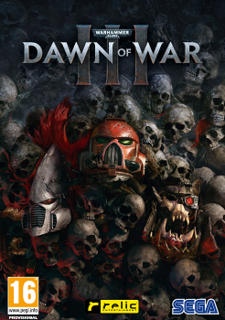
Warhammer 40,000: Dawn of War III is a real-time strategy video game with multiplayer online battle arena influences, released by Relic Entertainment and Sega in partnership with Games Workshop, the creators of the Warhammer 40,000 universe. It is the third stand-alone title in the Dawn of War series, and the first new release in the series since Dawn of War II: Retribution in 2011. It was released for Microsoft Windows on April 27, 2017. On May 26, 2017, Feral Interactive announced that the Linux version would use both the OpenGL and Vulkan graphics APIs, while the macOS port would use Apple's Metal. The macOS and Linux versions were released on June 8, 2017.

