
Eoophyla is a genus of moths of the family Crambidae. It was erected by Charles Swinhoe in 1900.

Audea is a genus of moths in the family Erebidae.

Asota is a genus of moths in the family Erebidae first described by Jacob Hübner in 1819. Species are widely distributed throughout Africa, India, Sri Lanka, Myanmar, the Malayan region and tropical parts of the Australian region.

Asota kinabaluensis is a species of noctuoid moth in the family Erebidae first described by Walter Rothschild in 1896. It appears to have no close relatives in the genus Asota.

Asota heliconia is a moth in the family Erebidae. It is found from the Indo-Australian tropics east to Queensland and the Solomons.
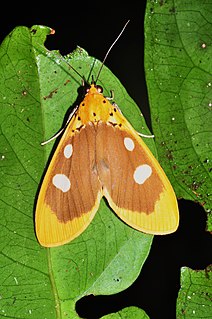
Asota javana is a moth of the family Erebidae first described by Pieter Cramer in 1780. It is found in Sundaland, the Philippines, Sulawesi and on Sula Island.
Asota orbona is a moth of the family Erebidae first described by Samuel Constantinus Snellen van Vollenhoven in 1863. It is found in Indonesia, Papua New Guinea and Queensland.
Asota dohertyi is a moth of the family Erebidae first described by Walter Rothschild in 1897. It is found on Sulawesi.
Asota iodamia is a moth of the family Erebidae first described by Gottlieb August Wilhelm Herrich-Schäffer in 1854. It is found in the Australian states of New South Wales and Queensland.
Asota australis is a moth of the family Erebidae first described by Jean Baptiste Boisduval in 1832. It is found in Australia, Indonesia and Papua New Guinea.

Synaphe is a genus of snout moths described by Jacob Hübner in 1825.

