| ||||||||||||||||||||||||||
| Turnout | 50.66% | |||||||||||||||||||||||||
|---|---|---|---|---|---|---|---|---|---|---|---|---|---|---|---|---|---|---|---|---|---|---|---|---|---|---|
This lists parties that won seats. See the complete results below. | ||||||||||||||||||||||||||
| ||||||||||||||||||||||||||
| This article is part of a series on the politics and government of Serbia |
|---|
|
Legislature |
Judiciary
|
The local election for the City Assembly of Belgrade, capital of Serbia, was held on 16 March 2014, alongside parliamentary election. The election was scheduled in late 2013, after the mayor Dragan Đilas lost a non-confidence motion in the assembly. Twenty-three parties and coalitions ran for 110 seats in the Assembly, with 5% election threshold required to win seats. [1]
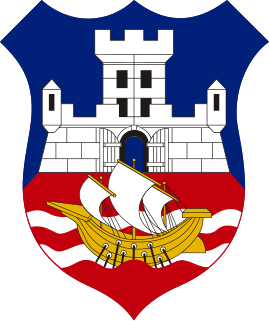
The City Assembly of Belgrade is the legislature of the City of Belgrade, capital of Serbia. It is a representative body that executes the essential functions of the local government stipulated by the legislation and the City Charter.
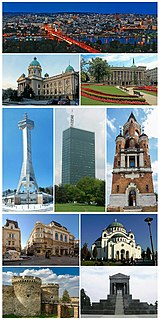
Belgrade is the capital and largest city of Serbia. It is located at the confluence of the Sava and Danube rivers, where the Pannonian Plain meets the Balkans. The urban area of the City of Belgrade has a population of 1.23 million, while nearly 1.7 million people live within its administrative limits.
Serbia, officially the Republic of Serbia, is a country situated at the crossroads of Central and Southeast Europe in the southern Pannonian Plain and the central Balkans. The sovereign state borders Hungary to the north, Romania to the northeast, Bulgaria to the southeast, North Macedonia to the south, Croatia and Bosnia and Herzegovina to the west, and Montenegro to the southwest. The country claims a border with Albania through the disputed territory of Kosovo. Serbia's population is about seven million. Its capital, Belgrade, ranks among the oldest and largest citiеs in southeastern Europe.
According to the final results, parliamentary winner Serbian Progressive Party also won 43.62% votes in Belgrade, and an absolute majority of 63 seats. Only three more lists surpassed the threshold: Democratic Party of Dragan Đilas with 15.7% of votes (22 seats), Socialist Party of Serbia with partners took 11.49% (16 seats) and Democratic Party of Serbia won 6.39% (9 seats). [2]
The Serbian Progressive Party is a populist conservative political party in Serbia.
The Democratic Party is a social-democratic and social-liberal political party in Serbia. It is the major centre-left party in Serbia and is the fifth largest party in the National Assembly. The Democratic Party is a full member of the Socialist International, the Progressive Alliance, and is an associate member of the Party of European Socialists.
The Socialist Party of Serbia is a political party in Serbia that identifies as a democratic socialist and social democratic party. The Socialist Party of Serbia was the direct descendant of the Communist Party of Serbia. Throughout its existence, the party has utilised some nationalist rhetoric and themes, and has therefore been labelled a Serbian nationalist party, although the SPS has never identified itself as such.
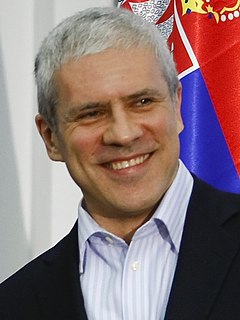
The aftermath of the 2012 elections was radical; then's incumbent president Boris Tadić lost to the oppositions counter-opponent Tomislav Nikolić. This effectively led to a change of the ruling majority with the Progressives ousting and replacing the Democrats (see for more detail: Government of Ivica Dačić). The result of the local elections, however, were considerably in favor of the Democrats and it was easy enough for mayor Dragan Đilas to secure a second term with a coalition of his coalition (DS along with its minor partners, the Social Democratic Party of Serbia and the Serbian Renewal Movement) with the SPS-PUPS-JS, lacking but a single vote for a majority. Over the following months there were some serious changes within the DS, with early party elections and Tadic's stepping down from the race acceding defeat and settling with an honorary presidential title, and Djilas becoming party leader; it was quickly followed by significant party-purges of those that took part in the 2008–2012 government due to political responsibility.
Boris Tadić is a Serbian politician who served as President of Serbia from 2004 to 2012. He was elected to his first term on 27 June 2004, when Serbia was part of Serbia and Montenegro, and re-elected for a second term on 3 February 2008, this time as president of independent Serbia. He resigned on 5 April 2012 in order to trigger an early election. Prior to his presidency, Tadić served as the last Minister of Telecommunications of the Federal Republic of Yugoslavia and as the first Minister of Defence of Serbia and Montenegro. He is a psychologist by profession.
Tomislav Nikolić is a Serbian politician who served as the President of Serbia from 2012 to 2017. He is also the founder of the Serbian Progressive Party, and he led the party until his election as President. In the 2012 presidential election, he was elected to a five-year term as President in a second round of voting.
Subsequent changes as a result were a swift decline of the DS in the opinion polls (including withdrawal from politics of a significant number of individuals, as well as a fraction breaking off and forming a new political party under the leadership of former minister Dušan Petrović called Together for Serbia) and SNS' plummeting. It led to after restructuring the government only PUPS remaining in support of Đilas by late 2013, with more and more pressure for an early election in Belgrade. In the end he was outvoted in late September 2013 and the government named a provisional team to administer the capital city until early elections, headed by acting mayor Siniša Mali who is closely associated with the SNS. Many parties and individuals participated in the provisional local government, but the DS withdrew from it early on; the long-lasting enforced government was perceived by the Democrats as a tyrannical act aimed at weakening their position and strengthening the Progressives' chances. As per the constitution and according laws, elections for Belgrade were finally scheduled in early 2014 for 16 March 2014.
Dušan Petrović is a Serbian politician, a former long-time member of Democratic Party (DS) and the former Minister of Agriculture, Trade, Forestry and Water Management between 2011 and 2012 and former Minister of Justice in the Government of Serbia between 2007 and 2008.
Together for Serbia is a political party in the Republic of Serbia. It was created by a broken-off fraction of the Democratic Party (DS) in the aftermath of the 2012 elections after which president Boris Tadić lost to his opponent Tomislav Nikolić and inner arguments maintaint on resulting in early party elections and Tadic's withdrawal from the leadership, settling for an honorary presidential title, in favor of Belgrade mayor Dragan Đilas. A total of 7 MPs left the DS and founded in 2012 the "Together for Serbia" parliamentary club. Its leader is former minister Dušan Petrović. At the 2014 election, ZZS teamed up with Boris Tadić's fraction of the DS in formation and will run on the election in a coalition with the League of Social Democrats of Vojvodina
Siniša Mali is a Serbian economist and politician. He serves as the Minister of Finance in the Government of Serbia since 29 May 2018.
This led to a chain of results with the Progressives deciding to go on early parliamentary elections simultaneously, bringing down Ivica Dačić's government.
The following are the electoral lists in the capital city so far proclaimed by the City Electoral Commission: [3]
| Ballot number | Ballot name | Ballot carrier | Note |
|---|---|---|---|
| 1 | ALEKSANDAR VUČIĆ — FUTURE WE BELIEVE IN (Serbian Progressive Party, Social Democratic Party of Serbia, New Serbia, Serbian Renewal Movement, Movement of Socialists) | Zorana Mihajlović - Milanović | |
| 2 | IVICA DAČIĆ — Socialist Party of Serbia (SPS), Party of United Pensioners of Serbia (PUPS), United Serbia (JS) — Milan Krkobabić | Aleksandar Antić | |
| 3 | DEMOCRATIC PARTY OF SERBIA - VOJISLAV KOŠTUNICA | Aleksandar Popović | |
| 4 | ČEDOMIR JOVANOVIĆ — LIBERAL DEMOCRATIC PARTY | Željko Ožegović | |
| 5 | SERBIAN RADICAL PARTY - DR VOJISLAV ŠEŠELJ | Vojislav Šešelj | |
| 6 | UNITED REGIONS OF SERBIA — MLAĐAN DINKIĆ | Mlađan Dinkić | |
| 7 | CYRILLIC FOR BELGRADE — CIVIC GROUP | Marko Mandić | |
| 8 | WITH THE DEMOCRATIC PARTY FOR A DEMOCRATIC BELGRADE — DRAGAN ĐILAS | Dragan Đilas | |
| 9 | DEMOCRACY — EUROPE - SERBIA | Dr Milorad Paunović | |
| 10 | THIRD SERBIA — FOR ALL THE HARD-WORKING PEOPLE | Aleksandar Protić | |
| 11 | BORIS TADIĆ — NEW DEMOCRATIC PARTY — GREENS — TOGETHER FOR SERBIA | Boris Ranković | |
| 12 | DVERI — VLADAN GLIŠIĆ | Vladan Glišić | |
| 13 | CIVIC GROUP PATRIOTIC FRONT — DR BORISLAV PELEVIĆ | Milica Đurđević | |
| 14 | ALLIANCE OF VOJVODINA HUNGARIANS — ISTVÁN PÁSZTOR | Nebojša Marjanović | M |
| 15 | GEPS FOR BELGRADE — PROF. DR JOVAN FILIPOVIĆ | Prof. Dr Jovan Filipović | |
| 16 | PARTY OF RUSSIANS OF SERBIA — DRAGAN CVETKOVIĆ | Dragan Cvetković | M |
| 17 | CIVIC GROUP ECONOMIC MOVEMENT - BRANKO DRAGAŠ | Predrag Mitrović | |
| 18 | CIVIC GROUP IT IS THE SAME IGOR BRAKUS | Igor Brakus | |
| 19 | PATRIOTISM IN PARLIAMENT — 1389 — MIŠA VACIĆ | Stefan Janković | |
| 20 | CIVIC GROUP ACADEMIC DR JOVAN I. DERETIĆ FREE SERBIA | Jovan I. Deretić | |
| 21 | IT'S ENOUGH — SAŠA RADULOVIĆ | Saša Radulović | |
| 22 | NONE OF THE ABOVE | Nikola Tulimirović | M |
| 23 | BLANK BALLOTS | Saša Damljanović |
M — National minority list
All lists endorse the forthcoming Pride parade in Belgrade, except for the DSS. [4]
The Representative Organizations of the Disabled Persons of Belgrade had signed a Protocol with the DS. [5]
According to Factor Plus, 20–26 January:
Below threshold:
According to a poll of the "Nina Media" research agency and TV Prva conducted after elections were scheduled in early 2014: [6]
Other parties are below the electoral threshold.
According to 24–25 February Faktor plus poll: [7]
The following are the final results proclaimed by the City Electoral Commission: [8]
| Party | Votes | % | Seats | +/– |
|---|---|---|---|---|
| Aleksandar Vučić — Future We Believe In | 351.183 | 43.62 | 63 | +26 |
| With the Democratic Party for a Democratic Belgrade — Dragan Đilas | 126.429 | 15.70 | 22 | –28 |
| Ivica Dačić — Socialist Party of Serbia (SPS), Party of United Pensioners of Serbia (PUPS), United Serbia (JS) — Milan Krkobabić | 92.539 | 11.49 | 16 | +3 |
| Democratic Party of Serbia — Vojislav Koštunica | 51.435 | 6.39 | 9 | –1 |
| Dveri — Vladan Glišić | 30.075 | 3.74 | 0 | — |
| Boris Tadić — New Democratic Party — Greens — Together for Serbia | 29.504 | 3.66 | 0 | — |
| Čedomir Jovanović — Liberal Democratic Party | 25.762 | 3.20 | 0 | — |
| Enough Is Enough — Saša Radulović | 16.591 | 2.06 | 0 | — |
| Serbian Radical Party — Dr Vojislav Šešelj | 16.250 | 2.02 | 0 | — |
| Citizen's Group "It's All the Same" — Igor Brakus | 11.644 | 1.45 | 0 | — |
| United Regions of Serbia — Mlađan Dinkić | 9.391 | 1.17 | 0 | — |
| Third Serbia — For All Hard-working People | 3.287 | 0.41 | 0 | — |
| Economic Movement — Branko Dragaš | 2.483 | 0.31 | 0 | — |
| None Of The Above | 1.984 | 0.25 | 0 | — |
| GEPS for Belgrade — Prof. Dr Jovan Filipović | 1.388 | 0.17 | 0 | — |
| Cyrillic for Belgrade | 1.362 | 0.17 | 0 | — |
| Academician Jovan I. Deretić — Free Serbia | 1.350 | 0.17 | 0 | — |
| Patriotic Front — Borislav Pelević | 996 | 0.12 | 0 | — |
| Party of Russians of Serbia — Dragan Cvetković | 845 | 0.10 | 0 | — |
| Blank Ballots | 799 | 0.10 | 0 | — |
| Alliance of Vojvodina Hungarians — István Pásztor | 774 | 0.10 | 0 | — |
| Democracy — Europe — Serbia | 722 | 0.09 | 0 | — |
| Patriotism in the Parliament — 1389 — Miša Vacić | 644 | 0.08 | 0 | — |
| Invalid/blank votes | 26.936 | 3.35 | – | – |
| Total | 805.046 | 100 | 110 | 0 |
| Registered voters/turnout | 1.588.996 | 50.66 | – | – |
| Source: Službeni List Grada Beograda | ||||

Dragan Maršićanin is a Serbian economist and politician. He was the ambassador of Serbia to Switzerland, serving from 2004 to 2009. He served as the Minister of Economy in 2004, only to leave it in order to run for president in 2004. He later resigned from the position and was replaced by Predrag Bubalo in October, 2004.
Dragan Đilas is a Serbian politician and businessman who was the Mayor of Belgrade from 2008 to 2013.
Parliamentary elections were held in Serbia on 11 May 2008 to elect members of the National Assembly. The election was held barely a year after the previous parliamentary election. There were 6,749,886 eligible electors who were able to vote in 8,682 voting places, as well as 157 special voting stations for refugees from Kosovo.
Parliamentary elections were held in Serbia on 6 May 2012 to elect members of the National Assembly, and were held simultaneously with provincial, local, and presidential elections.
Provincial elections were held in Vojvodina in May 2012. The first round was held on 6 May, while the second round was held on 20 May.
The presidential election took place on 6 May 2012 in Serbia, on the same date as the parliamentary election. The election was called following President Boris Tadić's early resignation in order to coincide with the parliamentary and local elections to be held on the same date. The Speaker of the Parliament, Slavica Đukić Dejanović, took over as the Acting President. As no candidate won a majority, a runoff was on 20 May, with incumbent Tadić facing Tomislav Nikolić of the Serbian Progressive Party.
Local elections in Serbia were held on 6 May 2012. Pursuant to the Constitution of Serbia, the parliamentary Speaker signed on 13 March 2012 the Decision on calling the elections for councilors of municipal assemblies, town assemblies and the Belgrade City Assembly for 6 May 2012, with the exception of: the councilors of the municipal assemblies of Aranđelovac, Bor, Vrbas, Vrnjačka Banja, Knjaževac, Kovin, Kosjerić, Kosovska Mitrovica, Leposavić, Negotin, Novo Brdo, Odžaci, Peć, Prijepolje and Ruma and councilors of the Priština Town Assembly, which have already had extraordinary elections in the period from 2008 to 2012, while for councilors of the municipal assembly of Kula, the elections were already called earlier on 29 February 2012.
Nebojša Stefanović is a Serbian politician and PhD in economics. He has served as the minister of the interior since 2014 and deputy prime minister since 2016. He is chairman of the Belgrade board of Serbian Progressive Party (SNS).
Parliamentary elections were held in Serbia on 16 March 2014, with nineteen electoral lists competing for 250 members of the National Assembly. The election was called early, after tensions in the coalition led by Serbian Progressive Party (SNS) and Socialist Party of Serbia (SPS), who ruled the country since 2012. President of Serbia Tomislav Nikolić scheduled the election at the same time as previously announced Belgrade local election. According to the preliminary results based on 99.08% of counted votes, the turnout was 53.09%, with 3.22% votes invalid.
Parliamentary elections were held in Serbia on 24 April 2016. They were originally due to be held by March 2018, but on 17 January 2016 Prime Minister Aleksandar Vučić called for a snap election claiming Serbia "needs four more years of stability so that it is ready to join the European Union". The elections were held simultaneously with provincial elections in Vojvodina and nationwide local elections.
Parliamentary elections are due to be held in Serbia in April 2020, although they may be held earlier if early elections are called.
The Green Party is a Slovak minority political party in Serbia, based in Novi Sad.
The Justice and Reconciliation Party, formerly known as the Bosniak Democratic Union of Sandžak, is a political party of the Bosniak ethnic minority concentrated in the Sandžak region in southwestern Serbia.
In the run up to the 2016 parliamentary elections in the Serbia, various organisations carried out opinion polling to gauge voting intention in Serbia. Results of such polls are displayed in this article.
Municipal elections were held in Montenegro on 17 April in Tivat and on 16 October in Andrijevica, Budva, Gusinje and Kotor.

The incumbent Government of Serbia, led by prime minister Ana Brnabić, was elected on 29 June 2017 by a majority vote in the National Assembly. It succeeded the second cabinet of Aleksandar Vučić, formed after the 2016 parliamentary election, after Vučić resigned the prime minister post following his election as the President of Serbia. Vučić appointed Ana Brnabić, previously the Minister of Public Administration, as his successor on 15 June 2017.
The local election for the City Assembly of Belgrade, capital of Serbia, was held on 4 March 2018. The election had to be scheduled by the end of February 2018, since this is when the mandate of the current City Assembly expires. Parties and coalitions ran for 110 seats in the Assembly, with 5% election threshold required to win seats.