
Bellis is a genus of flowering plants in the daisy family.
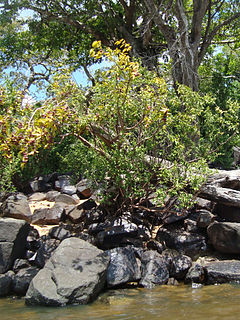
Myrciaria dubia, commonly known as camu-camu, camucamu, caçari, araçá-d'água, or camocamo, is a species of plant in the family Myrtaceae. It is a small bushy riverside tree from the Amazon rainforest in Peru and Brazil, which grows to a height of 3–5 m (9.8–16.4 ft) and bears a red/purple cherry-like fruit. It is a close relative of the jabuticaba and the guavaberry or rumberry. As much as 2-3% of the fresh fruit by weight is vitamin C.

Bellis perennis, the daisy, is a common European species of the family Asteraceae, often considered the archetypal species of that name. To distinguish this species from other "daisies" it is sometimes qualified as common daisy, lawn daisy or English daisy. Historically, it has also been widely known as bruisewort, and occasionally woundwort.

A botanical name is a formal scientific name conforming to the International Code of Nomenclature for algae, fungi, and plants (ICN) and, if it concerns a plant cultigen, the additional cultivar or Group epithets must conform to the International Code of Nomenclature for Cultivated Plants (ICNCP). The code of nomenclature covers "all organisms traditionally treated as algae, fungi, or plants, whether fossil or non-fossil, including blue-green algae (Cyanobacteria), chytrids, oomycetes, slime moulds and photosynthetic protists with their taxonomically related non-photosynthetic groups ."

Nepenthes dubia is a tropical pitcher plant endemic to Sumatra, where it grows at an altitude of 1600–2700 m above sea level. The specific epithet dubia is the Latin word for "doubtful".

Nepenthes talangensis is a tropical pitcher plant endemic to Sumatra, where it grows in upper montane forest at elevations of 1800–2500 m above sea level.

Nepenthes tenuis is a tropical pitcher plant endemic to Sumatra. The species was first collected in 1957, from a remote mountain in the western part of the island. It remained undescribed until 1994, and was only rediscovered in the wild in 2002. Prior to this, N. tenuis was known solely from a single photograph and dried herbarium specimen.
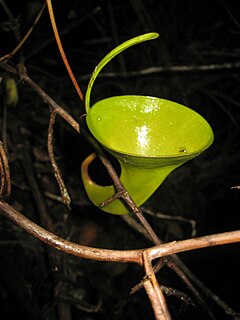
Nepenthes inermis is a tropical pitcher plant endemic to Sumatra. The specific epithet inermis is Latin for "unarmed" and refers to the upper pitchers of this species, which are unique in that they completely lack a peristome.

Nepenthes izumiae is a tropical pitcher plant endemic to Sumatra, where it grows in montane forest at 1700–1900 m above sea level. It appears to be most closely related to N. lingulata and N. singalana.

Thladiantha dubia, the Manchu tubergourd, goldencreeper, wild potato, or (French) thladianthe douteuse, is a herbaceous perennial climbing vine of the gourd family. It is native to Russia, northern China, and Korea, but has been introduced to Japan, southeast Europe, the Galapagos Islands, and scattered locations in North America. It is occasionally grown as a medicinal plant, or as an ornamental in North America.

Nepenthes jamban is a tropical pitcher plant endemic to northern Sumatra. The specific epithet jamban is the Indonesian word for "toilet" and refers to the shape of the pitchers.

Nepenthes × pyriformis is a natural hybrid involving N. inermis and N. talangensis. It is known only from Mount Talang in Sumatra, to which N. talangensis is endemic. Nepenthes talangensis was only described as a distinct species in 1994. Prior to this it was placed within N. bongso and some of the older literature identifies this hybrid as N. bongso × N. inermis.
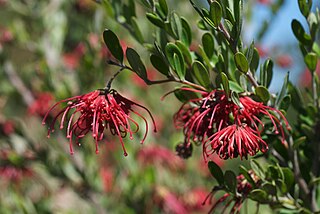
Grevillea speciosa, also known as red spider flower, is a shrub which is endemic to New South Wales in Australia.

Heteranthera dubia, commonly called water stargrass or grassleaf mudplantain, is a species of aquatic plant in the pickerel-weed family (Pontederiaceae). It is native to North and Central America where it is widespread from Canada to Guatemala.

Isopogon dubius, commonly known as pincushion coneflower, is a species of plant in the family Proteaceae and is endemic to the south-west of Western Australia. It is a shrub with sharply-pointed, deeply lobed or pinnate leaves and more or less spherical heads of pink to reddish pink flowers.

Ventenata is a genus of plants in the grass family, native to Europe, North Africa, and central + southwest Asia. One species, Ventenata dubia, is considered an invasive weed in many places.

Calochlaena dubia, commonly known as soft bracken, false bracken, common ground fern or rainbow fern, is a small Australian fern in the treefern family Dicksoniaceae. It is very common within its range, and often seen growing under eucalyptus forest, often on the poorer quality soils. It is an easy plant to grow in the garden.

Oroperipatus is a genus of Neotropical velvet worms in the family Peripatidae.

Cryptolepis dubia is a species of flowering plant in the family Apocynaceae that can be found in South and Southeast Asia, as well as southern China.
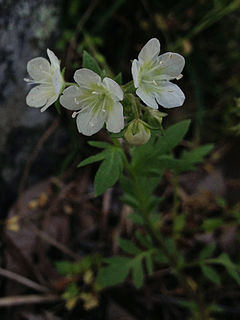
Phacelia dubia is an annual forb native to the eastern United States, that produces cream colored or light blue flowers in early spring.

