
Ctenacodon is a genus of extinct mammal that lived in what is now North America during the Upper Jurassic period. It is a member of the family Allodontidae within the order Multituberculata. Ctenacodon, also known as Allodon, was named by Othniel Charles Marsh in 1879. At least three species are currently recognized.

The broad-headed skink or broadhead skink is species of lizard, endemic to the southeastern United States. The broadhead skink occurs in sympatry with the five-lined skink and Southeastern five-lined skink in forest of the Southeastern United States. All three species are phenotypically similar throughout much of their development and were considered a single species prior to the mid-1930s.
The broad-headed spiny rat is a spiny rat species from South America. The etymology of the species name is the Latin word laticeps meaning "wide-headed".
Hylaeamys laticeps, also known as the Atlantic Forest oryzomys or the large-headed rice rat, is a species of rodent in the family Cricetidae.

The Australian swellshark or draughtboard shark, is a species of catshark, and part of the family Scyliorhinidae, endemic to southern Australia. This bottom-dwelling species can be found on the continental shelf down to a depth of 220 m (720 ft). Usually measuring 1 m long, it is a stout-bodied, broad-headed shark with a short tail and a first dorsal fin much larger than the second. It can be identified by its variegated dorsal coloration of brown or grey patches and numerous spots.

Bembidion is the largest genus of beetles in the family Carabidae by number of species. All species are small and move very fast. Most of them live close to water. The genus has a biantitropical distribution, meaning they are found in both the Northern and Southern Hemispheres, but not in the tropics. In warmer regions it is substituted by closely related Tachys and other genera.
Limnerpeton is an extinct genus of dissorophoidean euskelian temnospondyl within the family Amphibamidae.

Sapheosaurus was an extinct genus of Late Jurassic sphenodont. Its skull was longer and narrower than that of Homoeosaurus. It was classified as a genus of sapheosaur by Michael Benton in 1985. It reached a length of 70 cm from snout to tail. Sapheosaurus belongs to the clade Sapheosauridae, that also includes other taxa like Kallimodon. It is believed to be one of two aquatic sphenodont lineages, with Pleurosauridae being the other.

Chrysoblephus laticeps, the red roman or roman seabream, is a species of marine ray-finned fish belonging to the family Sparidae, the seabreams and porgies. This fish is endemic to Southern Africa, ranging from Namibia to the Eastern Cape.
Bembidion nigropiceum is a small, fast-moving water beetle in the Trechinae subfamily.
Bembidion rusticum is a species of ground beetle in the family Carabidae. It is found in North America.

Zootermopsis laticeps, known generally as Arizona dampwood termite, is a species of termite in the family Archotermopsidae. Other common names include the wide-headed rottenwood termite and southwestern rottenwood termite. It is found in arid parts of south-western North America.
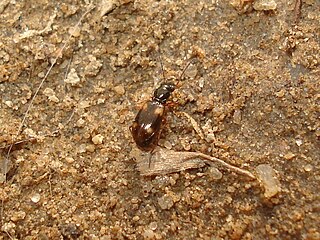
Bembidion quadrimaculatum is a species of ground beetle of the family Carabidae. It is found in Europe and Northern Asia, North America, and Southern Asia.

Bembidion mckinleyi is a species of ground beetle in the family Carabidae. It is found in North America and Europe.

Bembidion aratum is a species of ground beetle in the family Carabidae. It is found in North America.

Bembidion convexulum is a species of ground beetle in the family Carabidae. It is found in North America.
Mattauschia is an extinct genus of trematopid temnospondyls from the Late Carboniferous of the Czech Republic.

