The R4 is a South African 5.56×45mm assault rifle. It entered service as the standard service rifle of the South African Defence Force (SADF) in 1980. The R4 replaced the R1, a variant of the 7.62×51mm FN FAL. It was produced by Lyttelton Engineering Works, now Denel Land Systems.

The Beretta M1951 is a 9×19mm semi-automatic pistol, developed during the late 1940s and early 1950s by Pietro Beretta S.p.A. of Italy. The pistol was produced strictly for military use and was introduced into service with the Italian Armed Forces and security forces as the Modello 1951 (M1951), replacing the Modello 1934 pistol, chambered for the 9×17mm Short cartridge.

The PM-63 RAK is a Polish 9×18mm submachine gun, designed by Piotr Wilniewczyc in cooperation with Tadeusz Bednarski, Grzegorz Czubak and Marian Wakalski. The RAK combines the characteristics of a self-loading pistol and a fully automatic submachine gun. It is in effect an early personal defense weapon.
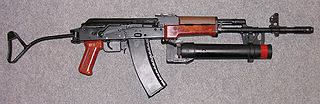
The karabinek wzór 1988 Tantal is a 5.45×39mm assault rifle designed and produced in Poland in the late 1980s.

The Bionix (BX) is a family of tracked Singaporean armoured fighting vehicles developed by Singapore Technologies Kinetics. Intended to augment the Singapore Army's aging M113 armoured personnel carriers, it is the first indigenous armoured vehicle to be developed in Southeast Asia. The Bionix has been operational with the Singapore Armed Forces (SAF) since 1999 in a wide variety of adaptations including the Bionix II, Bionix 25 and Bionix 40/50 variants.

The Jatimatic is a Finnish 9 mm submachine gun developed in the late 1970s and early 1980s by Jali Timari. The submachine gun made its debut in 1983. The Jatimatic was manufactured in very limited numbers initially by Tampereen Asepaja Oy of Tampere and later—Oy Golden Gun Ltd. The firearm was designed primarily for police, security forces and armored vehicle crews. It was never adopted into service by the Finnish Defence Forces, although the later GG-95 PDW version was tested by the FDF in the 1990s; the conclusion of the tests was that the GG-95 was not suitable as a service weapon.

The Steyr M is a series of semi-automatic pistols developed by Steyr Mannlicher GmbH & Co KG of Austria for police services and the civilian shooting market. Design work on the new pistol began in the early 1990s and the final product known as the M9 was officially unveiled in the spring of 1999. The M40 version chambered in .40 S&W was developed before the M9, followed later by the M357 and two smaller variants of the M9 and M40 designated the S9 and S40 respectively. These pistols were developed primarily for concealed carry and have a shortened barrel, slide, smaller frame and a reduced magazine capacity. In 2013 the Steyr M (Medium) and S (Small) form factors were complemented by the L (Large) sized series and the C (Compact) sized series both available in 9×19mm Parabellum and .40 S&W chamberings as the L9-A1, L40-A1, C9-A1 and C40-A1.

The PP-90 is a Russian 9 mm folding submachine gun, developed by the KBP Instrument Design Bureau in Tula for use with special units of the Russian Ministry of Internal Affairs (MVD). It is designed for close quarters combat, particularly engagements that require the weapon to be deployed rapidly in unusual circumstances.

The P-64 is a Polish semi-automatic pistol designed to fire the 9×18mm Makarov cartridge. The pistol was developed in the late 1950s at the Institute for Artillery Research by a team consisting of: W. Czepukajtis, R. Zimny, H. Adamczyk, M. Adamczyk, S. Kaczmarski and J. Pyzel. The P-64 is also known as the CZAK.
The G41 is a German 5.56×45mm NATO assault rifle introduced in 1981 and produced in limited quantities by Heckler & Koch. It was designed to replace the 5.56mm Heckler & Koch HK33 in service providing a more modern weapon compatible with contemporary NATO standards. It is chambered for the 5.56×45mm NATO cartridge and can use both SS109 and M193 ammunition. Assembly of the G41 has been discontinued by Heckler & Koch, however, production rights to the rifle were acquired by the Italian arms manufacturer Luigi Franchi.
Singapore Technologies Kinetics Ltd , in Singapore, is a strategic business area of ST Engineering and handles land systems and specialty vehicles.

The HK69A1 is a 40 mm grenade launcher developed and produced by the German arms manufacturer Heckler & Koch (H&K). The weapon was designed to engage enemy troops and strongpoints out to a distance of 350 m; it can also be used to deploy smoke grenades and illumination flares.
The Ameli is a 5.56mm light machine gun designed for the Spanish Army by the nationally owned and operated Centro de Estudios Técnicos de Materiales Especiales (CETME) small arms research institute.
The Model L is a Spanish 5.56×45mm NATO assault rifle developed in the late 1970s at the state-owned small arms research and development establishment CETME located in Madrid. The rifle retains many of the proven design elements the institute had used previously in its CETME Model 58 battle rifles.
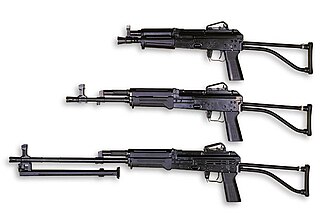
The ČZ 2000 is a prototype 5.56 mm caliber Czech weapon system, consisting of a standard rifle, carbine and light machine gun. The system was developed in 1991 after adapting the LADA firearm prototype J. Denel from the Brno-based Prototypa-ZM company is the chief designer for both systems. The ČZ 2000 was to be produced by Česká zbrojovka of Uherský Brod. It was to be the new service weapon of the Czech Army, replacing: the 7.62 mm vz. 58 assault rifle, 7.65 mm vz. 61 Škorpion submachine gun and 7.62 mm vz. 59 machine gun. As of 2007, the project has been discontinued.

The 5.45 mm subkarabinek wz. 1989 Onyks is a lightweight Polish carbine variant of the 5.45 mm wz. 1988 Tantal assault rifle, also based on the AK(S)-74U Work on the weapon began in 1989 at the Ośrodek Badawczo-Rozwojowy state research institute in the city of Radom. The weapon’s technical specifications were confirmed that same year. It was not until 1990 that production approval was given for the first prototypes, evaluated the following year in a series of military qualification tests resulting in an order for an initial pre-production batch in 1993, to be manufactured at the Łucznik Arms Factory in Radom.

The karabinek wz. 1996 Mini-Beryl is a Polish compact assault rifle (carbine) derived from the kbs wz. 1996 Beryl service rifle and chambered for 5.56×45mm. It was developed in parallel with the wz. 1996 Beryl by the "Łucznik" Arms Factory in Radom and introduced into service with the Polish Armed Forces in 1997 as the 5,56 mm karabinek krotki wz. 1996.
The STK 40 GL, formerly the CIS 40 GL is a 40 mm grenade launcher, developed in the late 1980s and produced by the Singaporean defense firm CIS - Chartered Industries of Singapore. The launcher is employed primarily by the Singapore Armed Forces and the police and security forces of several other countries.

The STK 50 MG, formerly known as the CIS 50MG, is a gas-operated, air-cooled, belt-fed heavy machine gun developed and manufactured by Chartered Industries of Singapore in the late 1980s, in response to a request by the Singaporean Defence Ministry to replace the 12.7mm Browning M2HB machine guns then in ubiquitous service with the Singapore Armed Forces (SAF).

The PPS is a family of Soviet submachine guns chambered in 7.62×25mm Tokarev, developed by Alexei Sudayev as a low-cost personal defense weapon for reconnaissance units, vehicle crews and support service personnel.