CIS 50MG

Last updated

CIS 50MG
CIS 50 HMG.jpg
The CIS 50MG on display during Singapore Army open house 2007.
Type Heavy machine gun
Place of origin Singapore
Service history
In service 1991–present [1]
Used by See Users
Production history
Designer Chartered Industries of Singapore (CIS, now ST Kinetics) [1] [2]
Designed Mid-1980s [1]
Manufacturer • CIS: 1988–2000 [1]
• ST Kinetics: 2000–present [1]
Produced 1988–present [1]
Specifications
Weight 30 kg (66.14 lb) (complete gun assembly w/o feed chute and tripod adaptor) [1] [3]
Length 1,778 mm (70.0 in) with stock [1]
Barrel  length 1,143 mm (45.0 in) [1]
Width 190 mm (7.5 in) [3]

Cartridge 12.7×99mm NATO [3]
Barrels Single barrel (progressive RH parabolic twist, 8 grooves) [1]
Action Gas-operated, rotating bolt [1]
Rate of fire 400–600 rounds/min [1]
Muzzle velocity 890 m/s (2,920 ft/s) [1]
Feed system Single sprocket Belt-fed with dual-feed chutes [1]
Sights Folding leaf sight [1]

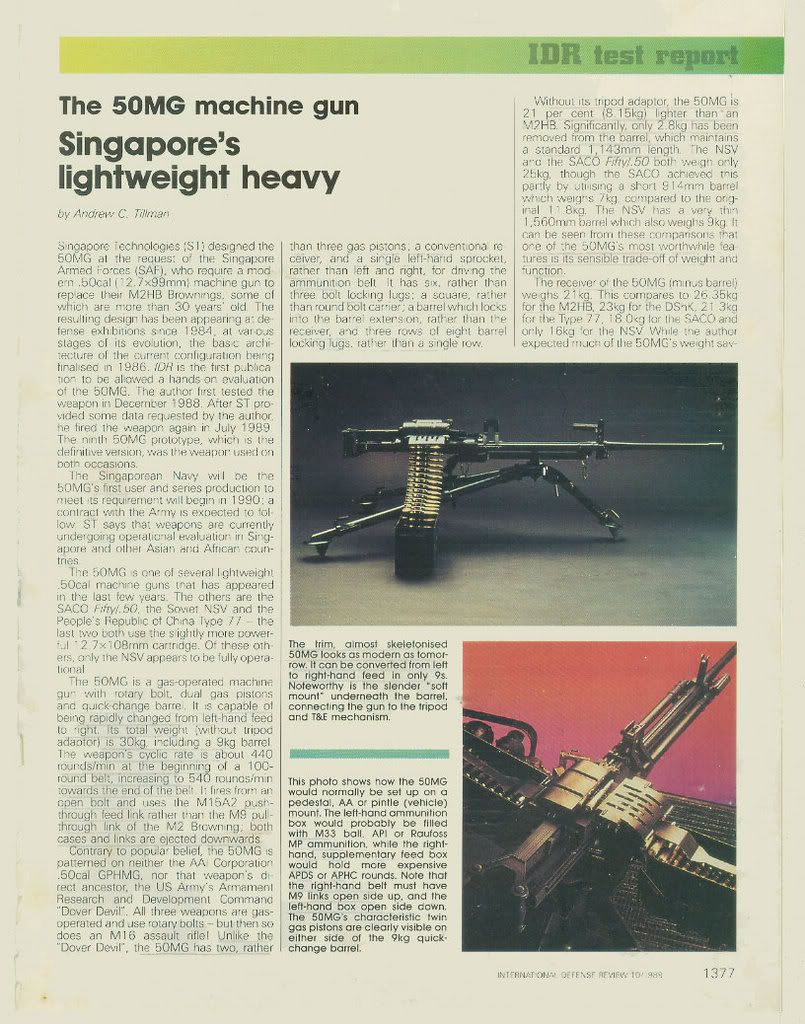
The CIS 50MG is a gas-operated, air-cooled, belt-fed heavy machine gun developed and manufactured by Chartered Industries of Singapore (CIS, now ST Kinetics) in the late 1980s, in response to a request by the Singaporean Defence Ministry to replace the 12.7mm Browning M2HB machine guns then in ubiquitous service with the Singapore Armed Forces (SAF). [2] [4]

Singapore Technologies Kinetics Ltd , in Singapore, is a strategic business area of ST Engineering and handles land systems and specialty vehicles.

Ministry of Defence (Singapore) Singapore government ministry responsible for military and national defense matters

The Ministry of Defence is a ministry of the Government of Singapore entrusted with overseeing the national defence needs of the Republic of Singapore. It is the headquarters of the Singapore Armed Forces. It has a policy of Total Defence which consists of Military Defence, Civil Defence, Economic Defence, Social Defence and Psychological Defence.
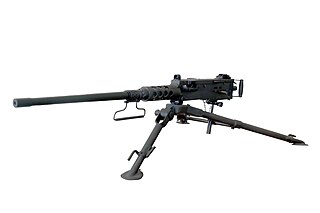
M2 Browning heavy machine gun

The M2 Machine Gun or Browning .50 Caliber Machine Gun is a heavy machine gun designed toward the end of World War I by John Browning. Its design is similar to Browning's earlier M1919 Browning machine gun, which was chambered for the .30-06 cartridge. The M2 uses the much larger and much more powerful .50 BMG cartridge, which was developed alongside and takes its name from the gun itself. It has been referred to as "Ma Deuce", in reference to its M2 nomenclature. The design has had many specific designations; the official designation for the current infantry type is Browning Machine Gun, Cal. .50, M2, HB, Flexible. It is effective against infantry, unarmored or lightly armored vehicles and boats, light fortifications and low-flying aircraft.

Contents

The aim was to have a brand new heavy machine gun design, that fires the same type of .50 cal rounds as the M2HB machine guns and to have the gun parts more readily available in view of easing SAF's chain of logistics and supplies. [1]

.50 BMG cartridge

The .50 Browning Machine Gun is a cartridge developed for the Browning .50 caliber machine gun in the late 1910s, entering official service in 1921. Under STANAG 4383, it is a standard cartridge for NATO forces as well as many non-NATO countries. The cartridge itself has been made in many variants: multiple generations of regular ball, tracer, armor-piercing (AP), incendiary, and saboted sub-caliber rounds. The rounds intended for machine guns are made into a continuous belt using metallic links.

Overview

Close in defence aboard RSS Resilience US Navy 040526-N-7906B-107 A Republic of Singapore Navy (RSN) gunner assigned to the patrol vessel RSS Resilience, keeps his sight trained on the Military Sealift Command (MSC) combat stores ship USNS Concord (T-AFS 5).jpg
Close in defence aboard RSS Resilience

The CIS engineers learnt from the lesson of the canceled (lack of funding) American "Dover Devil GPHMG" program known as the Special Projects Group at Picatinny Arsenal led by Charles J. Rhoades. Curt Johnson and Phil Baker developed the original concept to create a modular weapon suited for modern tactical doctrines and production techniques. [3] In 1988, CIS introduced the new 12.7mm machine gun which was aptly named as the CIS 50MG, after two years of development and testing phase. [2]

As the CIS 50MG is a gas-operated, air-cooled, belt-fed weapon, the gun is operated using dual gas pistons, located in two gas tubes placed on either side of the barrel. The barrel is locked by means of a rotary bolt with multiple radial lugs that engages the barrel extension, eliminating the need for headspace adjustments. The CIS 50MG utilises the same "constant recoil" system used in the Ultimax 100 and it also has a quick-detachable barrel equipped with a carrying handle to facilitate the ease of barrel changing under combat situations or during operational manoeuvres. [2]

Ultimax 100 A Singapore-made 5.56mm light machine gun

The Ultimax 100 is a Singapore-made 5.56mm light machine gun, developed by the Chartered Industries of Singapore by a team of engineers under the guidance of American firearms designer L. James Sullivan. The weapon is extremely accurate due to its constant-recoil operating system. It is considered one of the most lightweight machine guns in the world.

Features

The one unique feature of the CIS 50MG is its dual belt-feed system, the system allows for fast and easy switching of ammunition from standard ball rounds to the Raufoss Mk 211 Armor-Piercing-Incendiary rounds or the Saboted light armor penetrator (SLAP), which are capable of penetrating a rolled homogeneous armour plate with a thickness of 25 mm (0.98 in) from a range of 1 km (0.62 mi). [2] [3]

Raufoss Mk 211

The Raufoss Mk 211 is a .50 caliber multipurpose anti-matériel high-explosive incendiary/armor-piercing ammunition projectile produced by Nammo under the model name NM140 MP. It is commonly referred to as multipurpose or Raufoss, meaning red waterfall in Norwegian. This refers to Nammo's precursor company Raufoss Ammunisjonsfabrikker, an ammunition manufacturer established 1896 in Raufoss, Norway. The "Mk 211" name comes from the nomenclature Mk 211 Mod 0 used by the U.S. military for this round.

The saboted light armor penetrator (SLAP) family of ammunition is designed to penetrate armor more efficiently than standard armor-piercing ammunition.

Rolled homogeneous armour (RHA) is a type of armour made of a single steel composition hot-rolled to improve its material characteristics, as opposed to layered or cemented armour. Its first common application was in tanks. After World War II, it began to fall out of use on main battle tanks and other armoured fighting vehicles intended to see front-line combat as new anti-tank weapon technologies were developed which were capable of relatively easily penetrating rolled homogeneous armour plating even of significant thickness.

Such systems are more commonly used in modern automatic cannons such as the M242 Bushmaster 25mm cannon and the Mk44 Bushmaster II 30mm cannon, both of which are also in use by the Singapore Army's Bionix AFVs. [1]

Autocannon rapid-fire projectile weapon that fires armour piercing or explosive shells

An autocannon or automatic cannon is a large, fully automatic, rapid-fire projectile weapon that fires armour-piercing or explosive shells, as opposed to the bullet fired by a machine gun. Autocannons often have a larger calibre than a machine gun, but are usually smaller than a field gun or other artillery. When used on its own, the word "autocannon" indicates a single-barrel weapon. When multiple rotating barrels are involved, the word "rotary" is added, and such a weapon is referred to as a "rotary autocannon". Modern autocannons are typically not single soldier-portable or stand-alone units, rather they are usually vehicle-mounted, aircraft-mounted, or boat-mounted, or even remote-operated as in some naval applications. As such, ammunition is typically fed from a belt to reduce reloading or for a faster rate of fire, but a magazine remains an option. They can use a variety of ammunition: common shells include high-explosive dual-purpose types (HEDP), any variety of armour-piercing (AP) types, such as composite rigid (APCR) or discarding sabot types (APDS).

M242 Bushmaster chain gun

The M242 Bushmaster is a 25 mm (25×137mm) chain-driven autocannon. It is used extensively by the U.S. military, as well as by NATO's and some other nations' forces in ground combat vehicles, such as the Bradley fighting vehicle and various watercraft. Originally the weapon was designed and manufactured by Hughes Ordnance in Culver City, California, which was acquired by McDonnell Douglas ; however it is now produced by Northrop Grumman Innovation Systems.

Mk44 Bushmaster II chain gun

The Mk44 Bushmaster II is a 30 mm chain gun manufactured by Alliant Techsystems. It is a derivative of the 25 mm M242 Bushmaster, and uses 70% of the same parts as the M242 while increasing the firepower by as much as 50% with the 20% increase in caliber size. The barrel is chromium-plated for extended life. The gun uses standard GAU-8 Avenger ammunition that is available in API, HEI and APFSDS-T variants. The gun can be converted to a caliber of 40x180 mm, which involves changing the barrel and a few key parts, to use the SuperShot 40 cartridge. It can also be converted to use the 30x170 mm RARDEN cartridge.

Users

Related Research Articles

General-purpose machine gun machine gun adaptable for several light and medium roles

A general-purpose machine gun (GPMG) is an air-cooled, fully automatic weapon that can be adapted to light machine gun and medium machine gun roles. A GPMG weapon will typically feature a quick-change barrel, configuration for mounting on bipods, tripods, and vehicles as infantry support weapons, and calibered to fire full-powered rifle cartridges such as the 7.62×51mm NATO, 7.62×54mmR, 7.5×54mm French, 7.5×55mm Swiss, and 7.92×57mm Mauser.

Machine gun fully automatic mounted or portable firearm

A machine gun is a fully automatic mounted or portable firearm designed to fire rifle cartridges in rapid succession from an ammunition belt or magazine for the purpose of suppressive fire. Not all fully automatic firearms are machine guns. Submachine guns, rifles, assault rifles, battle rifles, shotguns, pistols or cannons may be capable of fully automatic fire, but are not designed for sustained fire. As a class of military rapid-fire guns, machine guns are fully automatic weapons designed to be used as support weapons and generally used when attached to a mount- or fired from the ground on a bipod or tripod. Many machine guns also use belt feeding and open bolt operation, features not normally found on rifles.

The MG 42 is a 7.92×57mm Mauser general-purpose machine gun designed in Nazi Germany and used extensively by the Wehrmacht and the Waffen-SS during the second half of World War II. It was intended to replace the earlier MG 34, which was more expensive and took much longer to produce, but both weapons were produced until the end of the war.

IWI Negev light machine gun

The Negev is a 5.56×45mm NATO light machine gun developed by the Israeli firearm manufacturer, Israel Weapon Industries (IWI).

FN Minimi light machine gun

The FN Minimi is a Belgian 5.56mm Squad Automatic Weapon, or SAW developed by Fabrique Nationale (FN) in Herstal by Ernest Vervier. First introduced in the late 1970s, it is now in service in more than 75 countries. The weapon is currently manufactured at the FN facility in Herstal and their U.S. subsidiary FN Manufacturing LLC.

FN MAG Belgian 7.62 mm general-purpose machine gun

The FN MAG is a Belgian 7.62 mm general-purpose machine gun, designed in the early 1950s at Fabrique Nationale (FN) by Ernest Vervier. It has been used by more than 80 countries, and it has been made under licence in several countries, including Argentina, Canada, Egypt, India and the United Kingdom.

SAR 21 assault rifle

The SAR 21 is a bullpup assault rifle designed and manufactured in Singapore. First revealed and subsequently adopted by the Singapore Armed Forces (SAF) in 1999, it was designed and developed over a four-year period and was intended to replace the locally license-built M16S1 by the Singaporean Ministry of Defence (MINDEF), Singapore Army and the Chartered Industries of Singapore. Many of its design features are directly intended to counter the weaknesses of the M16S1 as encountered operationally by some infantrymen.

SSPH Primus self-propelled artillery

The Singapore Self-Propelled Howitzer 1 Primus is a self-propelled howitzer armed with a 155 mm howitzer. Developed jointly by the Singapore Armed Forces (SAF), Defence Science and Technology Agency (DSTA) and Singapore Technologies Kinetics, it was introduced to the Singapore Artillery in 2004. Primus is derived from the Artillery motto In Oriente Primus.

Rate of fire is the frequency at which a specific weapon can fire or launch its projectiles. It is usually measured in rounds per minute, or rounds per second.

Rheinmetall MG 3 general-purpose machine gun

The MG 3 is a German general-purpose machine gun chambered for the 7.62×51mm NATO cartridge. The weapon's design is derived from the World War II era MG 42 universal machine gun that fired the 7.92×57mm Mauser round.

Rotary cannon

A rotary cannon, rotary autocannon, or Gatling-type cannon is a rapid-firing weapon that utilizes multiple barrels in a rotating cluster to provide a sustained rate of fire and saturation greater than single-barreled machine guns or autocannons of equivalent caliber. The loading, firing, and unloading functions are performed simultaneously in different barrels as they rotate, and the rotation also permits the barrels some time to cool. The rotating barrel cluster on most Gatling-type guns is powered by an external force such as an electric motor, although gas-operated versions have also been developed.

Bionix AFV infantry fighting vehicle

The Bionix (BX) is a family of tracked Singaporean armoured fighting vehicles developed by Singapore Technologies Kinetics. Intended to augment the Singapore Army's aging M113 armoured personnel carriers, it is the first indigenous armoured vehicle to be developed in Southeast Asia. The Bionix has been operational with the Singapore Armed Forces (SAF) since 1999 in a wide variety of adaptations including the Bionix II, Bionix 25 and Bionix 40/50 variants.

The STK 40 AGL, formerly the CIS 40 AGL is a 40 mm automatic grenade launcher, developed in the late 1980s and produced by the Singaporean defence firm − Chartered Industries of Singapore. The launcher is employed primarily by the Singapore Armed Forces and the police and security forces of several other countries.

ST Kinetics CPW personal defense weapon

The CPW is a multi-caliber submachine gun developed by ST Kinetics of Singapore as a PDW-class firearm. The prototype is chambered in 9×19mm Parabellum but the manufacturer assures that the weapon's modular design allows for a simple caliber conversion to either 5.7×28mm or 4.6×30mm.

References

Notes
  1. 1 2 3 4 5 6 7 8 9 10 11 12 13 14 15 16 17 18 19 20 Richard J, 2008.
  2. 1 2 3 4 5 "50MG Product Brochure" (PDF). ST Engineering. Archived from the original (PDF) on 19 February 2009. Retrieved 11 September 2008.
  3. 1 2 3 4 5 Andrew C, 1989.
  4. "Maximum Firepower: The Machine Guns of the SAF". Singaporean Defence Ministry. 7 June 2008. Archived from the original on 4 August 2012. Retrieved 14 July 2010.
  5. "Un repaso a las armas ligeras de Pindad" (in Spanish). ARMAS. Archived from the original on 2013-04-02. Retrieved 2010-07-05.
  6. https://web.archive.org/web/20170622123315/http://www.janes.com/images/assets/520/71520/New-model_African_armies.pdf
  7. Muhammad Juffry, Bin Joihani (Jul–Aug 2009). "PCG upgrades with new fleet and training centre". Police Life Monthly. Singapore: Singapore Police Force. 35 (7). ISSN   0217-8699 . Retrieved 10 November 2010.
Bibliography