Pol Pot was a Cambodian revolutionary and politician who served as the general secretary of the Communist Party of Kampuchea from 1963 to 1981. Ideologically a Marxist–Leninist and Khmer nationalist, he led the Khmer Rouge group from 1963 until 1997. From 1976 to 1979, he served as the Prime Minister of Democratic Kampuchea.
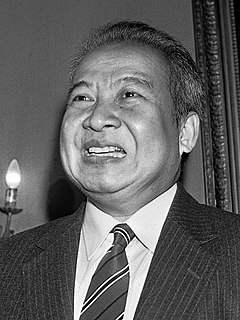
Norodom Sihanouk was a Cambodian royal, politician, composer and filmmaker who was twice the King of Cambodia. He was the son of King Norodom Suramarit and Queen Sisowath Kossamak. In Cambodia, he is also known as Samdech Euv.

The Kingdom of Cambodia, informally known as the first Kingdom of Cambodia and the Sangkum Reastr Niyum era, referred to Norodom Sihanouk's first administration of Cambodia from 1953 to 1970, an especially significant time in the country's history. Sihanouk continues to be one of the most controversial figures in Southeast Asia's turbulent and often tragic postwar history.
Hou Yuon was a veteran of the communist movement in Cambodia. A member of the Communist Party of Kampuchea, also known as the Khmer Rouge, he served in several ministerial posts during the 1960s and 1970s.

Son Sen, alias Comrade Khieu (សមមិត្តខៀវ), was a Cambodian Communist politician and soldier. A member of the Central Committee of the Communist Party of Kampuchea/Party of Democratic Kampuchea, the Khmer Rouge, from 1974 to 1992, Sen oversaw the Party's security apparatus, including the Santebal secret police and the notorious security prison S-21 at Tuol Sleng.
The Cambodian coup of 1970 refers to the removal of the Cambodian Head of State, Prince Norodom Sihanouk, after a vote in the National Assembly on 18 March 1970. Emergency powers were subsequently invoked by the Prime Minister Lon Nol, who became effective head of state, and led ultimately to the proclamation of the Khmer Republic later that year. It is generally seen as a turning point in the Cambodian Civil War. No longer a monarchy, Cambodia was semi-officially called "État du Cambodge" in the intervening six months after the coup, until the republic was proclaimed.
Son Ngoc Thanh was a Cambodian nationalist and republican politician, with a long history as a rebel and a government minister.
Lon Non was a Cambodian politician and soldier who rose to his greatest prominence during the Khmer Republic (1970–1975).
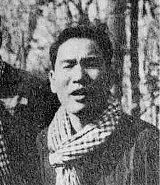
Hu Nim, alias "Phoas" (ភាស់), was a Cambodian Communist intellectual and politician who held a number of ministerial posts. His long political career included spells with the Sangkum regime of Prince Norodom Sihanouk, the Communist guerrilla resistance, the GRUNK coalition government-in-exile, and the administration of Democratic Kampuchea, when the country was controlled by the Communist Party of Kampuchea.
The Social Republican Party or Socio-Republican Party was a political party in Cambodia, founded by the then Head of State Lon Nol in June 1972 to contest the National Assembly Elections of the Khmer Republic held on September 3, 1972.
Keo Meas was a Cambodian communist politician. Keo Meas, then a fourth-year student at the Phnom Penh Teachers Training College, was recruited to the Indochinese Communist Party by Son Sichan in 1946. In 1950, he became a leading figure within the United Issarak Front. At the same time he was a leading figure in the Phnom Penh city unit of the ICP.
The Krom Pracheachon, often referred to simply as Pracheachon, was a Cambodian political party that contested in parliamentary elections in 1955, 1958 and 1972.
The Democratic Party was a left-leaning, pro-independence political party formed in 1946 by Prince Sisowath Youtevong, who had previously been a member of the French Section of the Workers' International. It was the sole dominant party in Cambodia from 1946 until the creation of Sangkum in 1955.
Prince Norodom Phurissara was a prominent leftist Cambodian politician of the 1950s, 1960s and 1970s, who held a number of ministerial posts. A member of the Cambodian royal family, he disappeared during the political purges carried out by the Communist Party of Cambodia after it came to power.
Saloth Chhay was a Cambodian left-wing journalist and political activist, who was prominent in the country's politics during the 1950s, 1960s and 1970s. He is best known for being the older brother of Pol Pot, future leader of the Khmer Rouge communists, and for influencing his early political development.

The Communist Party of Kampuchea, also known as Khmer Communist Party (KCP), was a communist party in Cambodia. Its leader was Pol Pot and its followers were generally known as Khmer Rouge. The party was underground for most of its existence and took power in the country in 1975 and established the state known as Democratic Kampuchea. The party lost power in 1979 with the establishment of the People's Republic of Kampuchea by leftists who were dissatisfied by the Pol Pot regime and by the intervention of Vietnamese military forces after a period of mass killing. The party was officially dissolved in 1981, with the Party of Democratic Kampuchea claiming its legacy.