| | |
| Overview | |
|---|---|
| Maker | Canon Inc. |
| Type | 35 mm bridge [1] |
| Released | June 1990 |
| Lens | |
| Lens mount | Fixed |
| Lens | 35–105 mm |
| F-numbers | f/3.2 to f/8 |
| Sensor/medium | |
| Film speed | ISO 25 to 400 |
| Focusing | |
| Focus | Automatic; 3-point smart AF system with near-infrared beam |
| Exposure/metering | |
| Exposure | Automatic |
| Exposure metering | EV2.35 to EV18.6 at ISO 100 |
| Flash | |
| Flash | Built-in |
| Shutter | |
| Shutter speed range | Auto mode and flash on mode: EV 10 (f/3.2 at 1/100 sec.) – EV 16 (f/13.2 at 1/350 sec.) at 38 mm EV 12.6 (f/8 at 1/100 sec.) – EV 18.6 (f/34 at 1/350 sec.) at 13 5mm Slow speed and flash off mode: EV 2.35 (f/3.2 at 2 sec.) – EV 16 (f/13.2 at 1/350 sec.) at 38 mm EV 5 (f/8 at 2 sec.) – EV 18.6 (f/34 at 1/350 sec.) at 135 mm |
| General | |
| Battery | 2CR5 |
| Dimensions | 100×74×170 mm (3.9×2.9×6.7 in) |
| Weight | 700 g (25 oz) with battery |
| Made in | Japan |
| Replaced by | Canon Epoca 135/Jet 135/Photura 135 |
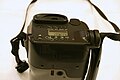
The Canon Epoca (also known as the Photura in North America and the Autoboy Jet in Japan [2] [3] ) is a 35mm bridge camera by Canon Inc. [4] [1]

Introduced in June 1990, the Epoca is known for its unusual design that more resembles a camcorder, as well as its 35 mm to 105 mm zoom lens. [5] [6] In addition, the camera features a flash that is stored behind the lens cover, a low-angle viewfinder on top of its body, and the option to imprint one of five captions on the picture. [2] [7] The North American release was offered without the quartz date and caption features, while the European and international version was released with these features as the Epoca Caption. [8] [9] Film is loaded into the chamber inside the bottom panel of the camera, where it is fed through a unique loading system that minimizes light exposure. [10] [11] A remote shutter and a close-up lens attachment with flash diffuser were bundled with the camera or sold separately; the lens attachment enables macro photography from 0.55 m to 0.8 m. [12] [1]
The name Epoca is derived from the word "epoch", implying that the camera's release marked an important point in the history of cameras. The name Photura is a portmanteau of the words "photography" and "Futura", the font used for the camera's logo in the North American market. For the Japanese market, the camera was called the Autoboy Jet, as it resembled a jet engine. [13]
In September 1991, Canon released the Autoboy Jet Canon Williams Racing Version for the 1991 Japanese Grand Prix, with the team logo printed on the hand strap and a pouch in the team's colors. The camera was limited to 5,000 units in Japan only. [14]
The Epoca was replaced by the Epoca 135/Photura 135/Jet 135 in March 1992, with a black body and a more powerful zoom up to 135 mm. [15] [1]