
Rosaceae, the rose family, is a family of flowering plants that includes 4,828 known species in 91 genera.

Oleaceae, also known as the olive family or sometimes the lilac family, is a taxonomic family of flowering shrubs, trees, and a few lianas in the order Lamiales. It presently comprises 28 genera, one of which is recently extinct. The extant genera include Cartrema, which was resurrected in 2012. The number of species in the Oleaceae is variously estimated in a wide range around 700. The flowers are often numerous and highly odoriferous. The family has a subcosmopolitan distribution, ranging from the subarctic to the southernmost parts of Africa, Australia, and South America. Notable members include olive, ash, jasmine, and several popular ornamental plants including privet, forsythia, fringetrees, and lilac.

Ephedraceae is a family of gymnosperms belonging to Gnetophyta, it contains only a single extant genus, Ephedra, as well as a number of extinct genera from the Early Cretaceous.
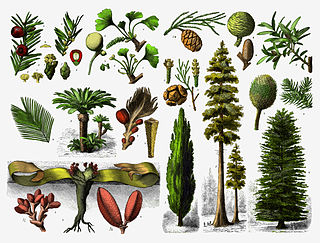
The gymnosperms are a group of woody, perennial seed-producing plants, typically lacking the protective outer covering which surrounds the seeds in flowering plants, that include conifers, cycads, Ginkgo, and gnetophytes, forming the clade Gymnospermae The term gymnosperm comes from the composite word in Greek: γυμνόσπερμος, and literally means 'naked seeds'. The name is based on the unenclosed condition of their seeds. The non-encased condition of their seeds contrasts with the seeds and ovules of flowering plants (angiosperms), which are enclosed within an ovary. Gymnosperm seeds develop either on the surface of scales or leaves, which are often modified to form cones, or on their own as in yew, Torreya, and Ginkgo.

The Dryopteridaceae are a family of leptosporangiate ferns in the order Polypodiales. They are known colloquially as the wood ferns. In the Pteridophyte Phylogeny Group classification of 2016 (PPG I), the family is placed in the suborder Polypodiineae. Alternatively, it may be treated as the subfamily Dryopteridoideae of a very broadly defined family Polypodiaceae sensu lato.

Osmanthus is a genus of about 30 species of flowering plants in the family Oleaceae. Most of the species are native to eastern Asia with a few species from the Caucasus, New Caledonia, and Sumatra. Osmanthus has been known in China since ancient times with the earliest writings coming from the Warring States period; the book Sea and Mountain. South Mountain states: "Zhaoyao Mountain had a lot of Osmanthus".

Cartrema americana, commonly called American olive, wild olive, or devilwood, is an evergreen shrub or small tree native to southeastern North America, in the United States from Virginia to Texas, and in Mexico from Nuevo León south to Oaxaca and Veracruz.

Romance of the Three Kingdoms is a Chinese television series adapted from the classical 14th century novel of the same title by Luo Guanzhong. The series was produced by China Central Television (CCTV) and was first aired on the network in 1994. It spanned a total of 84 episodes, each approximately 45 minutes long. One of the most expensive television series produced at the time, the project cost 170 million yuan. It was completed over four years and involved over 400,000 cast and crew members, including divisions of the People's Liberation Army from the Beijing, Nanjing and Chengdu military regions. Some of the dialogue spoken by characters was adapted directly from the novel. Extensive battle scenes, such as the battles of Guandu, Red Cliffs and Xiaoting, were also live-acted.

Stachybotrys is a genus of molds, hyphomycetes or asexually reproducing, filamentous fungi, now placed in the family Stachybotryaceae. The genus was erected by August Carl Joseph Corda in 1837. Historically, it was considered closely related to the genus Memnoniella, because the spores are produced in slimy heads rather than in dry chains. Recently, the synonymy of the two genera is generally accepted. Most Stachybotrys species inhabit materials rich in cellulose. The genus has a widespread distribution and contained about 50 species in 2008. There are 88 records of Stachybotrys on Species Fungorum, of which 33 species have DNA sequence data in GenBank. Species in the genus are commonly found in soil, plant litter and air and a few species have been found from damp paper, cotton, linen, cellulose-based building materials water-damaged indoor buildings, and air ducts from both aquatic and terrestrial habitats.

Nestegis is a genus of flowering plant in the olive family, Oleaceae. There are five currently accepted species in the genus: three species are endemic to New Zealand, while one can be found on New Zealand and Norfolk Island. Another is restricted to Hawaiʻi.

The Pleosporales is the largest order in the fungal class Dothideomycetes. By a 2008 estimate, it contained 23 families, 332 genera and more than 4700 species. The majority of species are saprobes on decaying plant material in fresh water, marine, or terrestrial environments, but several species are also associated with living plants as parasites, epiphytes or endophytes. The best studied species cause plant diseases on important agricultural crops e.g. Cochliobolus heterostrophus, causing southern corn leaf blight on maize, Phaeosphaeria nodorum causing glume blotch on wheat and Leptosphaeria maculans causing a stem canker on cabbage crops (Brassica). Some species of Pleosporales occur on animal dung, and a small number occur as lichens and rock-inhabiting fungi.
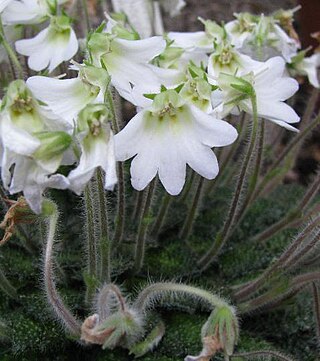
Petrocosmea is a genus of the family Gesneriaceae, the African violet family. Many of the species within this genus are endemic to high-elevation areas in Western China, although some are native to other parts of Asia. including north-central and southern China, Indochina, and the eastern Himalayas. It is a rosette-forming genus that generally grows on wet mossy rocks or forests.

Pestalotiopsis is a genus of ascomycete fungi in the Sporocadaceae family.
Thottopalayam thottimvirus, formerly Thottapalayam virus, (TMPV) is single-stranded, enveloped, negative-sense RNA virus species of the genus Thottimvirus in the Bunyavirales order. It is the first hantavirus to be isolated from a shrew. It was discovered in India in 1964.
The Investiture of the Gods is a 1990 Chinese shenmo television series written by Bing Tian, Gu Hanchang, Ouyang Yuping and Yu Youchen. The television series are based on the classical 16th-century novel Fengshen Yanyi written by Xu Zhonglin and Lu Xixing.

Eritrichium is a genus of flowering plants in the family Boraginaceae. It contains 78 species. Notable members include Eritrichium howardii and Eritrichium nanum.
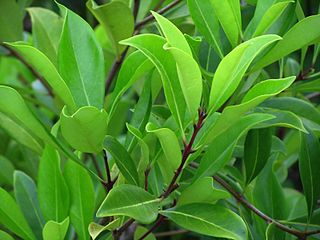
Cartrema is a genus of a few species of flowering plants in the family Oleaceae, native to southeastern Asia, southern China, and North America, formerly treated as section Leiolea of Osmanthus. Species of Cartrema may be distinguished from those of Osmanthus by the paniculate inflorescences of the former.

The Advisors Alliance is a 2017 Chinese two-part television series based on the life of Sima Yi, a government official and military general who lived in the late Eastern Han dynasty and Three Kingdoms period of China. The series starred Wu Xiubo as the main character, with Liu Tao, Li Chen, Janine Chang, Tang Yixin, Yu Hewei and Wang Luoyong playing supporting roles. The first part of the series started airing on Jiangsu TV and Anhui TV on 22 June 2017. The second part started airing on Youku on 8 December 2017.

The Sporocadaceae are a family of fungi, that was formerly in the order Xylariales. It was placed in the Amphisphaeriales order in 2020.
