
Look up connectivity in Wiktionary, the free dictionary.
Connectivity may refer to:
Connectivity may refer to:


In topology and related branches of mathematics, a connected space is a topological space that cannot be represented as the union of two or more disjoint non-empty open subsets. Connectedness is one of the principal topological properties that are used to distinguish topological spaces.

Algebraic topology is a branch of mathematics that uses tools from abstract algebra to study topological spaces. The basic goal is to find algebraic invariants that classify topological spaces up to homeomorphism, though usually most classify up to homotopy equivalence.
Graph may refer to:
In mathematics, connectedness is used to refer to various properties meaning, in some sense, "all one piece". When a mathematical object has such a property, we say it is connected; otherwise it is disconnected. When a disconnected object can be split naturally into connected pieces, each piece is usually called a component.

In topology, a branch of mathematics, two continuous functions from one topological space to another are called homotopic if one can be "continuously deformed" into the other, such a deformation being called a homotopy between the two functions. A notable use of homotopy is the definition of homotopy groups and cohomotopy groups, important invariants in algebraic topology.
Transitivity or transitive may refer to:
Boundary or Boundaries may refer to:
A topological soliton occurs when two adjoining structures or spaces are in some way "out of phase" with each other in ways that make a seamless transition between them impossible. One of the simplest and most commonplace examples of a topological soliton occurs in old-fashioned coiled telephone handset cords, which are usually coiled clockwise. Years of picking up the handset can end up coiling parts of the cord in the opposite counterclockwise direction, and when this happens there will be a distinctive larger loop that separates the two directions of coiling. This odd looking transition loop, which is neither clockwise nor counterclockwise, is an excellent example of a topological soliton. No matter how complex the context, anything that qualifies as a topological soliton must at some level exhibit this same simple issue of reconciliation seen in the twisted phone cord example.
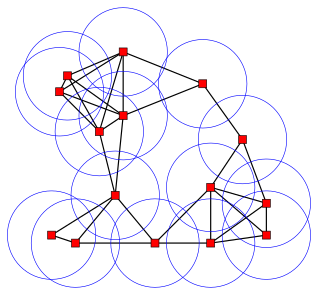
Discrete geometry and combinatorial geometry are branches of geometry that study combinatorial properties and constructive methods of discrete geometric objects. Most questions in discrete geometry involve finite or discrete sets of basic geometric objects, such as points, lines, planes, circles, spheres, polygons, and so forth. The subject focuses on the combinatorial properties of these objects, such as how they intersect one another, or how they may be arranged to cover a larger object.
Connected component may refer to:
In topology and related areas of mathematics, a topological property or topological invariant is a property of a topological space that is invariant under homeomorphisms. Alternatively, a topological property is a proper class of topological spaces which is closed under homeomorphisms. That is, a property of spaces is a topological property if whenever a space X possesses that property every space homeomorphic to X possesses that property. Informally, a topological property is a property of the space that can be expressed using open sets.
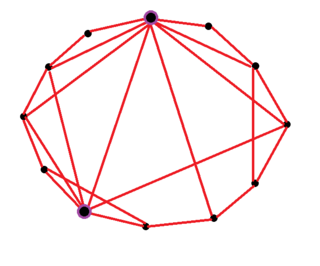
A small-world network is a type of mathematical graph in which most nodes are not neighbors of one another, but the neighbors of any given node are likely to be neighbors of each other and most nodes can be reached from every other node by a small number of hops or steps. Specifically, a small-world network is defined to be a network where the typical distance L between two randomly chosen nodes grows proportionally to the logarithm of the number of nodes N in the network, that is:

In mathematics, a topological space X is contractible if the identity map on X is null-homotopic, i.e. if it is homotopic to some constant map. Intuitively, a contractible space is one that can be continuously shrunk to a point within that space.
Digital topology deals with properties and features of two-dimensional (2D) or three-dimensional (3D) digital images that correspond to topological properties or topological features of objects.
In algebraic topology, homotopical connectivity is a property describing a topological space based on the dimension of its holes. In general, low homotopical connectivity indicates that the space has at least one low-dimensional hole. The concept of n-connectedness generalizes the concepts of path-connectedness and simple connectedness.
In the fields of chemical graph theory, molecular topology, and mathematical chemistry, a topological index, also known as a connectivity index, is a type of a molecular descriptor that is calculated based on the molecular graph of a chemical compound. Topological indices are numerical parameters of a graph which characterize its topology and are usually graph invariant. Topological indices are used for example in the development of quantitative structure-activity relationships (QSARs) in which the biological activity or other properties of molecules are correlated with their chemical structure.
In mathematics, a finite topological space is a topological space for which the underlying point set is finite. That is, it is a topological space which has only finitely many elements.
Mathematics is a broad subject that is commonly divided in many areas that may be defined by their objects of study, by the used methods, or by both. For example, analytic number theory is a subarea of number theory devoted to the use of methods of analysis for the study of natural numbers.
In mathematics, particularly in functional analysis and topology, closed graph is a property of functions. A function f : X → Y between topological spaces has a closed graph if its graph is a closed subset of the product space X × Y. A related property is open graph.
In algebraic topology, homological connectivity is a property describing a topological space based on its homology groups.