 | This article has multiple issues. Please help improve it or discuss these issues on the talk page . (Learn how and when to remove these template messages)
|


Counts who reigned over the county of Meaux include:
| This article has multiple issues. Please help improve it or discuss these issues on the talk page . (Learn how and when to remove these template messages)
|
Counts who reigned over the county of Meaux include:
The counts of Meaux were assisted by the viscounts of Meaux, [3] at least since 1081/1098.
They were also Lords of La Ferté-Ancoul/-sous-Jouarre, and from the end of the 11th century until the Revolution, the viscounts were descended from the old masters of La Ferté-sous-Jouarre: the families of La Ferté-Ancoul, then Oisy (Simon), of Montmirail (Jean de Montmirail and his daughter Marie; they had also Condé, long associated with La Ferté-Ancoul and Meaux), Coucy (Enguerrand III ; Enguerrand V), of Béthune-Locres, Bar (Robert of Marle and his daughter Jeanne), of Luxembourg-Saint-Pol (Louis and his granddaughter Marie), of Bourbon-Vendôme (Charles, duke of Vendôme and the grandfather of the King Henri IV) then Bourbon-Condé (Louis).
And then on 13 August 1627 Henri II of Condé (1588-1646, 26th Viscount of Meaux) yields the viscount (épicène at the time) to Maximilien de Béthune, Duke of Sully, from Béthune-Locres. The valuation was very low, 15,000 livres only (except if it concerns the income and not the capital of the viscount). [4]
The latter leaves it to his youngest son François, duke of Orval (1602-1678, brother of Maximilien II) and to his grandson Philippe (born August 1682, son of François, he is said to have ceded the viscount during his lifetime to his first cousin Maximilien III), then to Maximilien II, dukes of Sully, Maximilien III François (1615-1662), Maximilien IV Pierre (1640-1694), Maximilien V Pierre-François-Nicolas (1664-1712), Maximilien VI Henri (1669-1729, without offspring, vacant at his death), Maximilien VIII Antoine-Armand of Orval (1730-1786, known as viscount of Meaux "since his birth" [5] father of Maximilien IX Alexis (1750-1776) and Maximilien X Gabriel-Louis (1756-1800)).

Stephen Henry was the Count of Blois and Count of Chartres. He led an army during the First Crusade, was at the surrender of the city of Nicaea, and directed the siege of Antioch. Returning home without fulfilling his crusader vows, Stephen joined the crusade of 1101. Making his way to Jerusalem, he fought in the Second Battle of Ramla, where he was captured and later executed.
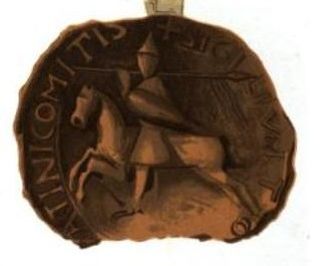
Theobald the Great (1090–1152) was count of Blois and of Chartres as Theobald IV from 1102 and was Count of Champagne and of Brie as Theobald II from 1125. Theobald held Auxerre, Maligny, Ervy, Troyes and Châteauvillain as fiefs from Odo II, Duke of Burgundy.

The Count of Champagne was the ruler of the County of Champagne from 950 to 1316. Champagne evolved from the County of Troyes in the late eleventh century and Hugh I was the first to officially use the title count of Champagne.
Eudes, French for Odo, may refer to:

The Valois was a region in the valley of the Oise river in Picardy in the north of France. It was a fief in West Francia and subsequently the Kingdom of France until its counts furnished a line of kings, the House of Valois, to succeed the House of Capet in 1328. It was, along with the counties of Beauvais, the Vexin, Vermandois, and Laon, part of the "Oise line" of fiefdoms which were held often by one individual or an individual family as a string of defences against Viking assault on Paris.

Vermandois was a French county that appeared in the Merovingian period. Its name derives from that of an ancient tribe, the Viromandui. In the 10th century, it was organised around two castellan domains: St Quentin (Aisne) and Péronne (Somme). In today's times, the Vermandois county would fall in the Picardy region of northern France.
Theobald III of Blois (1012–1089) was count of Blois, Meaux and Troyes. He was captured in 1044 by Geoffrey II, Count of Anjou, and exchanged the county of Touraine for his freedom. Theobald used his nephew's involvement with the Norman invasion of England, to gain authority over the County of Champagne. He died in 1089.

Odo II was the count of Blois, Chartres, Châteaudun, Champagne, Beauvais and Tours from 1004 and count of Troyes and Meaux from 1022. He twice tried to make himself a king: first in Italy after 1024 and then in Burgundy after 1032.
Adalbert I of Vermandois, was the son of Herbert II of Vermandois and Adela of France. Born about 915, he succeeded his father as Count of Vermandois in 946.

Herbert II, Count of Vermandois, Count of Meaux, and Count of Soissons. He was the first to exercise power over the territory that became the province of Champagne.
Odo was Count of Troyes and of Meaux from 1047 to 1066, then Count of Aumale from 1069 to 1115. He was later also known as the count of Champagne and as Eudes II of Troyes.
Stephen II of Troyes, sometimes called Etienne, was a Count of Troyes and Meaux from 1037 to 1047. He was the son of (Eudes) Odo II, Count of Blois and, Chartres, Champagne, Troyes and Meaux, and of Ermengarde of Auvergne.
Herbert the Younger was the Count of Troyes and Meaux. He was the son of Robert of Vermandois and Adelaide Werra, daughter of Gilbert, Duke of Burgundy. He belonged to the Herbertien dynasty, an illegitimate branch of the Carolingian dynasty.

The House of Blois is a lineage derived from the Frankish nobility, whose principal members were often named Theobald.
Adelaide of Vermandois was suo jure Countess of Vermandois and Valois from 1080 to 1120. And was the last landed ruler of the Carolingian Dynasty

The House of Bethune is a French noble house from the province of Artois in the north of France whose proven filiation dates back to Guillaume de Béthune who made his will in 1213. This family became extinct in 1807 with Maximilien-Alexandre de Béthune, Duke of Sully (1784-1807).
Herbert III d'Omois, Herbert the old, Heribert le Vieux was count of Omois from 943 to his death.
The Counts of Dammartin were the rulers of the county of Dammartin, based in the current commune of Dammartin-en-Goële as early as the 10th century. Located at the central plain of France, the county controlled the roads of Paris to Soissons and Laon. It seems that this county was initially held by Constance, the wife of Manasses Calvus, the first Count. The name Dammartin-en-Goële comes from Domnus Martinus, the Latin name of St. Martin of Tours, who evangelized the region of Goële in the fourth century. A small town in the district of Meaux in the Department of Seine-et-Marne, ancient village of Region of Île-de-France, it appears to go back to the earliest times; Dammartin-en-Goële, also called Velly, was in 1031 one of the most significant places in France.

The House of Montmirail is a French noble family from the Middle Ages, originally from the village of Montmirail, in the County of Champagne, and was a vassal of the Count of Champagne.
