Related Research Articles
Post-traumatic stress disorder (PTSD) is a mental and behavioral disorder that can develop because of exposure to a traumatic event, such as sexual assault, warfare, traffic collisions, child abuse, domestic violence, or other threats on a person's life. Symptoms may include disturbing thoughts, feelings, or dreams related to the events, mental or physical distress to trauma-related cues, attempts to avoid trauma-related cues, alterations in the way a person thinks and feels, and an increase in the fight-or-flight response. These symptoms last for more than a month after the event. Young children are less likely to show distress but instead may express their memories through play. A person with PTSD is at a higher risk of suicide and intentional self-harm.
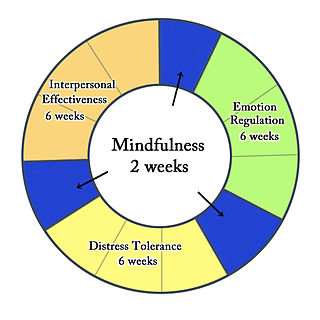
Dialectical behavior therapy (DBT) is an evidence-based psychotherapy that began with efforts to treat personality disorders and interpersonal conflicts. Evidence suggests that DBT can be useful in treating mood disorders and suicidal ideation, as well as for changing behavioral patterns such as self-harm and substance use. DBT evolved into a process in which the therapist and client work with acceptance and change-oriented strategies, and ultimately balance and synthesize them—comparable to the philosophical dialectical process of thesis and antithesis followed by synthesis.
Psychological trauma, mental trauma or psychotrauma is an emotional response to a distressing event or series of events, such as accidents, rape or natural disasters. Reactions such as psychological shock and psychological denial are typical. Longer-term reactions include unpredictable emotions, flashbacks, difficulties with interpersonal relationships and sometimes physical symptoms including headaches or nausea.
The expressive therapies are the use of the creative arts as a form of therapy, including the distinct disciplines expressive arts therapy and the creative arts therapies. Unlike traditional arts expression, the process of creation is emphasized rather than the final product. The expressive therapies are based on the assumption that people can heal through the various forms of creative expression. Expressive therapists share the belief that through creative expression and the tapping of the imagination, people can examine their body, feelings, emotions, and thought process.

Art therapy is a distinct discipline that incorporates creative methods of expression through visual art media. Art therapy, as a creative arts therapy profession, originated in the fields of art and psychotherapy and may vary in definition.
Complex post-traumatic stress disorder is a psychological disorder that is theorized to develop in response to exposure to a series of traumatic events in a context in which the individual perceives little or no chance of escape, and particularly where the exposure is prolonged or repetitive. It is not yet recognized by the American Psychiatric Association or the DSM-5 as a valid disorder, although was added to the eleventh revision of the International Classification of Diseases (ICD-11). In addition to the symptoms of post-traumatic stress disorder (PTSD), an individual with C-PTSD experiences emotional dysregulation, negative self-beliefs and feelings of shame, guilt or failure regarding the trauma, and interpersonal difficulties. C-PTSD relates to the trauma model of mental disorders and is associated with chronic sexual, psychological, and physical abuse or neglect, or chronic intimate partner violence, bullying, victims of kidnapping and hostage situations, indentured servants, victims of slavery and human trafficking, sweatshop workers, prisoners of war, concentration camp survivors, and prisoners kept in solitary confinement for a long period of time, or defectors from authoritarian religions. Situations involving captivity/entrapment can lead to C-PTSD-like symptoms, which can include prolonged feelings of terror, worthlessness, helplessness, and deformation of one's identity and sense of self.

Grief counseling is a form of psychotherapy that aims to help people cope with the physical, emotional, social, spiritual, and cognitive responses to loss. These experiences are commonly thought to be brought on by a loved person's death, but may more broadly be understood as shaped by any significant life-altering loss.
A trauma trigger is a psychological stimulus that prompts involuntary recall of a previous traumatic experience. The stimulus itself need not be frightening or traumatic and may be only indirectly or superficially reminiscent of an earlier traumatic incident, such as a scent or a piece of clothing. Triggers can be subtle, individual, and difficult for others to predict. A trauma trigger may also be called a trauma stimulus, a trauma stressor or a trauma reminder.
Trauma Systems Therapy (TST) is a mental health treatment model for children and adolescents who have been exposed to trauma, defined as experiencing, witnessing, or confronting "an event or events that involved actual or threatened death or serious injury, or a threat to the physical integrity of self or others". TST focuses on the child's emotional and behavioral needs as well as the environments where the child lives. The treatment model includes four components that are fully described in a published manual. A clinical trial showed that TST is effective in improving the mental health and well-being of children who have been traumatized. TST has also been successfully replicated.
Cognitive processing therapy (CPT) is a manualized therapy used by clinicians to help people recover from posttraumatic stress disorder (PTSD) and related conditions. It includes elements of cognitive behavioral therapy (CBT) treatments, one of the most widely used evidence-based therapies. A typical 12-session run of CPT has proven effective in treating PTSD across a variety of populations, including combat veterans, sexual assault victims, and refugees. CPT can be provided in individual and group treatment formats.
PTSD or post-traumatic stress disorder, is a psychiatric disorder characterised by intrusive thoughts and memories, dreams or flashbacks of the event; avoidance of people, places and activities that remind the individual of the event; ongoing negative beliefs about oneself or the world, mood changes and persistent feelings of anger, guilt or fear; alterations in arousal such as increased irritability, angry outbursts, being hypervigilant, or having difficulty with concentration and sleep.
Center for Justice and Peacebuilding (CJP) is an accredited graduate-level program founded in 1994. It also offers non-credit training. The program specializes in conflict transformation, restorative justice, trauma healing, equitable development, and addressing organizational conflict. CJP is housed at Eastern Mennonite University (EMU) in Harrisonburg, Virginia, which describes itself as "a leader among faith-based universities" in emphasizing "peacebuilding, creation care, experiential learning, and cross-cultural engagement." One of the three 2011 Nobel Peace Laureates, Leymah Gbowee of Liberia, earned a master's degree in conflict transformation from CJP in 2007.
Transgenerational trauma is the psychological and physiological effects that the trauma experienced by people has on subsequent generations in that group. There are two types of transmission: intergenerational transmission whereby epigenetic changes are passed down from the directly traumatized generation [F0] to their offspring [F1], and transgenerational transmission when the offspring [F1] then pass it down to their offspring [F2] who have not been exposed to the initial traumatic event. Exposure includes when the offspring is in utero.
Trauma focused cognitive behavioral therapy (TF-CBT) is an evidence-based psychotherapy or counselling that aims at addressing the needs of children and adolescents with post traumatic stress disorder (PTSD) and other difficulties related to traumatic life events. This treatment was developed and proposed by Drs. Anthony Mannarino, Judith Cohen, and Esther Deblinger in 2006. The goal of TF-CBT is to provide psychoeducation to both the child and non-offending caregivers, then help them identify, cope, and re-regulate maladaptive emotions, thoughts, and behaviors. Research has shown TF-CBT to be effective in treating childhood PTSD and with children who have experienced or witnessed traumatic events, including but not limited to physical or sexual victimization, child maltreatment, domestic violence, community violence, accidents, natural disasters, and war.
Race-based traumatic stress is the traumatic response to stress following a racial encounter. Robert T. Carter's (2007) theory of race-based traumatic stress implies that there are individuals of color who experience racially charged discrimination as traumatic, and often generate responses similar to post-traumatic stress. Race-based traumatic stress combines theories of stress, trauma and race-based discrimination to describe a particular response to negative racial encounters.
Psychosensory therapy is a form of therapeutic treatment that uses sensory stimuli to affect psychological and emotional health. In addition, psychosensory therapy is a group of therapeutic techniques that involves applying sensory inputs to treat various behaviors, mood, thoughts, symptoms, and pain. Psychosensory therapy has its roots in traditional Chinese medicine in addition to energy psychology. Some important figures in psychosensory therapy include chiropractor George Goodheart, psychiatrist John Diamond, clinical psychologist Roger Callahan, and Ronald Ruden.
Creative peacebuilding is a form of visual arts that offers a creative means to bring about peace within conflicted contexts. The use of the visual arts for effective peacebuilding emphasizes a consideration of the nature of the context where the tool is applied by not necessarily following a set format or paradigm. It reflects the potential to transcend traditional ideas, rules, patterns, relationships, or the like, to create meaningful new ideas, forms, methods, and interpretations geared towards establishing and sustaining peace.
Trauma-sensitive yoga is yoga as exercise, adapted from 2002 onwards for work with individuals affected by psychological trauma. Its goal is to help trauma survivors to develop a greater sense of mind-body connection, to ease their physiological experiences of trauma, to gain a greater sense of ownership over their bodies, and to augment their overall well-being. However, a 2019 systematic review found that the studies to date were not sufficiently robustly designed to provide strong evidence of yoga's effectiveness as a therapy; it called for further research.
Sexual trauma therapy is medical and psychological interventions provided to survivors of sexual violence aiming to treat their physical injuries and cope with mental trauma caused by the event. Examples of sexual violence include any acts of unwanted sexual actions like sexual harassment, groping, rape, and circulation of sexual content without consent.
Being exposed to traumatic events such as war, violence, disasters, loss, injury or illness can cause trauma. Additionally, the most common diagnostic instruments such as the ICD-11 and the DSM-5 expand on this definition of trauma to include perceived threat to death, injury, or sexual violence to self or a loved one. Even after the situation has passed, the experience can bring up a sense of vulnerability, hopelessness, anger and fear.
References
- ↑ "Selected Definitions of Peacebuilding". Alliance for Peacebuilding. Archived from the original on 4 March 2019. Retrieved 10 November 2017.
- ↑ Lederach, John Paul (2010). The Moral Imagination: The Art and Soul of Building Peace. New York: Oxford University Press. ISBN 978-0-19-974758-0.
- ↑ Mitchell, Jolyon P. (2012). Promoting Peace, Inciting Violence: The Role of Religion and Media. New York: Routledge. ISBN 978-0-415-55746-7.
- ↑ Ishaq, Ashfaq (December 2006). "Development of children's creativity to foster peace". The Lancet. 368: 26–27. doi:10.1016/s0140-6736(06)69915-7.
- ↑ Sayedy, Sayed (May 11, 2021) [October 9, 2018]. "What role does intercultural communication play in migration?". sayedy.com. Archived from the original on 2021-06-04. Retrieved October 27, 2021.
- ↑ Prutzman, Priscilla (October 1981). "Children's Creative Response to Conflict". Peace and Change. 7 (4): 77–79. doi:10.1111/j.1468-0130.1981.tb00454.x.
- ↑ Sutton, Julie P., ed. (2002). Music, Music Therapy and Trauma: International Perspectives. London: Jessica Kingsley Publishers. ISBN 978-1-84310-027-0.
- ↑ Avrahami, Dalia (2006). "Visual Art Therapy's Unique Contribution in the Treatment of Post-Traumatic Stress Disorders". Journal of Trauma & Dissociation. 6 (4): 5–38. doi:10.1300/j229v06n04_02. ISSN 1529-9732.
- ↑ Jones, Brent (18 June 2007). "Iraq vets use virtual reality to ease post-battle trauma". www.usatoday.com. Retrieved 14 November 2017.