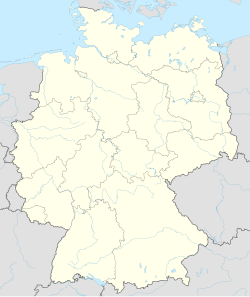
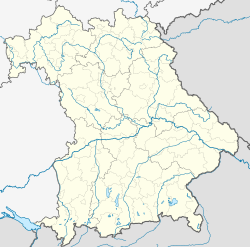
Munich is the capital and most populous city of Bavaria. With a population of 1,558,395 inhabitants as of 31 July 2020, it is the third-largest city in Germany, after Berlin and Hamburg, and thus the largest which does not constitute its own state, as well as the 11th-largest city in the European Union. The city's metropolitan region is home to 6 million people.

The Munich S-Bahn is an electric rail transit system in Munich, Germany. "S-Bahn" is the German abbreviation for Stadtschnellbahn, and the Munich S-Bahn exhibits characteristics of both rapid transit and commuter rail systems.

Coburg is a town located on the Itz river in the Upper Franconia region of Bavaria, Germany. Long part of one of the Thuringian states of the Wettin line, it joined Bavaria by popular vote only in 1920. Until the revolution of 1918, it was one of the capitals of the Duchy of Saxe-Coburg and Gotha and the Duchy of Saxe-Coburg-Saalfeld. Through successful dynastic policies, the ruling princely family married into several of the royal families of Europe, most notably in the person of Prince Albert, who married Queen Victoria in 1840. As a result of these close links with the royal houses of Europe in the late 19th and early 20th centuries, Coburg was frequently visited by the crowned heads of Europe and their families.
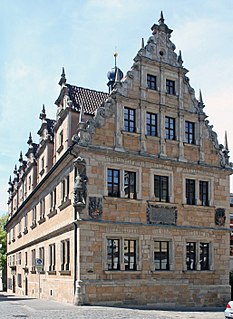
The Casimirianum, known to the students as the "Casi", is a Gymnasium in Coburg, Bavaria. It was founded in 1605 by Johann Casimir, the Duke of Saxe-Coburg (1564–1633), and named after him. Today the Casimirianum is a linguistic and humanistic high school with the curriculum including Latin from 5th Grade, English from 6th Grade, and Italian, Greek, French or Spanish as the third compulsory foreign language. With the school year of 2009–10, the program was expanded with a scientific-technological branch with Latin as a second language. The Casimirianum was once involved with a German pilot program, "The European Gymnasium" and was one of 44 Model Schools of "MODUS21", but both programs were closed by 2009.
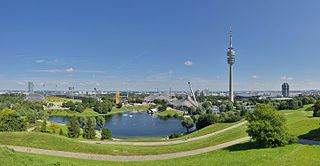
The Olympiapark München in Munich, Germany, is an Olympic Park which was constructed for the 1972 Summer Olympics. Located in the Oberwiesenfeld neighborhood of Munich, the Park continues to serve as a venue for cultural, social, and religious events, such as events of worship. It includes a contemporary carillon. The Park is administered by Olympiapark München GmbH, a holding company fully owned by the state capital of Munich.

München Hauptbahnhof is the main railway station in the city of Munich, Germany. It is one of the three stations with long-distance services in Munich, the others being München Ost and München-Pasing. München Hauptbahnhof sees about 450,000 passengers a day, which puts it on par with other large stations in Germany, such as Hamburg Hauptbahnhof and Frankfurt (Main) Hauptbahnhof. It is classified by Deutsche Bahn as a category 1 station, one of 21 in Germany and two in Munich, the other being München Ost. The mainline station is a terminal station with 32 platforms. The subterranean S-Bahn with 2 platforms and U-Bahn stations with 6 platforms are through stations.

München Ost is a railway station in Munich, the state capital of Bavaria, Germany. It opened as Haidhausen station in 1871 on the new Munich–Mühldorf and Munich–Rosenheim railway lines. The station is operated by DB Station&Service, a subsidiary of Deutsche Bahn AG, and is classified as a Category 1 station, one of 21 in Germany and two in Munich, the other being München Hauptbahnhof. It is the city's third interregional station besides München Hauptbahnhof in the city centre and München-Pasing in the west.

München-Pasing is a railway station with nine platforms situated in the west of Munich. It is the third-largest station in Munich, after München Hauptbahnhof and München Ost.

Ingolstadt Hauptbahnhof is a railway station in the Bavarian city of Ingolstadt, situated in southern Germany. Ingolstadt station is an important junction in the Deutsche Bahn network. It has 7 platform tracks and is classified by Deutsche Bahn as a category 2 station.

München Moosach station is a station in the Moosach district of Munich, the capital of the German state of Bavaria. It consists of an above-ground station for regional and Munich S-Bahn services and an underground station for the Munich U-Bahn.
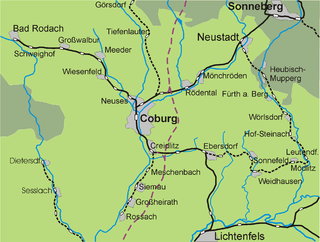
There are six railway stations in the town of Coburg in Bavaria, southern Germany. These include: two passenger stations, three halts and one goods station.
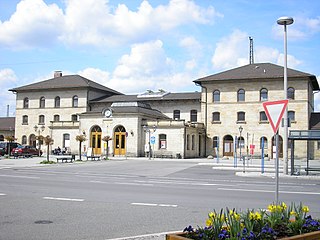
Lichtenfels station is in the town of Lichtenfels in Upper Franconia in the German state of Bavaria. It is a regional rail hub and a former ICE stop on the Hamburg–Berlin Munich route and is classified by Deutsche Bahn as a station of category 3.

The Coburg–Sonneberg railway is a single-track, electrified, 20 kilometre-long main line railway from Coburg in the German state of Bavaria via Neustadt to Sonneberg in Thuringia. It was opened in 1858 and is one of the oldest railways in Germany.

Bamberg station is the only passenger station of the city of Bamberg in Upper Franconia in the German state of Bavaria. It is a major hub station for local trains operated by Deutsche Bahn and Agilis and is also a regularly served by Intercity-Express and Intercity trains. The station is on the Nuremberg–Bamberg, Bamberg–Hof and Bamberg–Rottendorf railway lines. It has seven platform tracks and is classified by Deutsche Bahn as a category 2 station. It is the northern terminus of line S1 of the Nuremberg S-Bahn.

Landestheater Coburg is a medium-sized three-division theatre in Coburg, Bavaria, Germany. Located on Schlossplatz, a central square, the Neoclassical building has 550 seats. In 2008, the theatre employed 250 permanent staff and 100 part-time employees.

The Veste Coburg is one of the most well-preserved medieval fortresses of Germany. It is situated on a hill above the town of Coburg, in the Upper Franconia region of Bavaria.
Freising station is located in the town of Freising in the German state of Bavaria. It is located a few hundred metres to the south of the Domberg on the southern edge of the old town.
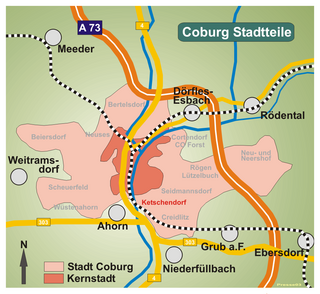
Ketschendorf is a southern suburb of the city of Coburg in the county of Upper Franconia, in the state of Bavaria in Germany.

The Free State of Coburg emerged from the Duchy of Saxe-Coburg and Gotha at the end of the First World War. It existed from November 1918 until its union with the Free State of Bavaria on 1 July 1920.
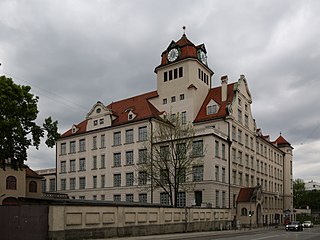
Boschetsrieder Straße is an inner city street in the Munich districts of Thalkirchen, Obersendling and Forstenried/Am Waldfriedhof, which runs west from Bundesstraße 11 on the Isar hillside to Kreuzhof, where it continues as the Fürstenrieder Straße.