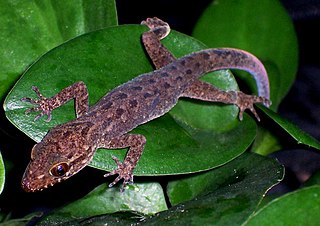
Cyrtodactylus is a diverse genus of Asian geckos, commonly known as bent-toed geckos, bow-fingered geckos, and forest geckos. The genus has at least 300 described species as of 2020, which makes it the largest of all gecko genera.

Gekkoninae is a diverse subfamily of the family Gekkonidae, geckos. It has the most species and genera — over 850 species in 30 genera. Hemidactylus and Cyrtodactylus together account for 185 species.

Agustín Sumuroy(better known as Juan Sumuroy) was a Filipino hero and Waray leader of the Sumuroy Rebellion, a rebellion of native Filipinos against colonial Spanish forces that occurred in eastern Visayas in 1649-1650.

Cyrtodactylus adleri is a species of bent-toed gecko, a lizard in the family Gekkonidae. The species is native to southern Asia.

Cyrtodactylus collegalensis, also known as the Kollegal ground gecko or forest spotted gecko, is a species of gecko found in and around Mysore hills, at the junction of the Western Ghats and the Eastern Ghats, in South India. Recent taxonomic works and genetic studies revealed that the formerly-supposed genus is actually a subgenus of the widespread genus Cyrtodactylus. It is often confused with the forest spotted gecko.

Cyrtodactylus brevidactylus is a nocturnal and terrestrial species of gecko that is found in Myanmar. It is an insectivore and eats most insects and arthropods that it comes across.

Doi Inthanon National Park, nicknamed "the roof of Thailand", is in the Thanon Thong Chai Range, Chom Thong District, Chiang Mai Province, northern Thailand. It includes Doi Inthanon, the country's highest mountain. It contains an area of 482 square kilometres (186 sq mi) in size. It was established in October 2, 1972.

Cyrtodactylus philippinicus, commonly known as the Philippine bent-toed gecko or Philippine bow-fingered gecko, is a species of gecko in family Gekkonidae.
Thirakhupt's bent-toed gecko is a species of gecko, a lizard in the family Gekkonidae. The species is endemic to Thailand.
National Highway 217 commonly referred to as NH 217, is a national highway in India. This route was earlier part of old national highways 51 and 62. It is a secondary route of National Highway 17. NH-217 runs through the states of Assam and Meghalaya in India.

Cyrtodactylus annandalei is a species of bent-toed gecko, a lizard in the family Gekkonidae. The species is endemic to Myanmar.
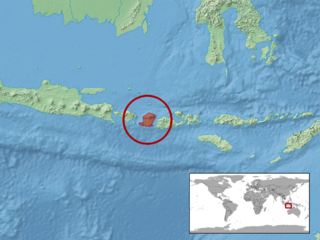
Cyrtodactylus gordongekkoi is a species of gecko, a lizard in the family Gekkonidae. The species is endemic to Lombok in Indonesia.
The Sabah bow-fingered gecko, also known commonly as Inger's bow-fingered gecko, is a species of lizard in the family Gekkonidae. The species is endemic to Sabah in Malaysia.
Jarujin's forest gecko is a species of lizard in the family Gekkonidae. The species is endemic to Southeast Asia.
Cyrtodactylus nuaulu is a species of gecko, a lizard in the family Gekkonidae. The species is endemic to Indonesia.
The farmer's bent-toed gecko is a species of lizard in the family Gekkonidae. The species is endemic to Java.
Rosichonariefi's bent-toed gecko is a species of lizard in the family Gekkonidae. The species is endemic to the island of Natuna Besar in Indonesia.
Cyrtodactylus slowinskii, known commonly as Slowinski's gecko, is a species of lizard in the family Gekkonidae. The species is endemic to Myanmar.
Cyrtodactylus zhaoermii is a species of gecko, a lizard in the family Gekkonidae. The species is endemic to the Tibet Autonomous Region of China.
Jarak Island, also known as Pulau Jarak, is an island in the straits of Malacca. It is administrated as part of Perak, Malaysia. The island is granitic, heavily forested, and has a rocky shoreline. Jarak has been described as being 8 hectares in size.
