Danish campaigns to Novgorod

Last updated

The Danish campaigns to Novgorod were a series of Crusader raids in 1241 by Danish royals and vassals, using the Duchy of Estonia as base of operation, against the Novgorod Republic. The Danish Crusades were supported and executed in coordination with the papacy and other Crusading states, notably Sweden and the Livonian Order, the former one not being able to send further support after being defeated at the Neva. [ citation needed ]

Contents

Background

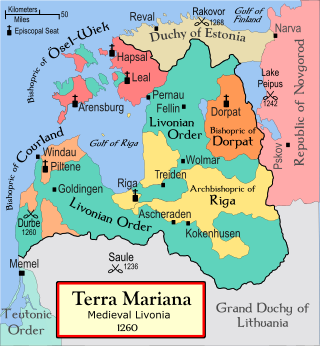
In 1227, the Livonian Brothers of the Sword took advantage of a weakened Denmark and seized the control in the Duchy of Estonia.[ citation needed ] Danish king Valdemar II tried to get it back by appealing to the Roman Curia, which was very slow to respond. It wasn't until February 1236 that the pope decided in favour of Denmark, but the Sword Brothers would not yield until they themselves were weakened by the 1236 Battle of Saule, and compelled to merge with the Teutonic Order as the Livonian Order. The 1238 Treaty of Stensby eventually returned all of Estonia (except Järva) to Denmark. Additionally, the king of Denmark would receive two-thirds of all future lands conquered from the pagans in the region, while the Brothers received one third. [1]

By 1240,[ citation needed ] Denmark under Valdemar II the Victorious, Sweden under Birger Jarl and the Livonian Order, were all in for a crusade. [2] [ page needed ] According to Rus' sources only, a Swedish fleet was defeated by Novgorodians in the Battle of the Neva in the summer of 1240. [3] [ page needed ]

Izborsk and Pskov campaign (1240)

1240 Izborsk and Pskov campaign
Datelate 1240
Location
Pskov Land (present-day Pskov Oblast)
Result

Temporary Livonian victory

  • Pro-Suzdalian faction overthrown [4]
  • Yaroslav Vladimirovich became Prince of Pskov, sharing power with City of Pskov, Bishopric of Dorpat and Teutonic Order, involving a complex temporary division of lands (late 1240–early 1242) [5] [6]
Belligerents
Simvol gospodarstva Pskovskogo.png City of Pskov
Commanders and leaders
Biskupstwo Dorpatu COA.svg Hermann of Dorpat
Yaroslav Vladimirovich
Seal of Alexander Nevsky 1236 Avers.svg Gavrilo Gorislavich   Simvol gospodarstva Pskovskogo.png Tverdilo Ivankovich

After northern Estonia was restored to the Danish king (1238), the Livonian Rhymed Chronicle (LRC) narrates that bishop Hermann of Dorpat was attacked by the Rus', who reportedly "had done him much harm". [4] He requested aid from the Teutonic Knights, as well as some of "the [Danish] king's men". [4] The Novgorod First Chronicle (NPL) reports that, after the Battle of the Neva (dated to July 1240), "the Nemtsy ("Germans") with the men of Medvezhya [Golova] (Odenpäh / Otepää), of Yurev (Dorpat / Tartu), and of Velyad (Fellin / Viljandi) with Knyaz Yaroslav Volodimirich took Izborsk." [7] [8] It is unknown who exactly led the Izborsk campaign; although the LRC associates the operation with Hermann Balk, he had already fled to Germany in 1238 and died in March 1239/1240. [9] He was succeeded by Dietrich von Grüningen and Andreas von Felben, but whether they personally participated in the campaign against Izborsk and Pskov, or the later battle of Lake Peipus, is unknown. [9] The army was allied with Yaroslav Vladimirovich of Pskov  [ ru; be ], son of the former prince of Pskov, who was in exile amongst the Livonians. [10] [11] The campaign intended to secure Pskov for Yaroslav and the Catholic Church and their first target was the Pskovian fortress of Izborsk. [10] [12] [4] The Livonian army with Yaroslav's troops took the fortress. [8] A 600-man force from Pskov continuously tried to recapture the fort, yet was defeated by the Livonian army. The Livonian Rhymed Chronicle recalls the event; [10]

"Those from Pskov [Plezcowe] were unhappy about the news [of Izborsk's capture]. This is the name of a neighboring town in Rus' [in Rûʒen lant] whose inhabitants were extremely evil. None of them stayed behind but rather all participated in the expedition and grimly stormed [toward Isborg], with many bright cuirasses and helmets shining like glass. There were many crossbowmen among them. When they came upon the [Teutonic] Brothers' army they attacked, and the Brothers and the [Danish] king's men boldly charged towards them. The Germans [dûtschen] hacked great wounds and the Rus' [Rûʒen] suffered terribly. Eight hundred of them fell on the battlefield, which was near Isborg [Îsburc]. The others took to flight and were pursued relentlessly...."

Livonian Rhymed Chronicle , verses 2099–2130 [13] [14] [10]

The Livonian army then marched on Pskov, which was left defenceless. [10] The Livonians camped outside of Pskov for a week, burning villages and Orthodox monasteries, including their books and icons. [10] With a reduced defence and a defeat at Izborsk, the mayor of Pskov, Tverdilo Ivankovich, opened the city gates and surrendered the city to the Livonians and Yaroslav Vladimirovich. [10] [12] [15] [11]

The political faction in Pskov supporting Aleksandr Yaroslavich was overthrown. [4] Yaroslav Vladimirovich, who may well have been Gêrpolt mentioned in the LRC, [16] as well as Prince Ghereslawus in a 1248 charter, [17] finally seems to have assumed the throne of Pskov of his late father, although his real authority likely remained dependent on mayor Tverdilo Ivankovich, as well as the Bishopric of Dorpat and the Order. [17] They would jointly control Pskov for the next two years until a force of Novgorodians commanded by Aleksandr Yaroslavich recaptured the city in spring 1242. [6]

It is unknown what happened to Yaroslav afterwards; he is last mentioned in historical sources in 1245, [6] and presumably died before 1248. [18] The 1248 charter claims that Prince Ghereslawus had donated his possession of Pskov to the Bishopric of Dorpat, and in 1248, the Bishopric ceded the rights of half the fiefs in the principality of Pskov to the Teutonic Order. [17] Similarly, the LRC narrates that Prince Gêrpolt donated the city and land of Pskov to the Teutonic Order in 1239/1240, [6] [a] and later comments that "many knights and squires / deserved their right to a fief" during the siege of Pskov. [8] Finally, while Yaroslav treated Pskov as a hereditary possession that he could pass on within his family or donate to whom he pleased, the Pskovian citizens sought to either make or keep the prince of Pskov an elective office (similar to the prince of Novgorod in the Novgorod Republic), in service of the people rather than vice versa. [6] [18] It is thus unlikely that the Pskovian veche would have accepted Yaroslav "donating" the Pskov Land to the Bishopric of Dorpat, let alone the cession of half of Pskov to the Teutonic Order in 1248. [6] [18] This suggests a complex division of powers and interests after the allies thus captured Izborsk and Pskov from the forces aligned with the Suzdalian dynasty, and when they lost it again two years later. [17] [6]

Votia campaign (1240–1241)

1240–1241 Votia campaign
Datewinter 1240/41 – late 1241
Location
Votia (situated in the western parts of present-day Leningrad Oblast)
Result

Novgorodian victory

Belligerents

Herb diecezji Ozylii.svg Bishopric of Ösel–Wiek

Local Votian leaders [20]
Commanders and leaders
Herb diecezji Ozylii.svg Henry of Ösel Seal of Alexander Nevsky 1236 Avers.svg Aleksandr Yaroslavich of Suzdal (late 1241 [19] )

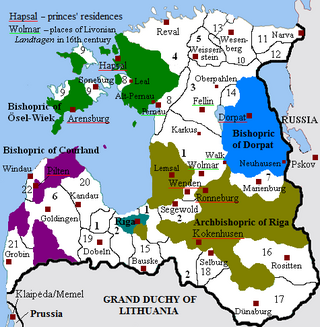
A force consisting of Germans and Estonians moved into Votia in the winter of 1240–1241. [19] [21] [ page needed ] The city of Koporye was occupied and a stone castle was erected to secure the territory. [10] [12] [22]

Further to the south, the villages of Tesov and Sablia were also captured, which only lay 30 versts (roughly 30 km) from Veliky Novgorod. [10] It is reported in the Novgorod First Chronicle that the Votians suffered greatly from the campaign. [22] [21] [ page needed ]

The primary motive seems to have been that the Livonian Order regarded Votia as a pagan territory to be conquered and converted, unlike Novgorod, which they appeared to have no military or religious designs against. [23] Nevertheless, the move was probably also done in order to cut off Novgorodian access to the southern side of the Gulf of Finland, which would severely impact its foreign trade. [11] [24] The 1241 treaty between bishop Henry of Ösel-Wiek and the Teutonic Order established legal and economic regulations in the newly acquired area, and mentions that campaign participants were given fiefdoms and other benefits in Votia. [25]

According to Fonnesberg-Schmidt (2007), "Votia, the lands north-east of Lake Peipus" (...) "were tributary to Novgorod". [26] On the other hand, Selart (2015) stated that "it is not clear how secure Novgorod's control was in Votia at the time (...) There are a number of references to Votia's dependence on Novgorod from the second half of the 13th century. It is nevertheless unknown how much of Votia fell within this dependency c. 1240." [27]

There is no indication that Denmark was involved with this campaign. [b] Moreover, on 28 March 1241, king Valdemar II died, [24] causing a succession crisis in Denmark between his sons Eric and Abel over the question of who should succeed Valdemar. [28] This situation made it impossible for the Danes to launch any kind of crusade in Estonia, let alone beyond Estonia. [c] In theory, it is possible that some nominal vassals of Valdemar II took part in the Votia campaign, such as Dietrich von Kivel and Otto von Lüneburg, as they appeared to have interests around Koporye later, perhaps stemming from enfeoffments made to campaign participants during the brief takeover of Votia; but those would have been conducted under the authority of the Bishopric of Ösel–Wiek and the Teutonic Order, not the Danish king. [25]

In late 1241, Aleksandr Yaroslavich of Suzdal returned to Novgorod, leading an army into Votia that defeated the Livonian troops, taking some captive while releasing others. [19] The NPL tells that Aleksandr supposedly hanged "the Votian and Chud' traitors". [19] The following year, 1242, the NPL narrates that "German" envoys travelled to Novgorod (when Aleksandr was absent), agreeing to withdraw from "the land of the Vod people, of Luga, Pleskov, and Lotygola". [19] [29]

Aftermath

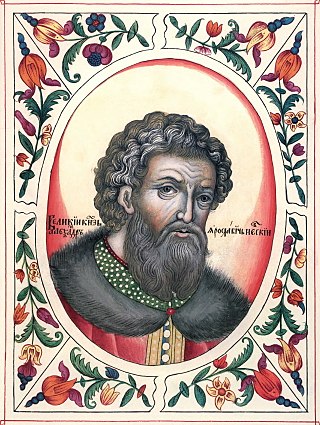
It had become clear to Novgorod, that the Crusaders (besides trade) were also interested in conquering new territories. [10] As a response to the fall of Pskov, Alexander Nevsky reassumed power. [30] The newly arrived prince took the Novgorodian city militia and set out for the occupied Votians, and retook the Crusader castle of Koporye. [10] [31] [11] Danish and German prisoners from the fortress were sent to Novgorod. [10] Nevsky, along with his brother, Prince Andrey of Suzdal, now appeared outside of the Crusader occupied Pskov and quickly stormed the city. The Novgorodians then crossed the Velikaya and began burning and pillaging the Crusader territory. [10] [ page needed ] In response, the Crusaders raised an army in Livonia and Estonia, under Hermann von Buxhoevden, and met the Russians at the Battle on the Ice. [30] [11]

See also

Notes

  1. "that Gêrpolt who was their prince / gave with his good will / the castle and the good lands / into the hands of the Teutonic Knights". [18]
  2. "The Votia campaign is consistent with the continual conquest of pagan lands provided for in the Treaty of Stensby. Commercial considerations may also have played a part in this respect. According to the Treaty of Stensby, however, Denmark too should have taken part in these events, yet there is no evidence of this in the sources." [24]
  3. By 1244, Eric and Abel had reconciled and marched as far as Ystad, only to abandon the crusade before it had even seen battle, possibly due to ongoing conflict between the two royal brothers. [28]

Related Research Articles

<span class="mw-page-title-main">Livonia</span> Historical region on the eastern shores of the Baltic Sea

Livonia, known in earlier records as Livland, is a historical region on the eastern shores of the Baltic Sea. It is named after the Livonians, who lived on the shores of present-day Latvia.

<span class="mw-page-title-main">Northern Crusades</span> 12th/13th century crusades around the Baltic Sea

The Northern Crusades or Baltic Crusades were Christianization campaigns undertaken by Catholic Christian military orders and kingdoms, primarily against the pagan Baltic, Finnic and West Slavic peoples around the southern and eastern shores of the Baltic Sea.

<span class="mw-page-title-main">Alexander Nevsky</span> Grand Prince of Vladimir from 1252 to 1263

Alexander Yaroslavich Nevsky was Prince of Novgorod, Grand Prince of Kiev (1246–1263) and Grand Prince of Vladimir (1252–1263).

<span class="mw-page-title-main">Saare County</span> County of Estonia

Saare County is one of 15 counties of Estonia. It consists of Saaremaa, the largest island of Estonia, and several smaller islands near it, most notably Muhu, Ruhnu, Abruka and Vilsandi. The county borders Lääne County to the east, Hiiu County to the north, and Latvia to the south. In 2022, Saare County had a population of 31,292, which was 2.4% of the population of Estonia.

<span class="mw-page-title-main">Novgorod Republic</span> Russian city-state (1136–1478)

The Novgorod Republic was a medieval state that existed from the 12th to 15th centuries in northern Russia, stretching from the Gulf of Finland in the west to the northern Ural Mountains in the east. Its capital was the city of Novgorod. The republic prospered as the easternmost trading post of the Hanseatic League, and its people were much influenced by the culture of the Byzantines, with the Novgorod school of icon painting producing many fine works.

<span class="mw-page-title-main">Battle on the Ice</span> 1242 battle of the Northern Crusades on the frozen Lake Peipus

The Battle on the Ice, also known as the Battle of Lake Peipus or Battle of Lake Chud, took place on 5 April 1242. It was fought on or near the frozen Lake Peipus when the united forces of the Republic of Novgorod and Vladimir-Suzdal, led by Prince Alexander Nevsky, emerged victorious against the forces of the Livonian Order and Bishopric of Dorpat, led by Bishop Hermann of Dorpat.

Ugaunians or Ugannians, referred to as Chudes by the earliest Russian chronicles, were a historic Finnic people inhabiting the southern Estonian Ugandi County that is now Tartu, Põlva, Võru and Valga counties of Estonia.

<span class="mw-page-title-main">Ugandi County</span> Ancient county of Estonia

Ugandi was an independent county between the east coast of Lake Võrtsjärv and west coast of Lake Pskov, bordered by Vaiga, Mõhu, Nurmekund, Sakala, Tālava, and The Principality of Pskov. Ugandi had an area of approximately 3000 hides. Ugandi corresponded roughly to the present Estonia's territory of Võru County, Põlva County and half of Tartu County and Valga County, as well as Petseri County.

<span class="mw-page-title-main">Duchy of Estonia (1219–1346)</span> Former Danish possession in Baltics

The Duchy of Estonia, also known as Danish Estonia, was a direct dominion of the King of Denmark from 1219 until 1346 when it was sold to the Teutonic Order and became part of the Ordensstaat.

<span class="mw-page-title-main">Daumantas of Pskov</span> Prince of Pskov from 1266 to 1299

Daumantas, Domantas or Dovmont was Prince of Pskov from 1266 to 1299. During his term in office, Pskov became de facto independent from Novgorod.

<span class="mw-page-title-main">Battle of Wesenberg (1268)</span> Part of the Northern Crusades

The Battle of Wesenberg, Rakvere or Rakovor was fought on 18 February 1268 between the combined forces of Danish Estonia, the Bishopric of Dorpat, the Livonian Order, and local Estonian militias on one side, and the forces of Novgorod and Pskov, led by Dmitry of Pereslavl, on the other. Medieval accounts of the battle vary with both sides claiming victory; however, the Livonian victory is seen as more plausible as Novgorodian-Pskovian forces retreated out of Danish Estonia, with Livonian Knights launching a retaliatory attack on Izborsk and Pskov soon afterward, in June 1269.

<span class="mw-page-title-main">Livonian Crusade</span> 12th–13th century Baltic Christianisation campaign

The Livonian crusade consists of the various military Christianisation campaigns in medieval Livonia – modern Latvia and Estonia – during the Papal-sanctioned Northern Crusades in the 12th–13th century. The Livonian crusade was conducted mostly by the Holy Roman Empire and the Kingdom of Denmark. It ended with the creation of Terra Mariana and the Danish duchy of Estonia. The lands on the eastern shores of the Baltic Sea were one of the last parts of Europe to be Christianised. The available information is largely based on Livonian Chronicle of Henry.

Hermann of Dorpat, also known as Hermann I or Hermann von Buxhövden (1163–1248), was the first Prince-Bishop of the Bishopric of Dorpat (1224–1248) within the Livonian Confederation.

Otto von Lutterberg was the Landmeister of the Livonian Order of the Teutonic Knights from 1267 to 1270.

The Pskov Land was a historical region in the north-west of medieval Russia centred around the city of Pskov. It was a vassal state of various Rus' states and had a measure of independence as Pskov Republic before being annexed by the Grand Duchy of Moscow. It had an important role in the trade and conflicts between Russia and its western neighbours.

<span class="mw-page-title-main">Novgorod Land</span> Historic region of Russia

Novgorodian Land was one of the largest historical territorial–state formations in Russia, covering its northwest and north. Novgorod Land, centered in Veliky Novgorod, was in the cradle of Kievan Rus' under the rule of the Rurikid dynasty and one of the most important princely thrones of the era. During the collapse of Kievan Rus' and in subsequent centuries, Novgorod Land developed as the Novgorod Republic: an autonomous state with republican forms of government under the suzerainty of the great princes of Vladimir-Suzdal. During the period of greatest development, it reached north to the White Sea, and in the east it has been claimed that it did spread beyond the Ural Mountains. It had extensive trade relations within the framework of the Hanseatic League and with the rest of Rus'. The Principality of Moscow conquered the Novgorod Republic in 1478, and annexed it in 1578, although Novgorod Land continued to exist as an administrative unit until 1708.

<span class="mw-page-title-main">Terra Mariana</span> Vassal state of the Holy See

Terra Mariana was the formal name for Medieval Livonia or Old Livonia. It was formed in the aftermath of the Livonian Crusade, and its territories were composed of present-day Estonia and Latvia. It was established on 2 February 1207, as a principality of the Holy Roman Empire, and lost this status in 1215 when Pope Innocent III proclaimed it as directly subject to the Holy See.

The Livonian campaign to Novgorod was a military campaign that lasted from 1240 to 1242, and was carried out by the Teutonic Knights of the Livonian Order with the aim to conquer the lands of Pskov and Novgorod and convert them to Catholicism.

<span class="mw-page-title-main">Treaty of Stensby</span> 1238 treaty between Denmark and the Teutonic Order

The Treaty of Stensby was an agreement between king Valdemar II of Denmark and the Teutonic Order, signed on 7 June 1238 in Stensby on the island of Zealand in Denmark, and confirmed by Innocent IV in September 1243. The arrangement transferred northern maritime Estonia to the Kingdom of Denmark in exchange for military support.

References

  1. Selart 2015, p. 142.
  2. Fonnesberg-Schmidt 2007.
  3. Lind, John H. (1991). "Early Russian-Swedish Rivalry: The battle on the Neva in 1240 and Birger Magnussons' second crusade to Tavastia". Scandinavian Journal of History. 16 (4): 269. doi:10.1080/03468759108579222. ISSN   0346-8755 . Retrieved 18 July 2022.
  4. 1 2 3 4 5 Selart 2015, p. 159.
  5. Selart 2015, pp. 165–166.
  6. 1 2 3 4 5 6 7 Mänd & Tamm 2020, p. 96.
  7. Michell & Forbes 1914, p. 85.
  8. 1 2 3 Selart 2015, p. 160.
  9. 1 2 Selart 2015, p. 163.
  10. 1 2 3 4 5 6 7 8 9 10 11 12 13 Basilevsky, Alexander (2016). Early Ukraine: A Military and Social History to the Mid-19th Century. McFarland. p. 161.
  11. 1 2 3 4 5 Nicholle, David. Lake Peipus 1242; Battle of the Ice.
  12. 1 2 3 Martin 2007, pp. 175–219.
  13. Meyer 1876, p. 49.
  14. Smith & Urban 1977, p. 30.
  15. Sichynsky, V. (1953). Volodymyr Sichynskyi. p. 141.
  16. Selart 2015, p. 162.
  17. 1 2 3 4 Selart 2015, p. 165.
  18. 1 2 3 4 Selart 2015, p. 166.
  19. 1 2 3 4 5 6 7 8 9 Selart 2015, p. 154.
  20. 1 2 3 Selart 2015, pp. 154–155.
  21. 1 2 Lind, John (2004). Danske korstog (in Danish). København: Høst & Søn. ISBN   978-87-14-29712-1.
  22. 1 2 Selart 2015, pp. 154–156.
  23. Selart 2015, pp. 156–157.
  24. 1 2 3 Selart 2015, p. 157.
  25. 1 2 Selart 2015, p. 158.
  26. Fonnesberg-Schmidt 2007, p. 18.
  27. Selart 2015, p. 156.
  28. 1 2 Selart 2015, p. 169.
  29. Michell & Forbes 1914, p. 87.
  30. 1 2 Hellie, Richard (2006). "Alexander Nevskii's April 5, 1242 Battle on the Ice". Russian History. 33 (2/4): 284. doi:10.1163/187633106X00177. JSTOR   24664445 via JSTOR.
  31. Murray, Alan V. (5 July 2017). Crusade and Conversion on the Baltic Frontier 1150–1500. Taylor & Francis. ISBN   978-1-351-94715-2.

Bibliography

Primary sources

Literature