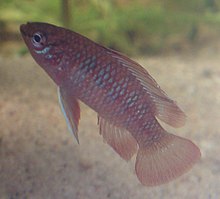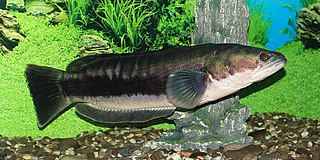
Channa is a genus of predatory fish in the family Channidae, commonly known as snakehead, native to freshwater habitats in Asia. This genus contains more than 45 scientifically described species. The genus has a wide natural distribution extending from Iraq in the west, to Indonesia and China in the east, and parts of Siberia in the Far East. A particularly high richness exists in Myanmar (Burma) and northeastern India, and many Channa species live nowhere else. In contrast, a few widespread species have been introduced to several regions outside their natural range where they often become invasive. The large and medium-sized Channa species are among the most common staple food fish in several Asian countries and they are extensively cultured. Apart from their importance as a food fish, snakeheads are consumed in some regions as a traditional medicine for wound healing and reducing post-operative pain and discomfort, and collected for the international aquarium pet trade.

Pangio is a genus of freshwater fish in the loach family (Cobitidae). In earlier taxonomic schemes it was known as Acanthophthalmus. It is best known for the "kuhli loach", which is often kept by aquarists.

Crenicichla is a genus of cichlids native to South America commonly known as the pike cichlids. They are found in most tropical and subtropical freshwater habitats between the Andes and the Atlantic.
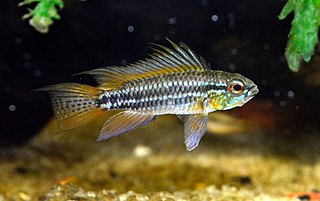
Apistogramma is a genus of fish in the family Cichlidae found in South America. They are relatively small and belong among the dwarf cichlids. Most species are strongly sexually dimorphic, with males generally larger and differently coloured to females. In a few species this pattern is reverse. All species are micropredators. Their main prey items consist of fry of other fish, insect larvae and other invertebrates. Brood care is highly developed, as in most cichlids. Nearly all species spawn in caves, typically under rocks or in holes in sunken logs or branches. In three of the described species, A. barlowi, A. megastoma, and A. pantalone, both females and males are mouthbrooding. A number of breeding strategies exist. Some species breed in polygamous harems, while other species form monogamous pairs. In most cases, regardless of the breeding strategy, the female is more highly involved with brood care, whilst the male defends a territory from predators. The sex of the fry is affected by the water conditions, with warmer and more acid water favoring more males.

Aequidens is a genus of fish in the family Cichlidae found in South America. Formerly a wastebasket genus, as presently defined Aequidens is largely restricted to the Amazon Basin, Orinoco Basin and river basins in The Guianas. The only exceptions are A. plagiozonatus which also occurs in the Paraná Basin, and A. tetramerus which also occurs in the Parnaíba River.

Geophagus is a genus of cichlids that mainly live in South America as far south as Argentina and Uruguay, but a single species, G. crassilabris is from Panama. They are found in a wide range of freshwater habitats. They are part of a group popularly known as eartheaters and mostly feed by picking up mouthfuls of sand to sift out food items such as invertebrates, plant material and detritus. The largest species reach up to 28 cm (11 in) in standard length. They are often kept in aquariums.
The black-barred danio is a species of Danio discovered in Myanmar by Tin Win in 2005 and described in 2015 by Sven Oscar Kullander and Ralf Britz.

Danio is a genus of small freshwater fish in the family Cyprinidae found in South and Southeast Asia, commonly kept in aquaria. They are generally characterised by a pattern of horizontal stripes, rows of spots or vertical bars. Some species have two pairs of long barbels. Species of this genus consume various small aquatic insects, crustaceans and worms.
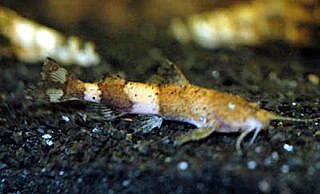
Pseudolaguvia is a genus of South Asian river catfishes. These species inhabit hill streams and large rivers. P. tenebricosa is found in fast running, clear water; the river has a sandy bottom and numerous rocks and boulders and aquatic vegetation is absent. P. inornata is from clear, shallow, moderately flowing streams with a predominantly sandy bottom. P. muricata is found in clear, shallow, slow-flowing streams with a mixed substrate of sand and detritus; these fish are found amongst detritus in areas with current. P. ferula is also found in swift flowing waters with a mixed rocky/sandy bottom.

Glyptothorax is a genus of catfishes order Siluriformes of the family Sisoridae. It is the most species-rich and widely distributed genus in the family with new species being discovered on a regular basis. These species are distributed in the Black Sea basin, northern Turkey, south and east to the Yangtze River drainage in China and south throughout Indo-China to Java, Indonesia. They are found in Asia Minor and southwards to Southeast Asia. The genus is very diverse in the Indian subcontinent. Southeast Asian species tend to have restricted distributions.

Teleocichla is a genus of fish in the family Cichlidae found in the Tapajós, Xingu, Tocantins and Jari River basins, which are part of the Amazon River Basin in Brazil. All species are rheophilic, and highly elongated in shape. They generally are smaller than 9 cm (3.5 in) in length, making them some of the smallest cichlids of the Americas. Only T. preta can grow larger, reaching about 12 cm (4.7 in). Since restricted to areas with fast currents, they are particularly vulnerable to the building of dams, and the Belo Monte Dam may cause the extinction of T. centisquama. Other species recognized as threatened by Brazil's Ministry of the Environment are T. cinderella, T. prionogenys and T. wajapi.
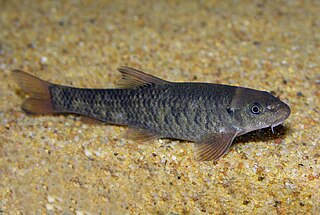
Garra is a genus of fish in the family Cyprinidae. These fish are one example of the "log suckers", sucker-mouthed barbs and other cyprinids commonly kept in aquaria to keep down algae. The doctor fish of Anatolia and the Middle East belongs in this genus. The majority of the more than 140 species of garras are native to Asia, but about one-fifth of the species are from Africa.

Monopterus is a genus of swamp eels mainly native to Asia, but with two species in Africa. They live in various freshwater habitats and some have a fossorial lifestyle. Three species, M. eapeni, M. digressus and M. roseni, live in underground waters.

Psilorhynchus is a genus of fish in the family Psilorhynchidae native to South Asia. This genus is the only member of its family. The members of Psilorhynchus are small benthic fishes which occur in rivers and streams with fast to swift currents, hence they are often referred to a torrent minnows. They are distributed in southern Asia, in the Indo-Burma region and the Western Ghats. The genus is the sister group to the family Cyprinidae, and with that family the Psilorhynchidae makes up the superfamily Cyprinoidea, with all the other cypriniform families in the superfamily Cobitoidea.
The Garo spineless eel, Garo khajuriai, is a species of earthworm eel endemic to India. It belongs to the monotypic genus Garo. It is demersal and lives in fresh water

Pethia is a genus of small freshwater fish in the family Cyprinidae native to South Asia, East Asia(only Pethia stoliczkana recorded)and Mainland Southeast Asia. Some species are commonly seen in the aquarium trade. The name Pethia is derived from the Sinhalese "pethia", a generic word used to describe any of several small species of cyprinid fishes. Members of this genus were formerly included in Puntius.

Badis is a genus of fish in the family Badidae found in South Asia, Southeast Asia and China. These species have a sharp spine on the opercle, soft and spinous parts of the dorsal fin contiguous, three spines in the anal fin, tubed pores in the lateral line, villiform teeth and a rounded caudal fin. In addition, they differ from the related genus Dario by being larger and displaying more involved parental care.

Badis khwae is a species of freshwater fish native to Thailand.

Pristolepis is a genus of fish in the family Pristolepididae native to freshwater habitats in Southeast Asia and India's Western Ghats. This genus is the only member of its family, but the common name "leaffish" is shared with the families Nandidae and Polycentridae.

The Anabantiformes are an order of freshwater ray-finned fish with seven families and having at least 252 species. This group of fish are found in Asia and Africa, with some species introduced in United States of America.