
The Supreme Court of Canada is the highest court of Canada, the final court of appeals in the Canadian justice system. The court grants permission to between 40 and 75 litigants each year to appeal decisions rendered by provincial, territorial and federal appellate courts. Its decisions are the ultimate application of Canadian law and binding upon all lower courts of Canada, except to the extent that they are overridden or otherwise made ineffective by federal or provincial legislation.
Canadian federalism involves the current nature and historical development of the federal system in Canada.

Same-sex marriage in Canada was progressively introduced in several provinces by court decisions beginning in 2003 before being legally recognized nationwide with the enactment of the Civil Marriage Act on July 20, 2005. On June 10, 2003, the Court of Appeal for Ontario issued a decision immediately legalizing same-sex marriage in Ontario, thereby becoming the first province where it was legal. The introduction of a federal gender-neutral marriage definition made Canada the fourth country in the world, and the first country outside Europe, to legally recognize same-sex marriage throughout its borders. Before the federal recognition of same-sex marriage, court decisions had already introduced it in eight out of ten provinces and one of three territories, whose residents collectively made up about 90% of Canada's population. More than 3,000 same-sex couples had already married in those areas before the Civil Marriage Act was passed. Most legal benefits commonly associated with marriage had been extended to cohabiting same-sex couples since 1999.
The legal system of Canada is pluralist: its foundations lie in the English common law system, the French civil law system and Indigenous law systems. The Constitution of Canada and Canadian Aboriginal law provide the framework within which the systems interact and operate.
In common law systems, a superior court is a court of general competence which typically has unlimited jurisdiction with regard to civil and criminal legal cases. A superior court is "superior" in relation to a court with limited jurisdiction, which is restricted to civil cases involving monetary amounts with a specific limit, or criminal cases involving offenses of a less serious nature. A superior court may hear appeals from lower courts. The highest of the superior courts is the Supreme court.

The Constitution Act, 1867 is a major part of the Constitution of Canada. The Act created a federal dominion and defines much of the operation of the Government of Canada, including its federal structure, the House of Commons, the Senate, the justice system, and the taxation system. The British North America Acts, including this Act, were renamed in 1982 with the patriation of the Constitution ; however, it is still known by its original name in United Kingdom records. Amendments were also made at this time: section 92A was added, giving provinces greater control over non-renewable natural resources.
The Federal Court of Canada, which succeeded the Exchequer Court of Canada in 1971, was a national court of Canada that had limited jurisdiction to hear certain types of disputes arising under the federal government's legislative jurisdiction. Originally composed of two divisions, the Appellate Division and the Trial Division, in 2003 the Court was split into two separate Courts, the Federal Court and the Federal Court of Appeal. The jurisdiction and powers of the two courts remained largely unchanged from the predecessor divisions.
The Court of Appeal for Ontario is the appellate court for the province of Ontario, Canada. The seat of the court is Osgoode Hall in downtown Toronto, also the seat of the Law Society of Ontario and the Divisional Court of the Ontario Superior Court of Justice.
The court system of Canada forms the judicial branch of government, formally known as "The Queen on the Bench", which interprets the law and is made up of many courts differing in levels of legal superiority and separated by jurisdiction. Some of the courts are federal in nature, while others are provincial or territorial.
The Federal Court of Appeal is a Canadian appellate court that hears cases concerning federal matters.
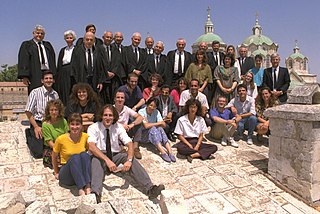
A law clerk or a judicial clerk is an individual—generally an attorney—who provides direct assistance and counsel to a judge in making legal determinations and in writing opinions by researching issues before the court. Judicial clerks often play significant roles in the formation of case law through their influence upon judges' decisions. Judicial clerks should not be confused with legal clerks, court clerks, or courtroom deputies who only provide secretarial and administrative support to attorneys and/or judges.

The Federal Court is a Canadian trial court that hears cases arising under certain areas of federal law. The Federal Court is a superior court with nationwide jurisdiction.
The Committee on Monetary and Economic Reform (COMER) is an economics-oriented publishing and education centre based in Toronto, Ontario, Canada.
Federal judges are judges appointed by a federal level of government as opposed to the state/provincial/local level.

The supreme court is the highest court within the hierarchy of courts in many legal jurisdictions. Other descriptions for such courts include court of last resort, apex court, and highcourt of appeal. Broadly speaking, the decisions of a supreme court are not subject to further review by any other court. Supreme courts typically function primarily as appellate courts, hearing appeals from decisions of lower trial courts, or from intermediate-level appellate courts.
Johanne Gauthier is a judge currently serving on the Federal Court of Appeal.
Donald J. Rennie is a justice with the Federal Court of Appeal of Canada. He is also Chairman of the Canadian Competition Tribunal. Previously, he served as a justice with the Federal Court of Canada. Prior to his appointment to the bench, he was a Justice Assistant Deputy Attorney General with the Department of Justice in Ottawa.
René Leblanc is a justice with the Federal Court of Appeal of Canada.
George R. Locke is a justice in the Federal Court of Appeal of Canada.
John B. Laskin is a justice in the Federal Court of Appeal of Canada.


