Martin Glacier is a glacier, 3 nautical miles (6 km) wide and 9 nautical miles (17 km) long, which flows west and then northwest from the south side of Mount Lupa to the southeast corner of Rymill Bay where it joins Bertrand Ice Piedmont, on the west coast of Graham Land, Antarctica. It was first surveyed in 1936 by the British Graham Land Expedition (BGLE) under John Riddoch Rymill, and was resurveyed in 1948–1949 by the Falkland Islands Dependencies Survey. The glacier was named for James H. Martin, a member of the British Australian and New Zealand Antarctic Research Expedition (1929–1931) under Sir Douglas Mawson, and first mate of the Penola during the BGLE.
Hadley Upland is a triangular shaped remnant plateau with an undulating surface, 1,500 to 1,900 metres, in southern Graham Land, Antarctica. It is bounded by Windy Valley and Martin Glacier, Gibbs Glacier and Lammers Glacier. The existence of this upland was known to the United States Antarctic Service, 1939–41, Finn Ronne and Carl R. Eklund having travelled along Lammers and Gibbs Glaciers in January 1941. The upland was surveyed by the Falkland Islands Dependencies Survey in 1948–50 and 1958, and was named by the UK Antarctic Place-Names Committee after John Hadley, an English mathematician who, at the same time as Thomas Godfrey, independently invented the quadrant, in 1730–31.

Posadowsky Glacier is a glacier about 9 nautical miles long, flowing north to Posadowsky Bay immediately east of Gaussberg. Posadowsky Bay is an open embayment, located just east of the West Ice Shelf and fronting on the Davis Sea in Kaiser Wilhelm II Land. Kaiser Wilhelm II Land is the part of East Antarctica lying between Cape Penck, at 87°43'E, and Cape Filchner, at 91°54'E, and is claimed by Australia as part of the Australian Antarctic Territory. Other notable geographic features in this area include Drygalski Island, located 45 mi NNE of Cape Filchner in the Davis Sea, and Mirny Station, a Russian scientific research station.

Apollo Glacier is a glacier, 9 nautical miles (17 km) long, flowing northeast and joining the lower part of Aphrodite Glacier 2 nautical miles (4 km) from the east coast of the Antarctic Peninsula. The lower part of this glacier was first plotted by W.L.G. Joerg, from aerial photographs taken by Sir Hubert Wilkins in December 1928 and by Lincoln Ellsworth in November 1935. The glacier was subsequently photographed by the Ronne Antarctic Research Expedition in December 1947 and roughly surveyed by the Falkland Islands Dependencies Survey in November 1960. It was named by the UK Antarctic Place-Names Committee after Apollo, the god of manly youth and beauty in Greek mythology.
Balch Glacier is a glacier 9 nautical miles (17 km) long, on the east coast of Graham Land, flowing southeast into Mill Inlet, to the south of Gould Glacier. It was first surveyed by the Falkland Islands Dependencies Survey in 1946–47, and named "East Balch Glacier". With "West Balch Glacier" it was reported to fill a transverse depression across Graham Land, but further survey in 1957 showed that there is no close topographical alignment between the two. The name "Balch", for Edwin S. Balch, an American Antarctic historian, has been limited to this glacier and an entirely new name, Drummond Glacier, approved for the west glacier.
Besnard Point is a headland which lies at the southeast side of Port Lockroy, Wiencke Island, and marks the east side of the entrance to Alice Creek, in the Palmer Archipelago. It was discovered by the French Antarctic Expedition, 1903–05, under Jean-Baptiste Charcot, and named by him for A. Besnard, seaman on the expedition ship Français.

Crystal Sound is a sound in Antarctica between the southern part of the Biscoe Islands and the coast of Graham Land, with northern limit Cape Evensen to Cape Leblond and southern limit Holdfast Point, Roux Island, Liard Island and the Sillard Islands. It was so named by the UK Antarctic Place-Names Committee in 1960 because many features in the sound are named for men who have undertaken research on the structure of ice crystals. To the north of Crystal Sound, many geographical features are named after physiologists.
Jennings Reef is a reef, mostly submerged, extending between Avian Island and the Rocca Islands, off the south end of Adelaide Island, Antarctica. It was named by the UK Antarctic Place-Names Committee for Leading Seaman Ronald A.J. Jennings, the coxswain of the survey motorboat Quest, used by the Royal Navy Hydrographic Survey Unit which charted the feature in 1963.
Knuckle Reef is a reef lying off Beacon Head, Horseshoe Island, Antarctica. The reef was so named by the UK Antarctic Place-Names Committee in 1958 because the individual rocks in the reef, which are exposed at low tide, resemble the knuckles of a clenched fist.
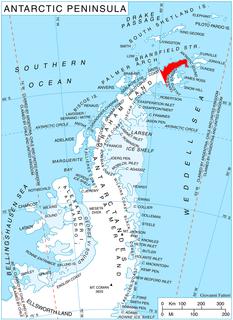
Diplock Glacier is a narrow straight glacier, 10 miles (16 km) long, flowing eastward from Detroit Plateau, on Trinity Peninsula in Graham Land, into Prince Gustav Channel 5 miles (8 km) south of Alectoria Island. It is situated south of Marla Glacier and north of Zavera Snowfield. The feature was mapped from surveys by the Falkland Islands Dependencies Survey (1960–61), and was named by the UK Antarctic Place-Names Committee for Bramah Joseph Diplock, a British engineer who made considerable advances in the design of chain-track tractors (1885–1913).
Edge Glacier is a small cliff-type glacier draining northward into Davis Valley in northeast Dufek Massif, Pensacola Mountains. It was mapped by the United States Geological Survey from surveys and U.S. Navy air photos, 1956–66, and was named by the Advisory Committee on Antarctic Names for Joseph L. Edge, a photographer with U.S. Navy Squadron VX-6 on Operation Deep Freeze 1963 and 1964.
Flanagan Glacier is a glacier in the Pioneer Heights of the Heritage Range, Antarctica, draining east from Thompson Escarpment between the Gross Hills and the Nimbus Hills to the confluent ice at the lower end of Union Glacier. It was mapped by the United States Geological Survey from surveys and U.S. Navy air photos, 1961–66, and was named by the Advisory Committee on Antarctic Names for Lieutenant Walter B. Flanagan, an assistant maintenance officer with U.S. Navy Squadron VX-6 at McMurdo Station during Operation Deep Freeze 1963 and 1964.
Mount Gevers is a rock peak, 1,480 metres (4,860 ft) high, in the Hays Mountains of the Queen Maud Mountains of Antarctica, standing at the north side of Cappellari Glacier at the point where it enters Amundsen Glacier. It was mapped by the United States Geological Survey from surveys and U.S. Navy air photos, 1960–64, and was named by the Advisory Committee on Antarctic Names for T.W. Gevers of the University of the Witwatersrand (Johannesburg), a geologist at McMurdo Station in 1964–65.
Morriss Peak is a peak, 950 metres (3,120 ft) high, at the southwest end of the Wiener Peaks, in the Ford Ranges of Marie Byrd Land, Antarctica. The peak was mapped by the United States Antarctic Service 1939–41, led by Richard E. Byrd, and by the United States Geological Survey from surveys and U.S. Navy air photos, 1959–65. The naming was proposed by Admiral Byrd for P.G.B. Morriss, manager of the Hotel Clark in Los Angeles, who provided office space and quarters for the Byrd Antarctic Expeditions of 1928–30 and 1933–35.

Mudge Passage is a marine passage running east-west from the vicinity of Prospect Point, Graham Coast, between Beer Island and Dodman Island to the north and Saffery Islands and Trump Islands to the south, to the vicinity of Extension Reef. The passage was navigated and charted by Captain C.R. Elliott in RRS John Biscoe in January 1979. Named by the United Kingdom Antarctic Place-Names Committee (UK-APC) in association with Harrison Passage and Maskelyne Passage to the northeast, after Thomas Mudge (1715–94), English horologist who made substantial improvements to marine chronometers.

Mitterling Glacier is a glacier on the east coast of Graham Land, Antarctica, draining between Mount Vartdal and Mount Hayes into the northern part of Mill Inlet. It was named by the UK Antarctic Place-Names Committee after American historian Philip I. Mitterling, the author of America in the Antarctic to 1840.
The McConnel Islands are islands lying in Darbel Bay southeast of the Kidd Islands, off the west coast of Graham Land, Antarctica. They were photographed by the Falkland Islands and Dependencies Aerial Survey Expedition, 1956–57, and were named by the UK Antarctic Place-Names Committee in 1960 for James C. McConnel (1860–1890), an English physicist who, along with Dudley Kidd, made pioneer experiments on the plastic deformation of ice, both single and polycrystals, 1881–90.
Humphreys Ice Rise is an ice rise in the Muller Ice Shelf in the southwestern part of Lallemand Fjord, Loubet Coast, Antarctica. It was photographed from the air by the Falkland Islands and Dependencies Aerial Survey Expedition, 1956–57, and surveyed by the Falkland Islands Dependencies Survey, 1956–59. In association with the names of glaciologists grouped in this area, the feature was named "Humphreys Hill" by the UK Antarctic Place-Names Committee after William J. Humphreys, an American meteorologist and specialist on the effects of ice in the atmosphere. Humphreys was joint author with W.A. Bentley of Snow Crystals, New York, 1931. It was renamed as Humphreys Ice Rise to reflect the true nature of the feature.
Snubbin Island is an island lying 2 nautical miles (3.7 km) west of Pickwick Island at the western end of the Pitt Islands, in the Biscoe Islands. Shown on an Argentine government chart of 1957. Named by the United Kingdom Antarctic Place-Names Committee (UK-APC) in 1959 after Mr. Serjeant Snubbin, a barrister in Charles Dickens' Pickwick Papers.
Relay Hills is a group of low, ice-covered hills, mainly conical in shape, between Mount Edgell and Kinnear Mountains in western Antarctic Peninsula. First roughly surveyed from the ground by British Graham Land Expedition (BGLE), 1936-37. Photographed from the air by Ronne Antarctic Research Expedition (RARE), November 1947. Resurveyed by Falkland Islands Dependencies Survey (FIDS), November 1958. The name, applied by the United Kingdom Antarctic Place-Names Committee (UK-APC), arose because both the BGLE and the FIDS sledging parties had to relay their loads through this area to the head of Prospect Glacier.