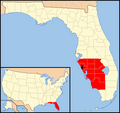
The Diocese of Venice in Florida (Latin: Dioecesis Venetiae in Florida) is a diocese of the Catholic Church in southwest Florida in the United States. It was founded on June 16, 1984. Frank Dewane has been bishop since 2007. Venice in Florida is a suffragan diocese of the metropolitan Archdiocese of Miami.
The first Catholic presence in southwest Florida was the expedition of the Spaniard Juan Ponce de León, who arrived on the Gulf Coast in 1513. Hostility from the native Calusa people prevented him from landing. De Leon returned to the region with a colonizing expedition in 1521, landing near either Charlotte Harbor or the mouth of the Caloosahatchee River. His expedition included 200 men, and several priests were among them.[2]
In 1539, Spanish explorer Hernando De Soto landed near present day Port Charlotte or San Carlos Bay. He named the new territory "La Bahia de Espiritu Santo," in honor of the Holy Spirit.[3] DeSoto led an expedition of 10 ships and 620 men. His company included 12 priests.[3] The De Soto expedition later proceeded to the Tampa Bay area and then into central Florida.
The Spanish missionary Luis de Cáncer arrived by sea with several Dominican priests in present day Bradenton in 1549. Encountering a seemingly peaceful party of Tocobaga clan members, they decided to travel on to Tampa Bay. Several of the priests went overland with the Tocobaga while Cáncer and the rest of the party sailed to Tampa Bay to meet them.[4] Arriving at Tampa Bay, Cáncer learned, while still on his ship, that the Tocobaga had murdered the priests in the overland party. Ignoring advice to leave the area, Cáncer went ashore, where he too was murdered.[4] The Spanish attempted to establish another mission in the Tampa Bay area in 1567, but it was soon abandoned.[5]
In 1565, the Spanish explorer Pedro Menéndez de Avilés, the founder of Saint Augustine and Governor of Spanish Florida, brokered a peace agreement with the Calusa peoples. This agreement allowed him to build the San Antón de Carlos mission at Mound Key in what is now Lee County. Menéndez de Avilés also built a fort at Mound Key and established a garrison. San Antón de Carlos was the first Jesuit mission in the Western Hemisphere and the first Catholic presence within the Venice area. Juan Rogel and Francisco de Villareal spent the winter at the mission studying the Calusa language, then started evangelizing among the Calusa in southern Florida. The Jesuits built a chapel at the mission in 1567. Conflicts with the Calusa soon increased, prompting Menéndez de Avilés to abandon San Antón de Carlos in 1569.[6]
Further development
After the end of the French and Indian War in 1763, Spain ceded all of Florida to Great Britain for the return of Cuba. Given the antagonism of Protestant Great Britain to Catholicism, the majority of the Catholic population in Florida fled to Cuba.[7] After the American Revolution, Spain regained control of Florida in 1784.[8] In 1793, the Vatican changed the jurisdiction for Florida Catholics from Havana to the Apostolic Vicariate of Louisiana and the Two Floridas, based in New Orleans.[9] In the Adams–Onís Treaty of 1819, Spain ceded all of Florida to the United States, which established the Florida Territory in 1821.[10]
In 1825, the Vicariate of Alabama and Florida was erected; it included all of Florida, based in Mobile, Alabama.[11]In 1858, Pius IX moved Florida into a new Apostolic Vicariate of Florida,[12] which in 1870 was converted into the Diocese of St. Augustine, which included the Venice area.[13]
After the end of the American Civil War in 1865, Catholic missionaries from dioceses in Savannah, St. Augustine, and Tampa, began visiting the Venice area.[14] In 1889, the Venice area was placed under the jurisdiction of the Jesuit Order in Tampa, with Bishop John Moore requesting that the Jesuits cover Hillsborough County southward to Key West.[14][15] Jesuit priests made regular visits to Bradenton, Fort Myers, Arcadia, and adjacent missions. The first missions established by Jesuits in southwest Florida were:[14]
Sacred Heart in Bradenton (1868)
Immaculate Conception of the Blessed Virgin Mary (later St. Francis Xavier) in Fort Myers (1878)
Epiphany Parish, the first in Venice, was established as a mission in 1935.[16]
After World War II, Bishop Joseph P. Hurley of St. Augustine started a program of purchasing property throughout Florida to develop new parishes for the increasing Catholic population. He also recruited priests from the northern states and Ireland. St. Ann's, the first parish in Naples, opened in 1950.[17]
Charles Cikovic pleaded guilty in 1993 to sexual battery on a child and of lewd and lascivious assault on a child. The priest's victim was a 13-year-old girl whom he abusede in 1992 and early 1993. Cikovic was sentenced to six months in prison and 20 years of probation.[20] The girl's family sued the diocese in February 1994; the diocese settled the lawsuit three years later.[21]
In November 2005, a St. Petersburg man filed a lawsuit against Nevins and the diocese, claiming that he was sexually abused as a minor by George E. Brennan. The plaintiff claimed to have been sodomized in 1984 four times at Incarnation Catholic Church in Sarasota. The suit said that Nevins covered up the alleged crime.[22] Brennan had been arrested in 1991 during a police sting operation against prostitution after exposing himself to an undercover officer. He pleaded no contest to the charge.[23]
The diocese settled a lawsuit with a Fort Myers man in 2014 regarding Jean Joseph from Holmes Beach. The plaintiff claimed that Joseph sexually abused him in the 1990s. Joseph was ultimately removed from his posting and laicized.[24]
Robert Little, a lay minister at St. Francis Xavier Parish in Fort Myers, was arrested in January 2014 on felony charges of lewd or lascivious behavior on a victim between ages 12 and 16. The victim was a special needs 13-year-old whom Little sexually abused several times at a condo. In a plea agreement, Little was sentenced to three days in jail and ten years probation.[25]
At the time of his death in December 2025, Leo Riley, who had served as a priest in the Diocese of Venice since 2002 and was also accused of committed sex abuse from 1984 to 1986 while serving in the Iowa-based Archdiocese of Dubuque, was facing numerous two lawsuits stemming from Florida's Charlotte and Sarasota counties.[26][27] After his arrival to the Diocese of Venice in 2002, Riley would serve in the Diocese until 2023,[28] serving as parochial vicar of St. Charles Borromeo Parish in Port Charlotte, Sacred Heart Parish in Punta Gorda, and St. Peter the Apostle Parish in Naples, before serving as the pastor of San Antonio Parish in Port Charlotte from January 2019 to May 2023.[29] In May 2023, Riley was placed on administrative leave following allegations of sex abuse he alleged committed while he was serving as a priest in Dubuque.[30] It was also revealed that one of the two lawsuits Riley was facing at the time of his death was for sex abuse he allegedly committed while serving in Florida.[28] The Sarasota County lawsuit was set to begin trial in March 2026, while an additional hearing for the lawsuit based in Charlotte County, which has been related to the abuse allegations stemming from Riley's time while serving at a church in the Archdiocese of Dubuque,[29][31] was set to be held on March 2, 2026.[29]
12Robert S. Weddle (2006). "Soto's Problems of Orientation". In Galloway, Patricia Kay (ed.). The Hernando de Soto Expedition: History, Historiography, and "Discovery" in the Southeast (Newed.). University of Nebraska Press. p.223. ISBN978-0-8032-7122-7. Retrieved 17 February 2017.
This page is based on this Wikipedia article Text is available under the CC BY-SA 4.0 license; additional terms may apply. Images, videos and audio are available under their respective licenses.


 United States