
Myrtaceae or the myrtle family is a family of dicotyledonous plants placed within the order Myrtales. Myrtle, pohutukawa, bay rum tree, clove, guava, acca (feijoa), allspice, and eucalyptus are some notable members of this group. All species are woody, contain essential oils, and have flower parts in multiples of four or five. The leaves are evergreen, alternate to mostly opposite, simple, and usually entire. The flowers have a base number of five petals, though in several genera the petals are minute or absent. The stamens are usually very conspicuous, brightly coloured and numerous.

Eugenia is a large asteroid of the asteroid belt. It is famed as one of the first asteroids to be found to have a moon orbiting it. It is also the second known triple asteroid, after 87 Sylvia.

Eugenia is a genus of flowering plants in the myrtle family Myrtaceae. It has a worldwide, although highly uneven, distribution in tropical and subtropical regions. The bulk of the approximately 1,100 species occur in the New World tropics, especially in the northern Andes, the Caribbean, and the Atlantic Forest of eastern Brazil. Other centers of diversity include New Caledonia and Madagascar. Many of the species that occur in the Old World have received a new classification into the genus Syzygium.

Syzygium is a genus of flowering plants that belongs to the myrtle family, Myrtaceae. The genus comprises about 1200–1800 species, and has a native range that extends from Africa and Madagascar through southern Asia east through the Pacific. Its highest levels of diversity occur from Malaysia to northeastern Australia, where many species are very poorly known and many more have not been described taxonomically.

Eugenia uniflora, the pitanga, Suriname cherry, Brazilian cherry, Cayenne cherry, cerisier carré, monkimonki kersie or ñangapirí, is a flowering plant in the family Myrtaceae, native to tropical South America’s east coast, ranging from Suriname, French Guiana to southern Brazil, as well as Uruguay and parts of Paraguay and Argentina. It is often used in gardens as a hedge or screen. The tree was introduced to Bermuda for ornamental purposes but is now out of control and listed as an invasive species. The tree has also been introduced to Florida.

Specklinia is a genus of orchids native to South America, Central America, and the Caribbean. It contains approximately 100 species.

Acmena is a genus of shrubs and trees in the myrtle family Myrtaceae. They are related to guavas. The name is derived from the Greek word for "plentiful."
Calycorectes is a genus of plant in family Myrtaceae first described as a genus in 1856. It is native to South America, southern Mexico, and the Dominican Republic.

Eugenia koolauensis, commonly known as Koʻolau eugenia or nioi, is a species of flowering plant in the myrtle family, Myrtaceae. It is endemic to Hawaii, where it could previously be found on the islands of Molokaʻi and Oʻahu; today populations only exist on the latter. This is a federally listed endangered species of the United States.

Eugenia reinwardtiana is a shrub to small tree in the family Myrtaceae,. Also known as the Cedar Bay cherry. Other common names includes; Beach Cherry, Australian Beach, Mountain Stopper, and Nioi (Hawaii). They are typically 2 to 6 m in height.

Eugenia Silva is a Spanish model. With a law degree from the Complutense University of Madrid, she has been the image of many fashion houses such as Dolce & Gabbana and Oscar de la Renta.
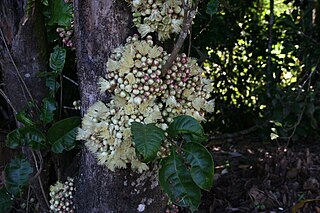
Syzygium cormiflorum, commonly known as the bumpy satinash, is a species of Syzygium tree endemic to Queensland in northeastern Australia.

Syzygium antisepticum, or shore eugenia, is native to Maritime Southeast Asia.
Eugenia abunan is a species of plant in the family Myrtaceae. It is native to Brazil.
Eugenia acapulcensis is a species of plant in the family Myrtaceae. It is native to Mexico to Brazil.
Eugenia acrantha is a species of plant in the family Myrtaceae. It is native to Cuba.
Eugenia acrensis is a species of plant in the family Myrtaceae. It is native to Bolivia, Brazil, and Peru.
Eugenia subterminalis, commonly known as cambuí pitanga, cereja do mato verdadeira, pitanga lisa de sombra, pitanga preta, and cambuízão vermelho do rio Paranapanema, is a species of plant in the family Myrtaceae. It is endemic to araucária forest in Bolivia, northern Brazil, Colombia, Ecuador, and Peru. The plant is a semi-deciduous shrub that grows to between 2 and 4 metres tall, and produces egg shaped fruit between 15 and 25mm tall, and 18 to 20mm wide.

