In many countries, a mayor is the highest-ranking official in a municipal government such as that of a city or a town.

Klaus Wowereit is a German politician, member of the SPD, and was the Governing Mayor of Berlin from 21 October 2001 to 11 December 2014. In 2001 state elections his party won a plurality of the votes, 29.7%. He served as President of the Bundesrat in 2001/02. His SPD-led coalition was re-elected in the 2006 elections; after the 2011 elections the SPD's coalition partner changed from the Left to the Christian Democratic Union. He was also sometimes mentioned as a possible SPD candidate for the Chancellorship of Germany (Kanzlerkandidatur), but that never materialized.
The Party for a Rule of Law Offensive, Rule of Law State Offensive Party, Party for the Promotion of the Rule of Law,Law and Order Offensive Party, or Party of Law and Order Offensive, commonly known as the "Schill party" from 2000 to 2003, was a minor right-wing populist party in Germany, mainly active in the state of Hamburg, that ran on a platform of law and order. It was founded in July 2000 by the judge Ronald Schill and was temporarily very successful in Hamburg, winning 19.4% of the votes in the 2001 state election and joining a coalition government. After the centre-right coalition collapsed and Schill left the party in 2003, it quickly lost support. Attempts to expand to other states or the federal level were unsuccessful. It may therefore be considered a "flash party" or protest party.

The Hamburg state election, 2004 was conducted on 29 February 2004 to elect members to the Hamburgische Bürgerschaft of Hamburg. It was the 18th legislative period of the Hamburg Parliament.

Henning Voscherau was a German politician who was a member of the Social Democratic Party of Germany. He was the First Mayor of his home city of Hamburg from 1988 to 1997, serving as President of the Bundesrat from 1990 to 1991.

Ortwin Runde is a German politician from the Social Democratic party. He was the First Mayor of the Free and Hanseatic City Hamburg from 1997 to 2001.
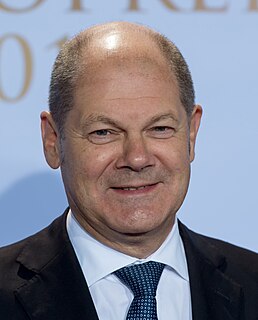
Olaf Scholz is a German politician serving as Federal Minister of Finance and Vice Chancellor under Chancellor Angela Merkel from the CDU since 14 March 2018. He served as First Mayor of Hamburg from 7 March 2011 to 13 March 2018 and Acting Leader of the Social Democratic Party (SPD) from 13 February to 22 April 2018.
The government of Hamburg is divided into executive, legislative and judicial branches. Hamburg is a city-state and municipality, and thus its governance deals with several details of both state and local community politics. It takes place in two ranks – a citywide and state administration, and a local rank for the boroughs. The head of the city-state's government is the First Mayor and President of the Senate. A ministry is called Behörde (office) and a state minister is a Senator in Hamburg. The legislature is the state parliament, called Hamburgische Bürgerschaft, and the judicial branch is composed of the state supreme court and other courts. The seat of the government is Hamburg Rathaus. The President of the Hamburg Parliament is the highest official person of the Free and Hanseatic City of Hamburg. This is a traditional difference to the other German states. The president is not allowed to exert any occupation of the executive.

Kurt Sieveking was a German politician (CDU) and First Mayor of Hamburg. On 7 September 1956 he was elected for a one-year-term as President of the German Bundesrat. Because his successor-elect, Governing Mayor of Berlin Otto Suhr, had died on 30 August 1957, Sieveking was re-elected as President of the Bundesrat in order to avoid a vacancy. He resigned on 1 November 1957, when Willy Brandt became the new Governing Mayor of Berlin and President of the Bundesrat subsequently. Because of that, Sieveking is, as yet, the only President of the Bundesrat to be re-elected to a second consecutive term.

Max Julius Friedrich Brauer was a German politician of the Social Democratic Party (SPD) and the first elected First Mayor of Hamburg after World War II.
On 27 March 1966, elections for members of the sixth legislative period of the Hamburg Parliament after the Second World War were held in the German state of Hamburg. There were 1,375,491 eligible voters.

On September 21, 1997, Hamburg state elections for members of the 16th legislative period of the Hamburg Parliament after the Second World War were held in the German state of Hamburg. There were 1,211,312 eligible voters.
On September 19, 1993, Hamburg state elections for members of the 15th legislative period of the Hamburg Parliament after the Second World War were held in the German state of Hamburg. There were 1,240,259 eligible voters.

Birgit Schnieber-Jastram is a German politician and representative of the Christian Democratic Union of Germany.

The 2001 United States elections were held on November 5 of that year. The 2001 recession was a dominant issue throughout the year as well as to a lesser extent the September 11 attacks and subsequent War on Terror, the latter of which would become especially important issue in the next year.

Werner von Melle was a mayor and senator of Hamburg, as well as a jurist. Melle, who held multiple doctorates, also served on the first board of trustees for the Hamburg Scientific Foundation.

The 1999 United States elections, which were held on Tuesday, November 2, were off-year elections in which no members of the Congress were standing for election. However, there were three gubernatorial races, state legislative elections in four states, numerous citizen initiatives, mayoral races in several major cities, and a variety of local offices on the ballot.


