Hamburg state election, 2008

Last updated
Hamburg state election, 2008
Flag of Hamburg.svg
  2004 28 February 2008 2011  

All 121 seats of the Hamburg Parliament

  First party Second party
  Ole von beust.jpg Michael Naumann.jpg
Leader Ole von Beust Michael Naumann
Party CDU SPD
Last election 47.2% 30.5%
Seats before 63 41
Seats won 57 45
Seat changeDecrease2.svg7Increase2.svg4
Percentage 42.6% 34.1%
SwingDecrease2.svg4.6Increase2.svg3.6%

Sitzverteilung Hamburgische Burgerschaft 19. Wahlperiode.png

Seats of the Hamburg Parliament in the 19th legislative period.
Coat of arms of Hamburg.svg
This article is part of a series on the
politics and government of
Hamburg

On 24 February 2008 state elections were held in Hamburg, Germany, for the 19th legislative period of the Hamburg Parliament. The four parties having more than 5 percent (minimum to qualify) are the conservative CDU, the social-democratic SPD, the left-wing Die Linke and the ecological Green Party (GAL). CDU and GAL formed a coalition and Ole von Beust continued as Minister-President.

Hamburg City in Germany

Hamburg is the second-largest city in Germany with a population of over 1.8 million.

Germany Federal parliamentary republic in central-western Europe

Germany, officially the Federal Republic of Germany, is a country in Central and Western Europe, lying between the Baltic and North Seas to the north, and the Alps to the south. It borders Denmark to the north, Poland and the Czech Republic to the east, Austria and Switzerland to the south, France to the southwest, and Luxembourg, Belgium and the Netherlands to the west.

Hamburg Parliament Parliament of the state and city of Hamburg, Germany

The Hamburg Parliament is the unicameral legislature of the German state of Hamburg according to the constitution of Hamburg. As of 2011 there were 121 members in the parliament, representing a relatively equal amount of constituencies. The parliament is situated in the city hall Hamburg Rathaus and part of the Government of Hamburg.

Contents

Pre-election

Results of the election 2004 as followed:

Party Vote percentage Total Seats Seat percentage
Christian Democratic Union (CDU) 47.2% 63 52.1%
Social Democratic Party (SPD) 30.5% 41 33.9%
Green-Alternative List (GAL) 12.3% 17 14.0%

Ole von Beust, head of Senate of Hamburg and First Mayor, was the main candidate of the CDU. The candidate for SPD was Michael Naumann.

Ole von Beust German politician

Carl-Friedrich Arp Ole Freiherr von Beust, generally called Ole von Beust, is a German politician who was First Mayor of Hamburg from 31 October 2001 to 25 August 2010, serving as President of the Bundesrat from 1 November 2007 on for one year. He was succeeded as mayor by Christoph Ahlhaus.

Michael Naumann German journalist and politician

Michael Naumann is a German politician, publisher and journalist. He was the German secretary of culture from 1998 until 2001. He is married to Marie Warburg, daughter of Eric Warburg and granddaughter of Max Warburg.

Results

Party Party List votes Vote percentage Total Seats Seat percentage
Christian Democratic Union (CDU) 331,184 42.6% (-4.6) 56 (-7) 46.3%
Social Democratic Party (SPD) 265,515 34.1% (+3.6) 45 (+4) 37.2%
Green-Alternative List (GAL) 74,744 9.6% (-2.7) 12 (-5) 9.9%
The Left 50,173 6.4% (+6.4) 8 (+8) 6.6%
Free Democratic Party (FDP) 36,995 4.8% (+2.0) 0 (+0) 0.0%
All Others 19,373 2.5% 0 0.0%
Totals 777,984 100.0% 121 100.0%

Post election

Winner Ole von Beust (CDU) did not achieve an absolute majority. He formed Germany's very first "Black-Green"coalition on the federal state level with the Greens (after the respective party colours, CDU's colour is black). [1] [2]

The term "coalition" is the denotation for a group formed when two or more people, factions, states, political parties, militaries etc. agree to work together temporarily in a partnership to achieve a common goal. The word coalition connotes a coming together to achieve a goal.

States of Germany First-level administrative subdivisions of the Federal Republic of Germany

Germany is a federal republic consisting of sixteen states. Since today's Germany was formed from an earlier collection of several states, it has a federal constitution, and the constituent states retain a measure of sovereignty. With an emphasis on geographical conditions, Berlin and Hamburg are frequently called Stadtstaaten (city-states), as is the Free Hanseatic City of Bremen, which in fact includes the cities of Bremen and Bremerhaven. The remaining 13 states are called Flächenländer.

On 28 November 2010 the Hamburg Home Office announced that the Hamburg parliament would be dissolved on 16 December 2010. The next elections were held on 20 February 2011. [3]

See also

The number of elections in Hamburg varies. Hamburg has a state election every four years, the elections for the state parliament. There are also elections to the federal diet of Germany, the local elections of the diet of the boroughs (Bezirksversammlungen) and every five years to the European Parliament. All elections take place by universal adult suffrage and are regulated by law.

The state elections in Hamburg, Germany for the parliament of Hamburg (Hamburgische Bürgerschaft) in the years of 1919–1933. The term Weimar Republic is used to signify the democratic and republican period of Germany from 1919 to 1933.

Related Research Articles

The Christian Social Union in Bavaria is a Christian-democratic and conservative political party in Germany. The CSU operates only in Bavaria while its larger counterpart, the Christian Democratic Union (CDU), operates in the other fifteen states of Germany. It differs from the CDU by being somewhat more conservative in social matters. The CSU is considered an effective successor of the Weimar-era Catholic Bavarian People's Party (BVP).

Free Democratic Party (Germany) political party in Germany

The Free Democratic Party is a liberal and classical liberal political party in Germany. The FDP is led by Christian Lindner.

Alliance 90/The Greens political party in Germany

Alliance 90/The Greens, often simply Greens, is a green political party in Germany that was formed in 1993 from the merger of the German Green Party and Alliance 90. The party focuses on ecological, economic, and social sustainability. Since January 2018 Annalena Baerbock and Robert Habeck have co-led the party. In the 2017 federal elections the Greens came sixth with 8.9% of the votes and 67 out of 709 seats in the Bundestag.

Klaus Wowereit German politician

Klaus Wowereit is a German politician, member of the SPD, and was the Governing Mayor of Berlin from 21 October 2001 to 11 December 2014. In 2001 state elections his party won a plurality of the votes, 29.7%. He served as President of the Bundesrat in 2001/02. His SPD-led coalition was re-elected in the 2006 elections; after the 2011 elections the SPD's coalition partner changed from the Left to the Christian Democratic Union. He was also sometimes mentioned as a possible SPD candidate for the Chancellorship of Germany (Kanzlerkandidatur), but that never materialized.

Ronald Barnabas Schill is a former German judge, the founder of the German political parties Party for a Rule of Law Offensive and Pro DM/Schill. He served as the Senator of the Interior and Second Mayor in the government of Hamburg from 2001 to 2003.

The Party for a Rule of Law Offensive, Rule of Law State Offensive Party, Party for the Promotion of the Rule of Law,Law and Order Offensive Party, or Party of Law and Order Offensive, commonly known as the "Schill party" from 2000 to 2003, was a minor right-wing populist party in Germany, mainly active in the state of Hamburg, that ran on a platform of law and order. It was founded in July 2000 by the judge Ronald Schill and was temporarily very successful in Hamburg, winning 19.4% of the votes in the 2001 state election and joining a coalition government. After the centre-right coalition collapsed and Schill left the party in 2003, it quickly lost support. Attempts to expand to other states or the federal level were unsuccessful. It may therefore be considered a "flash party" or protest party.

2004 Hamburg state election election

The Hamburg state election, 2004 was conducted on 29 February 2004 to elect members to the Hamburgische Bürgerschaft of Hamburg. It was the 18th legislative period of the Hamburg Parliament.

2001 Hamburg state election election

The Hamburg state election, 2001, was conducted on 23 September 2001, to elect members to the Hamburgische Bürgerschaft of Hamburg. It was the 17th legislative period of the parliament.

2005 German federal election

Federal elections were held in Germany on 18 September 2005 to elect the members of the 16th Bundestag. This became necessary after a motion of confidence in Chancellor Gerhard Schröder failed on 1 July. Following the defeat of Schröder's Social Democratic Party (SPD) in a state election, Schröder asked his supporters to abstain from the Bundestag motion, knowing the motion would fail and thus triggering an early federal election.

Peter Harry Carstensen German politician

Peter Harry Carstensen is a German politician, in the Christian Democratic Union (CDU) party.

Christoph Ahlhaus German politician

Christoph Ahlhaus is a German politician. He is a representative of the German Christian Democratic Union which he joined in 1985. He was the mayor of Hamburg from August 2010 to March 2011.
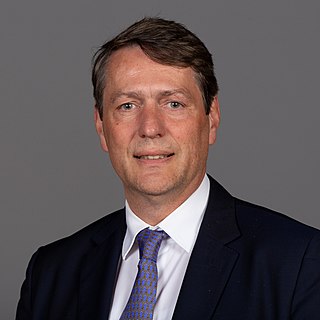
Dietrich Wersich German politician

Dietrich Wersich is a German politician of the German Christian Democratic Union (CDU), and physician. Since March 7, 2011 he is chairman of the CDU parliamentary Group in the Hamburg state legislature, the largest opposition party. From May 7, 2008 to March 7, 2011 he was Hamburg State Minister of Social Affairs, Family Affairs, Health and Consumer Protection. From November 29, 2010 to March 7, 2011 he was also Deputy Mayor of Hamburg.
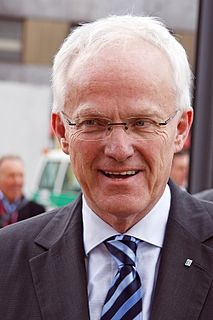
2010 North Rhine-Westphalia state election election

The North Rhine-Westphalia state election, 2010, was an election held on 9 May 2010, to elect members to the Landtag of the German state of North Rhine-Westphalia. The incumbent government at the election was the Christian Democrat (CDU)–FDP administration of Minister-President Jürgen Rüttgers. The biggest opposition party was the Social Democratic Party, led by Hannelore Kraft since 2005.

The last Berlin state election was held on 18 September 2011, to elect members to the Abgeordnetenhaus of Berlin. All 141 seats were up for election. Berlin was governed by a coalition between the Social Democratic Party and The Left at the time. Current mayor Klaus Wowereit was the favourite heading into Sunday's election.

2011 Hamburg state election election

On 20 February 2011, a state election was held in Hamburg, Germany, for the 20th legislative period of the Hamburg Parliament after World War II. The election is a result of the collapse of the coalition government led by the Christian Democratic Union (CDU) and the Green Alternative List (GAL). The Hamburg Parliament was officially dissolved on December 15, 2010. The Social Democratic Party (SPD) won an absolute majority after winning 62 seats. Absolute majorities are considered rare in Germany. The Free Democratic Party (FDP) re-entered parliament after failing to win any seats in the previous election.

Reiner Haseloff German politician

Reiner Haseloff is a German politician who serves as the Minister President of the federal state of Saxony-Anhalt. A scientist like Chancellor Angela Merkel, he was widely considered as one of her closest party allies, but distanced himself from her during the European migrant crisis.

Rüdiger Kruse German politician

Rüdiger Kruse, is a German politician who represents the Christian Democratic Union (CDU) in the Bundestag, the German federal parliament.

2014 Saxony state election

A state election was held on 31 August 2014 in the state of Saxony in Germany, as required by the state constitution. Minister-President Stanislaw Tillich sought to retain power.

References

  1. German conservatives win most votes, usa today, 2008-02-24, retrieved 2008-08-13
  2. Kopp, Martin (2008-08-12), Geheime Absprachen zwischen CDU und Grünen (in German), Hamburg, Germany: Die Welt, archived from the original on 2009-06-29, retrieved 2008-08-13.Check date values in: |year= / |date= mismatch (help)
  3. Veit Medick: Union schäumt, SPD träumt. Koalitionsbruch in Hamburg. Der Spiegel, 28 November 2010