
Orson Knapp Miller Jr. was an American mycologist. He published numerous papers in mycology and was responsible for the naming of many taxa, as well as being one of the authors erecting the genus Chroogomphus. He described Omphalotus olivascens, several species of Amanita, and the ghoul fungus Hebeloma aminophilum.

Alexander Hanchett Smith was an American mycologist known for his extensive contributions to the taxonomy and phylogeny of the higher fungi, especially the agarics.
Hebeloma ammophilum is a species of mushroom in the family Hymenogastraceae. It was described as new to science in 1978 by the Hungarian mycologist Gábor Bohus.
Hebeloma cylindrosporum is a species of mushroom-forming fungus in the family Hymenogastraceae. It was described as new to science in 1965 by French mycologist Henri Romagnesi.
Hebeloma vinosophyllum is a toxic species of agaric fungus in the family Hymenogastraceae. It contains eleven poisonous compounds collectively known as hebevinosides. An ammonia fungus, it tends to grow on the corpses of animals. The species was described by Japanese mycologist Tsuguo Hongo in 1965. It was recorded from Vietnamese Pinus kesiya forests in 2014, its first record in Southeast Asia.
Hebeloma vaccinum is a species of agaric fungus in the family Hymenogastraceae. It was described as new to science in 1965 by French mycologist Henri Romagnesi.
Psilocybe collybioides is a species of agaric fungus in the family Hymenogastraceae. It was first described scientifically by mycologists Rolf Singer and Alexander H. Smith in 1958, from collections made in montane habitat near Tafí del Valle, Argentina. It is in the section Zapotecorum of the genus Psilocybe, other members of this section include Psilocybe muliercula, Psilocybe angustipleurocystidiata, Psilocybe aucklandii, Psilocybe graveolens, Psilocybe kumaenorum, Psilocybe zapotecorum, Psilocybe pintonii, Psilocybe subcaerulipes, Psilocybe moseri, Psilocybe zapotecoantillarum, Psilocybe zapotecocaribaea, and Psilocybe antioquiensis.

Psilocybe muliercula is a species of entheogenic mushroom in the family Hymenogastraceae. This mushroom is native to Mexico and contains the compounds psilocybin and psilocin. It is in the section Zapotecorum, other members of this section include Psilocybe angustipleurocystidiata, Psilocybe aucklandii, Psilocybe collybioides, Psilocybe graveolens, Psilocybe kumaenorum, Psilocybe zapotecorum, Psilocybe pintonii, Psilocybe subcaerulipes, Psilocybe moseri, Psilocybe zapotecoantillarum, Psilocybe zapotecocaribaea, and Psilocybe antioquiensis.

Meinhard Michael Moser was an Austrian mycologist. His work principally concerned the taxonomy, chemistry, and toxicity of the gilled mushrooms (Agaricales), especially those of the genus Cortinarius, and the ecology of ectomycorrhizal relationships. His contributions to the Kleine Kryptogamenflora von Mitteleuropa series of mycological guidebooks were well regarded and widely used. In particular, his 1953 Blätter- und Bauchpilze [The Gilled and Gasteroid Fungi ], which became known as simply "Moser", saw several editions in both the original German and in translation. Other important works included a 1960 monograph on the genus Phlegmacium and a 1975 study of members of Cortinarius, Dermocybe, and Stephanopus in South America, co-authored with the mycologist Egon Horak.

Rhodocybe gemina is a species of fungus in the family Entolomataceae. It has the recommended English name of tan pinkgill and produces agaricoid basidiocarps that are fleshy and cream when young, becoming brownish when mature.

Tricholoma moseri is a mushroom of the agaric genus Tricholoma. It was first formally described in 1989 by Rolf Singer.

Hebeloma clavulipes is a species of mushroom in the family Hymenogastraceae. It was described as new to science in 1965 by French mycologist Henri Romagnesi.
Phaeocollybia moseri is a species of fungus in the family Cortinariaceae. Found in Chiapas, Mexico, where it grows under pine, it was described as new to science in 1996 by Victor Bandala and Gastón Guzmán. It belongs to the section Versicolores of the genus Phaeocollybia. The specific epithet moseri honors Dutch mycologist Meinhard Moser, "on the occasion of his 70th anniversary and for his contribution to agaric systematics".
Gymnopus moseri is a European species of agaric fungus in the family Omphalotaceae. It was described as new to science in 1997 by mycologists Vladimír Antonín and Machiel Noordeloos from collections made in Sweden. Fruit bodies of the holotype collection were found growing among Polytrichum and in coarse humus and leaves under birch (Betula) and willow (Salix). Collybia moseri is a synonym proposed by Marcel Bon in 1998. The specific epithet moseri honours Austrian mycologist Meinhard Michael Moser.
Leucoagaricus moseri is a species of agaric fungus found in Europe. The species was originally described as Lepiota moseri by Solomon Wasser in 1975. The specific epithet honours Austrian mycologist Meinhard Moser. Wasser transferred the fungus to the genus Leucoagaricus in 1978.
Conocybe moseri is a mushroom species in the family Bolbitiaceae. It was described as new to science in 1980 by mycologist Roy Watling, from collections made in France. The specific epithet moseri honours Austrian mycologist Meinhard Moser. The fungus has been reported from the United Kingdom, growing in grassy areas, fields, and edges of woods. In 1995, it was recorded from Switzerland, from Ukraine in 2007, and from Russia in 2007. It was reported from India in 2015, where it was found growing on cattle dung.
Tubaria moseri is a species of agaric fungus in the family Tubariaceae. Found in Argentina, it was described as new to science in 1974 by Jörg H. Raithelhuber. The specific epithet moseri honours Austrian mycologist Meinhard Moser.
Psathyrella moseri is a species of agaric fungus in the family Psathyrellaceae. Found in Argentina, it was described as new to science by mycologist Rolf Singer in 1969.
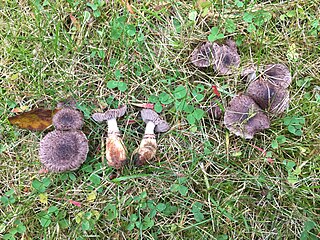
Dissoderma is a genus of parasitic fungi in the family Squamanitaceae. Basidiocarps superficially resemble normal agarics but emerge from parasitized fruit bodies of deformed host agarics.

