Highfield Moss

Last updated
Highfield Moss
Highfield Moss SSSI - geograph.org.uk - 942965.jpg
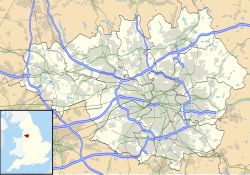
Greater Manchester UK location map 2.svg
Red pog.svg
Location in Greater Manchester
OS grid SJ 614 956
Coordinates 53°27′17″N2°35′05″W / 53.45472°N 2.58472°W / 53.45472; -2.58472
Area17.9 hectares (44 acres)
Operated by Wildlife Trust for Lancashire, Manchester and North Merseyside
Designation Site of Special Scientific Interest
Website www.lancswt.org.uk/nature-reserves/highfield-moss

Highfield Moss is a nature reserve of the Wildlife Trust for Lancashire, Manchester and North Merseyside, near Lowton in the Metropolitan Borough of Wigan, Greater Manchester. It is designated a Site of Special Scientific Interest. [1]

Contents

Description

The area, of size 17.9 hectares (44 acres), is a lowland raised mire, an unusual type of wetland among those in the Greater Manchester area, with diverse habitats over deep peat, including wet heath, tall fen and standing water. [2]

Peatlands are important, because they store carbon dioxide, which has been absorbed over thousands of years, whereas degraded peatland emits carbon dioxide; and peatlands reduce flooding by soaking up water. Restoration is also important for species of wildlife which are adapted to this particular environment, and which would otherwise disappear. [3]

There is access to the reserve by public footpaths. [4]

Wildlife

The Liverpool and Manchester Railway, built by George Stephenson between 1826 and 1830, crosses the area; heaps of sand left by the construction are occupied by several species of bees including tawny mining bees and buffish mining bees. [4] [5]

There are several pools where dragonflies and damselflies can be seen such as black darter, common hawker, four-spotted chaser and emerald damselfly. [6]

Birds which may be seen include whitethroats, linnets, hobbies and kestrels. [4]

Plants in the reserve include in particular the marsh gentian, which is generally rare in the UK, and because of the diverse habitats there is a variety of species, including species rarely found in the Greater Manchester area, such as petty whin, false fox-sedge, cross-leaved heath and lousewort. [2]

Inclusion in national nature reserve

The reserve in one of the sites included in the Risley, Holcroft and Chat Moss National Nature Reserve, a national nature reserve created in 2025, consisting of eleven sites of varied lowland peat areas in Greater Manchester and Cheshire. [7]

See also

References

  1. "Highfield Moss SSSI" Archived 23 June 2025 at the Wayback Machine Wigan Council. Retrieved 1 October 2025.
  2. 1 2 "Greater Manchester's National Nature Reserves" gov.uk, updated 29 July 2025. Retrieved 1 October 2025
  3. "Peatland restoration" Wildlife Trust for Lancashire, Manchester and North Merseyside. Retrieved 1 October 2025.
  4. 1 2 3 "Highfield Moss" Archived 11 November 2025 at the Wayback Machine Wildlife Trust for Lancashire, Manchester and North Merseyside. Retrieved 1 October 2025.
  5. "Why homes for bees were installed near a busy railway line" Lancashire Life, 11 July 2024. Retrieved 1 October 2025.
  6. "Damselflies and dragonflies" Wildlife Trust for Lancashire, Manchester and North Merseyside. Retrieved 2 October 2025.
  7. "Historic peatlands at the heart of the industrial revolution become new National Nature Reserve" Wildlife Trust for Lancashire, Manchester and North Merseyside, 17 July 2025. Retrieved 1 October 2025.