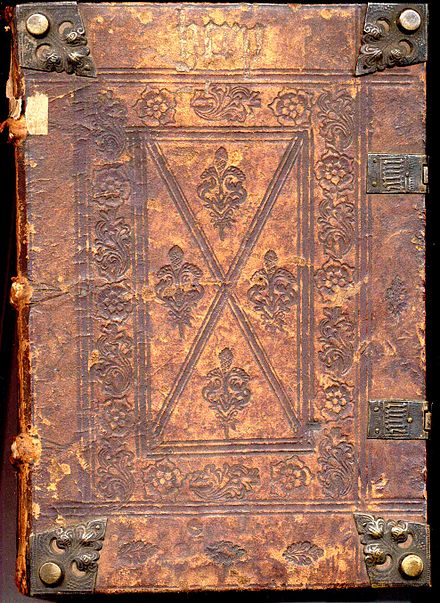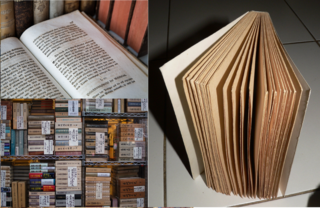
As a physical object, a book is a stack of usually rectangular pages oriented with one edge tied, sewn, or otherwise fixed together and then bound to the flexible spine of a protective cover of heavier, relatively inflexible material. The technical term for this physical arrangement is codex. In the history of hand-held physical supports for extended written compositions or records, the codex replaces its immediate predecessor, the scroll. A single sheet in a codex is a leaf, and each side of a leaf is a page.

A codex, plural codices, is a book constructed of a number of sheets of paper, vellum, papyrus, or similar materials. The term is now usually only used of manuscript books, with hand-written contents, but describes the format that is now near-universal for printed books in the Western world. The book is usually bound by stacking the pages and fixing one edge to a bookbinding, which may just be thicker paper, or with stiff boards, called a hardback, or in elaborate historical examples a treasure binding.

A manuscript was, traditionally, any document that is written by hand -- or, once practical typewriters became available, typewritten -- as opposed to being mechanically printed or reproduced in some indirect or automated way. More recently, the term has come to be understood to further include any written, typed, or word-processed copy of an author's work, as distinguished from its rendition as a printed version of the same. Before the arrival of printing, all documents and books were manuscripts. Manuscripts are not defined by their contents, which may combine writing with mathematical calculations, maps, explanatory figures or illustrations. Manuscripts may be in book form, scrolls or in codex format. Illuminated manuscripts are enriched with pictures, border decorations, elaborately embossed initial letters or full-page illustrations. A document should be at least 75 years old to be considered a manuscript.

A printing press is a mechanical device for applying pressure to an inked surface resting upon a print medium, thereby transferring the ink. It marked a dramatic improvement on earlier printing methods in which the cloth, paper or other medium was brushed or rubbed repeatedly to achieve the transfer of ink, and accelerated the process. Typically used for texts, the invention and global spread of the printing press was one of the most influential events in the second millennium.

In textual studies, a palimpsest is a manuscript page, either from a scroll or a book, from which the text has been scraped or washed off so that the page can be reused for another document. Pergamene was made of lamb, calf, or goat kid skin and was expensive and not readily available, so in the interest of economy a pergamene often was re-used by scraping the previous writing. In colloquial usage, the term palimpsest is also used in architecture, archaeology, and geomorphology to denote an object made or worked upon for one purpose and later reused for another, for example a monumental brass the reverse blank side of which has been re-engraved.

Parchment is a writing material made from specially prepared untanned skins of animals—primarily sheep, calves, and goats. It has been used as a writing medium for over two millennia. Vellum is a finer quality parchment made from the skins of young animals such as lambs and young calves.

Papyrus is a material similar to thick paper that was used in ancient times as a writing surface. It was made from the pith of the papyrus plant, Cyperus papyrus, a wetland sedge. Papyrus can also refer to a document written on sheets of such material, joined together side by side and rolled up into a scroll, an early form of a book.

Vellum is prepared animal skin or "membrane" used as a material for writing on. The term is derived from the Latin word vitulinum meaning "made from calf", leading to Old French velin for "calfskin". Parchment is another term for this material category. If vellum is distinguished, it is by vellum being made from calf skin, as opposed to that from other animals, or otherwise being of higher quality. Vellum is prepared as a surface for writing to produce scrolls, single pages, codices or books.

An illuminated manuscript is a manuscript in which the text is supplemented with such decoration as initials, borders (marginalia) and miniature illustrations. In the strictest definition, the term refers only to manuscripts decorated with either gold or silver; but in both common usage and modern scholarship, the term refers to any decorated or illustrated manuscript from Western traditions. Comparable Far Eastern and Mesoamerican works are described as painted. Islamic manuscripts may be referred to as illuminated, illustrated or painted, though using essentially the same techniques as Western works.
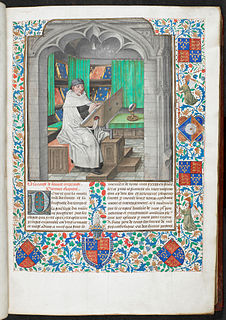
Scriptorium, literally "a place for writing", is commonly used to refer to a room in medieval European monasteries devoted to the writing, copying and illuminating of manuscripts by monastic scribes.
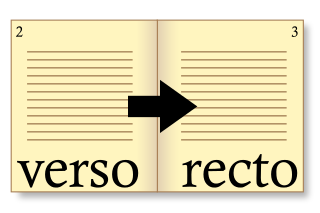
The terms recto and verso refer, respectively, to the text written or printed on the "right" or "front" side and on the "back" side of a leaf of paper in a bound item such as a codex, book, broadsheet, or pamphlet. The terms are shortened from Latin rectō foliō and versō foliō, translating to "on the right side of the leaf" and "on the back side of the leaf", respectively. The two opposite pages themselves are called folium rectum and folium versum in Latin, and the ablative recto, verso already imply that the text on the page are referred to.

A scroll, also known as a roll, is a roll of papyrus, parchment, or paper containing writing.
Print culture embodies all forms of printed text and other printed forms of visual communication. One prominent scholar in the field is Elizabeth Eisenstein, who contrasted print culture, which appeared in Europe in the centuries after the advent of the Western printing-press, to scribal culture. Walter Ong, by contrast, has contrasted written culture, including scribal, to oral culture. Ong is generally considered one of the first scholars to define print culture in contrast to oral culture. These views are related as the printing press brought a vast rise in literacy, so that one of its effects was simply the great expansion of written culture at the expense of oral culture. The development of printing, like the development of writing itself, had profound effects on human societies and knowledge. "Print culture" refers to the cultural products of the printing transformation.
Manuscript culture uses manuscripts to store and disseminate information; in the West, it generally preceded the age of printing. In early manuscript culture, monks copied manuscripts by hand. They copied not just religious works, but a variety of texts including some on astronomy, herbals, and bestiaries. Medieval manuscript culture deals with the transition of the manuscript from the monasteries to the market in the cities, and the rise of universities. Manuscript culture in the cities created jobs built around the making and trade of manuscripts, and typically was regulated by universities. Late manuscript culture was characterized by a desire for uniformity, well-ordered and convenient access to the text contained in the manuscript, and ease of reading aloud. This culture grew out of the Fourth Lateran Council (1215) and the rise of the Devotio Moderna. It included a change in materials, and was subject to remediation by the printed book, while also influencing it.
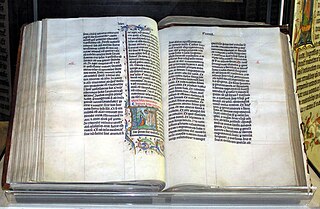
A biblical manuscript is any handwritten copy of a portion of the text of the Bible. Biblical manuscripts vary in size from tiny scrolls containing individual verses of the Jewish scriptures to huge polyglot codices containing both the Hebrew Bible (Tanakh) and the New Testament, as well as extracanonical works.
Preserving parchment becomes more difficult when pigments, inks, and illumination are added into the equation. Pigments do not dye parchment; instead, they lie on the surface of the parchment and so are rather fragile. The goal of restoring illuminated manuscripts should be to make them resilient to damage while altering them as little as possible. Each individual manuscript, and even each individual page, must be considered as a separate object with different aspects that must be taken into consideration. This in turn will help determine the best course of preservation or conservation treatment.
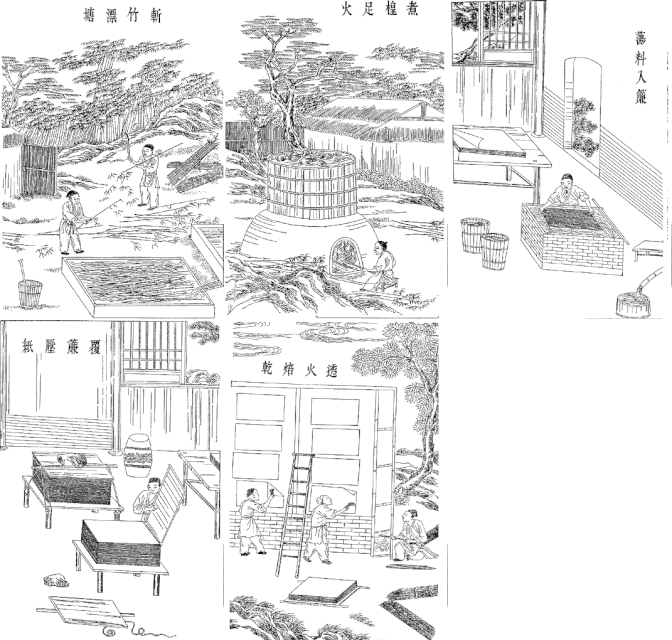
Paper is a thin unwoven material made from milled plant fibers, is primarily used for writing, artwork, and packaging; it is commonly white. The first papermaking process was documented in China during the Eastern Han period, traditionally attributed to the court official Cai Lun. During the 8th century, Chinese papermaking spread to the Islamic world, where pulp mills and paper mills were used for papermaking and money making. By the 11th century, papermaking was brought to Europe. By the 13th century, papermaking was refined with paper mills utilizing waterwheels in Spain. Later European improvements to the papermaking process came in the 19th century with the invention of wood-based papers.
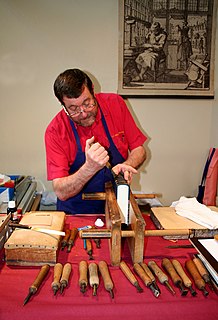
Bookbinding is the process of physically assembling a book of codex format from an ordered stack of paper sheets that are folded together into sections or sometimes left as a stack of individual sheets. The stack is then bound together along one edge by either sewing with thread through the folds or by a layer of flexible adhesive. Alternative methods of binding that are cheaper but less permanent include loose-leaf rings, individual screw posts or binding posts, twin loop spine coils, plastic spiral coils, and plastic spine combs. For protection, the bound stack is either wrapped in a flexible cover or attached to stiff boards. Finally, an attractive cover is adhered to the boards, including identifying information and decoration. Book artists or specialists in book decoration can also greatly enhance a book's content by creating book-like objects with artistic merit of exceptional quality.

The following outline is provided as an overview of and topical guide to books:

A scroll, is a roll of papyrus, parchment, or paper containing writing. The history of scrolls dates back to ancient Egypt. In most ancient literate cultures scrolls were the earliest format for longer documents written in ink or paint on a flexible background, preceding bound books; rigid media such as clay tablets were also used but had many disadvantages in comparison. For most purposes scrolls have long been superseded by the codex book format, but they are still produced for some ceremonial or religious purposes, notably for the Jewish Torah scroll for use in synagogues.