
The Arctiinae are a large and diverse subfamily of moths, with around 11,000 species found all over the world, including 6,000 neotropical species. This group includes the groups commonly known as tiger moths, which usually have bright colours, footmen, which are usually much drabber, lichen moths, and wasp moths. Many species have "hairy" caterpillars that are popularly known as woolly bears or woolly worms. The scientific name of this subfamily refers to this hairiness. Some species within the Arctiinae have the word tussock in their common name due to people misidentifying them as members of the Lymantriinae based on the characteristics of the larvae.
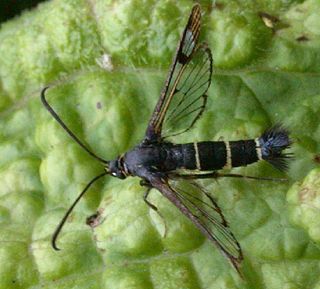
The Sesiidae or clearwing moths are a diurnal moth family in the order Lepidoptera known for their Batesian mimicry in both appearance and behaviour of various Hymenoptera.
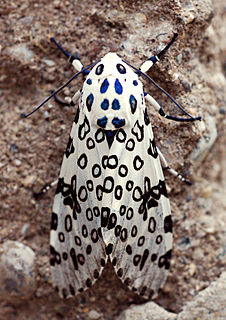
The giant leopard moth is a moth of the family Erebidae. They are distributed through North America from southern Ontario, and southern and eastern United States through New England, Mexico and down to Panama. The obsolete name Ecpantheria scribonia is still occasionally encountered.

Hypercompe is a genus of tiger moths in the family Erebidae erected by Jacob Hübner in 1819.
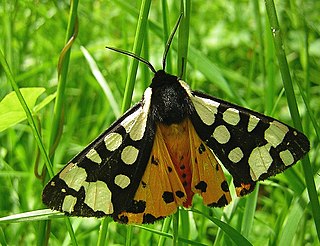
The Arctiina are a subtribe of moths in the family Erebidae.

Hypercompe permaculata, the many-spotted tiger moth, is a tiger moth of the family Erebidae. It was first described by Alpheus Spring Packard in 1872. It is native to the western United States and parts of northern Mexico.
Hypercompe abdominalis is a moth of the family Erebidae. It is found in Brazil.
Hypercompe bari is a moth of the family Erebidae first described by Charles Oberthür in 1881. It is found in French Guiana.
Hypercompe caudata is a moth of the family Erebidae. It was described by Francis Walker in 1855. It is found in Texas, southern Arizona, Mexico, Costa Rica, Honduras and Nicaragua.

Hypercompe mus is a moth of the family Erebidae first described by Charles Oberthür in 1881. It is found in Paraguay and Brazil.

Hypercompe cunigunda is a moth of the family Erebidae first described by Caspar Stoll in 1781. It is found in French Guiana, Suriname, Brazil, Venezuela, Ecuador and Bolivia.
Hypercompe deflorata is a moth of the family Erebidae first described by Johan Christian Fabricius in 1775. It is found in Ecuador.
Hypercompe detecta is a moth of the family Erebidae first described by Charles Oberthür in 1881. It is found in Brazil.
Hypercompe flavopunctata is a moth of the family Erebidae first described by William Schaus in 1921. It is found in Paraguay.
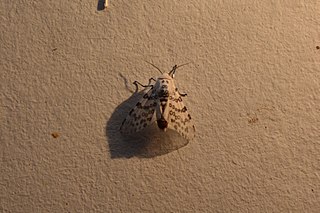
Hypercompe icasia is a moth of the family Erebidae first described by Pieter Cramer in 1777. It is widely distributed in South America and is also found on Martinique, Guadeloupe, Saint Martin, Dominica, St. Kitts, Nevis, St. Thomas and Puerto Rico.
Hypercompe indecisa is a moth of the family Erebidae first described by Francis Walker in 1855. It is found in Argentina and Uruguay.

Hypercompe laeta is a moth of the family Erebidae first described by Francis Walker in 1855. It is found in Panama and Venezuela.
Hypercompe ocularia, the ocularia leopard, is a moth of the family Erebidae. The species was first described by Johan Christian Fabricius in 1775.

Hypercompe ochreator is a species of tiger moth first described by Felder and Rogenhofer in 1874. It is found in Guatemala.
Hypercompe suffusa is a moth of the family Erebidae. It was described by William Schaus in 1889. It is found in southern Arizona, western Texas and Mexico.
