
Namie Amuro is a retired Japanese singer. She rose to prominence as a teen idol, and transitioned into a leading pop artist due to her versatility across music styles and visual presentation. Due to her career reinventions and longevity, she is known as an icon across Japan and Asia. She has been referred to as the "Queen of Japanese Pop", and her influence domestically has drawn equivalent comparisons to artists such as Janet Jackson and Madonna in Western pop culture.

I Am... is the fourth studio album by Japanese recording artist Ayumi Hamasaki. It was released on January 1, 2002 by Avex Trax and was distributed throughout Asia in both physical and digital formats. Hamasaki enlisted long-time collaborator Max Matsuura to assist with the album's creation, and was inspired by the events of the September 11, 2001 attacks to emphasise lighter themes in contrast to her previous work.

Duty is the third studio album by Japanese recording artist Ayumi Hamasaki. It was released on September 27, 2000, by Avex Trax. Duty is Hamasaki's first studio album inside the 2000s decade, and her third consecutive studio album to be fully produced by Japanese musician and businessman Max Matsuura. The album's composing and arrangement was handled by several music collaborators, such as Ken Harada, Kazuhito Kikuchi, Dai Nagao, HΛL, among many others. Hamasaki contributed to the album as the primary and background vocalist, and songwriter to every song. Three different formats were released to promote the album: a standalone CD, a limited edition Playbutton, and a digital download. The cover sleeve has Hamasaki wearing a leopard-print cat suit.

"Evolution" is a song recorded by Japanese recording artist and lyricist Ayumi Hamasaki, released on January 31, 2001, as the second single from her fourth studio album I Am... (2002).

"Daybreak" is a song recorded by Japanese recording artist and lyricist Ayumi Hamasaki, released on March 6, 2002 as the eighth and final single on her fourth studio album I am.... Influenced by the recent events off the September 11 attacks in New York City and Washington D.C. in North America, Hamasaki sought a new inspiration for her then-forthcoming album; instead off writing songs about confusion, loneliness and love like her previous efforts, she was encouraged to engage in more peaceful and worldly themes. This resulted in several songs on I Am..., including "Daybreak".

Japanese singer Ayumi Hamasaki has released eighteen studio albums, five compilation albums, twenty-six remix albums, four live albums and numerous singles and promotional singles. She debuted in 1995 under Nippon Columbia with the stage name Ayumi, releasing an extended play Nothing from Nothing, which was a collaboration with Dohzi-T and DJ Bass. Three years later, Hamasaki debuted again as a singer under Avex Trax with the single "Poker Face" (1998). Her first album A Song for ×× (1999) debuted at number one on Oricon's albums chart, and sold over 1.4 million copies.

"Movin' On Without You" is a song recorded by Japanese–American singer and producer Hikaru Utada taken from her debut studio album First Love (1999). The song was written, arranged, and produced by Utada herself, and it became her first ever hit. "Movin' On Without You" was written, produced and composed while Utada was attending college in Tokyo, Japan, during 1997. Utada, who received a record contract by Toshiba-EMI, had written an English-language version of the song, but the song remains unreleased.

The discography of Japanese-American R&B and pop singer Hikaru Utada consists of eleven studio albums, three compilation albums, eleven video albums and numerous singles and promotional singles. Utada began as a musician in the early 1990s as a member of U3, a family unit made up of her, her mother Junko Utada, also known as 1970s enka singer Keiko Fuji, and her father, musical producer Teruzane Utada. U3 released their debut album Star in 1993, with the hope to debut in America. In 1996, the group was rebranded as Cubic U, an R&B project focusing on Hikaru Utada, resulting in the English language album Precious in 1998 with record label Toshiba EMI.

The discography of Japanese R&B singer Misia consists of nine studio albums, three compilation albums, one extended play (EP), one live album, six remix albums, twenty-six singles, twelve promotional singles, eighteen video albums and thirty-seven music videos. In 1997, Misia signed a recording contract with BMG Japan and joined the then up-and-coming talent agency, Rhythmedia. Under the sub-label Arista Japan, Misia released her first single, "Tsutsumikomu Yō ni..." in February 1998, followed by "Hi no Ataru Basho" in May. In June, her debut album, Mother Father Brother Sister, opened at number three on the Oricon chart. The album peaked at number one three weeks later and stayed in the top five for eleven consecutive weeks. Mother Father Brother Sister was certified double million and won a Japan Record Award for Best Album, as well as a Japan Gold Disc Award for Pop Album of the Year. In 2000, Misia's second studio album, Love Is the Message, debuted at number one and was certified double million. It won a Japan Record Award for Best Album and a Japan Gold Disc Award for Pop Album of the Year. The album spawned three top ten hits: "Believe," "Wasurenai Hibi" and "Sweetness." Misia's first remix album, Misia Remix 2000 Little Tokyo, was released three months later and shot to number one. It sold over 800,000 copies and is the second best-selling remix album of all time in Japan.

"Baby Don't Cry" is a song recorded by Japanese recording artist Namie Amuro for her eighth studio album, Play (2007). It was written, composed, arranged, and produced by Japanese musician Naoaki Yamato, under the alias Nao'ymt. The single also included the B-side track "Nobody", a re-recorded version of her single "White Light". It premiered on January 24, 2007 as the third single from the album in Japan. It was also released worldwide on February 21, 2007 through Avex Entertainment Inc. Musically, "Baby Don't Cry" is a pop ballad, influenced by R&B music.

Guilty is the ninth studio album by Japanese recording artist Ayumi Hamasaki. It was released on January 1, 2008 by Avex Trax. Guilty marks Hamasaki's ninth consecutive album to be fully produced by Japanese producer and manager Max Matsuura, while she contributes to the album as the lead vocalist, background vocalist, and songwriter to all songs. Recorded in Japanese with minor phrases in English, Guilty is a rock album with numerous musical elements such as pop rock, heavy metal, synthrock, and power ballad melodies.
The discography of Japanese singer Mai Kuraki consists of fifteen studio albums, six compilation albums, twenty-three video albums, three remix albums, fifty-six singles, and sixteen promotional singles. Kuraki debuted in 1999, while she was still in high school, through Giza Studio. The label initially marketed Kuraki in the United States under the name Mai K, and released the single "Baby I Like" (1999). However, the single was a commercial failure which prompted the label to send her back to Japan. There, they released her single "Love, Day After Tomorrow", which peaked at number two on the Oricon Singles Chart and was certified million by the Recording Industry Association of Japan (RIAJ). The second single, "Stay by My Side" became her first number one single on the chart. Kuraki's debut album, Delicious Way, topped the Oricon Albums Chart and was certified triple million by the RIAJ.

A Complete: All Singles is a greatest hits album by Japanese singer Ayumi Hamasaki. Avex Trax released it on September 10, 2008 in a variety of formats, and was created to commemorate the singer's tenth anniversary since the release of her 1998 single "Poker Face". The album is divided into three sections, each highlighting a single released by Hamasaki from her debut in 1998 to her most recent single, "Talkin' 2 Myself" in 2007. Additionally, the compilation includes two new songs: the stand-alone single "Mirrorcle World" and a re-recorded version of "Who...".
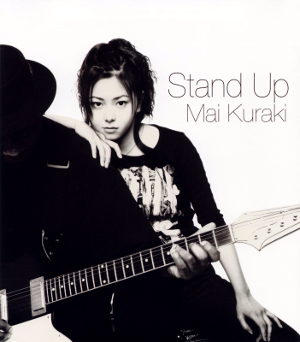
"Stand Up" is a song by Japanese singer-songwriter Mai Kuraki from her second studio album, Perfect Crime (2001). It was released as the third single from the album on April 18, 2001. The lyrics to the song were penned by Kuraki and the track was produced by Akihito Tokunaga. The single peaked at number two on the Oricon Singles Chart and was certified platinum by the Recording Industry Association of Japan (RIAJ). It has sold about 476,000 copies in Japan as of October 2014. The single's jacket image was compared to that of Bruce Springsteen's Born to Run (1975).
The discography of Japanese group KinKi Kids consists of 17 studio albums, 6 compilation albums, 25 video albums and 44 singles. All of KinKi Kids' singles have reached number one in Japan on Oricon charts. All of their music has been released by Johnny's Entertainment in Japan. In Taiwan, Kinki Kids' music has been released under Forward Music from 1997 to 2000, Skyhigh Entertainment and What's Music in 2001, and Avex Taiwan from 2002 to the present.

"Sit! Stay! Wait! Down! / Love Story" is an extended play by Japanese recording artist Namie Amuro from her tenth studio album and debut bilingual album Uncontrolled (2012). The EP contains the songs "Sit! Stay! Wait! Down!" and "Love Story" from the parent album and two new tracks "Higher" and "Arigatou". The EP was produced by Michico, T. Kura, Miriam Nervo, Olivia Nervo, T-SK, Tesung Kim, and Nao'ymt, and is divided into two dance-pop songs and two pop ballads.
The discography of Japanese actress and singer-songwriter Takako Matsu includes ten studio, three compilation, two live, seven video albums, twenty-one singles, and twenty music videos. Born into a family of actors, Matsu made her debut as a stage performer before her roles in TV dramas and films. That year she released her first single, "Ashita, Haru ga Kitara", which peaked at number 8 on the Oricon Singles Chart and was certified platinum by the Recording Industry Association of Japan (RIAJ) for shipments of 400,000 copies. Matsu's debut album, Sora no Kagami, peaked at number 4 on the Oricon Albums Chart. Selling over 300,000 copies, it earned a platinum certification from the RIAJ and Matsu was named Best New Artist of the Year at the 12th Japan Gold Disc Awards.

"Ashita, Haru ga Kitara" is a song by Japanese entertainer Takako Matsu from her debut album, Sora no Kagami (1997). It was released on March 21, 1997, through BMG Japan as her debut single. The song was written by Yūji Sakamoto and Daisuke Hinata, while Hinata produced the song. Following the wrap-up of the drama Long Vacation, she decided to give singing a try upon the suggestion of one of its directors.

Ai no Tobira is the second studio album by Japanese actress and recording artist Takako Matsu. It was released on September 23, 1998, through Arista Records Japan. The album peaked at number 3 on the Oricon Albums Chart and was certified Gold by the RIAJ for shipment of 200,000 copies. The album has sold about 245,000 copies in Japan, as of June 2014.
The discography of Japanese boy band SMAP consists of 21 studio albums, 5 compilation albums, 23 video albums, and numerous singles. Sports Music Assemble People, abbreviated as SMAP, was formed in 1988 by a group of backup dancers for the boy band Hikaru Genji of Johnny & Associates. The band's initial releases performed poorly on the charts, but the following ones started gaining attention, aided by the group's appearance on their own variety show, SMAP×SMAP. Meanwhile Kimi Iro Omoi single was used in anime Akazukin Chacha broadcast in Japan only. In worldwide broadcast, Kimi Iro Omoi single was replaced by Shoko Sawada. However, that single can only available on MP3 Store, then download between TV Size and Full version. Their 2003 single "Sekai ni Hitotsu Dake no Hana" sold over two million copies in Japan, becoming one of the best-selling singles in the country. In August 2016, the group announced that they will disband by the year end. Since 2003, all of the band's releases have peaked at number one on the Oricon Albums or Singles Chart. The group has sold over 38,5 million records in Japan.

