
Stribog is a god in Slavic mythology found in three East Slavic sources, whose cult may also have existed in Poland. The sources do not inform about the functions of the god, but nowadays he is most often interpreted as a wind deity who distributes wealth.

Proto-Indo-European mythology is the body of myths and deities associated with the Proto-Indo-Europeans, speakers of the hypothesized Proto-Indo-European language. Although the mythological motifs are not directly attested – since Proto-Indo-European speakers lived in preliterate societies – scholars of comparative mythology have reconstructed details from inherited similarities found among Indo-European languages, based on the assumption that parts of the Proto-Indo-Europeans' original belief systems survived in the daughter traditions.
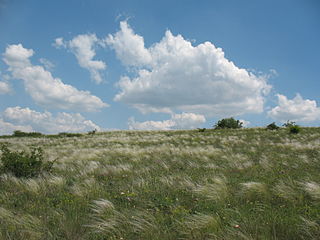
*Dyḗus, also *Dyḗus ph₂tḗr, is the reconstructed name of the daylight-sky god in Proto-Indo-European mythology. *Dyēus was conceived as a divine personification of the bright sky of the day and the seat of the gods, the *deywṓs. Associated with the vast diurnal sky and with the fertile rains, *Dyēus was often paired with *Dʰéǵʰōm, the Earth Mother, in a relationship of union and contrast.
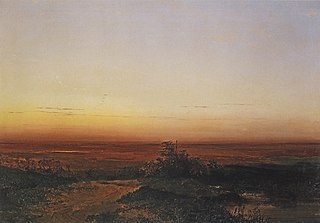
*H₂éwsōs or *Haéusōs is the reconstructed Proto-Indo-European name of the dawn goddess in the Proto-Indo-European mythology.
Perëndi is an Albanian noun for God, deity, sky and heaven. It is used capitalized to refer to the Supreme Being, and uncapitalized for "deity", "sky" and "heaven".
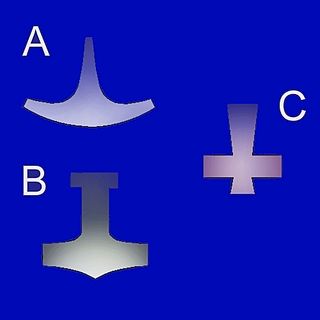
Ukonvasara, or Ukonkirves, is the symbol and magical weapon of the Finnish thunder god Ukko, similar to Thor's Mjölnir. Ukonvasara means 'hammer of Ukko'; similarly, Ukonkirves means 'axe of Ukko'. It was said that Ukko created lightning with Ukonvasara.
*Perkʷūnos is the reconstructed name of the weather god in Proto-Indo-European mythology. The deity was connected with fructifying rains, and his name was probably invoked in times of drought. In a widespread Indo-European myth, the thunder-deity fights a multi-headed water-serpent during an epic battle in order to release torrents of water that had previously been pent up. The name of his weapon, *ml̥dʰnis, which denoted both "lightning" and "hammer", can be reconstructed from the attested traditions.
Fjörgyn is a personification of earth in Norse mythology, and the mother of the thunder god Thor, the son of Odin. The masculine form Fjörgynn is portrayed as the father of the goddess Frigg, the wife of Odin.
The Indo-European Etymological Dictionary is a research project of the Department of Comparative Indo-European Linguistics at Leiden University, initiated in 1991 by Peter Schrijver and others. It is financially supported by the Faculty of Humanities and Centre for Linguistics of Leiden University, Brill Publishers, and the Netherlands Organisation for Scientific Research.
Rick Derksen is a Dutch linguist and Indo-Europeanist at the University of Leiden who specializes in Balto-Slavic historical linguistics with an emphasis on accentology and etymology.
Proto-Germanic paganism was the beliefs of the speakers of Proto-Germanic and includes topics such as the Germanic mythology, legendry, and folk beliefs of early Germanic culture. By way of the comparative method, Germanic philologists, a variety of historical linguist, have proposed reconstructions of entities, locations, and concepts with various levels of security in early Germanic folklore. The present article includes both reconstructed forms and proposed motifs from the early Germanic period.
*H₁n̥gʷnis is the reconstructed Proto-Indo-European name of the fire god in the Proto-Indo-European mythology.
*Manu and *Yemo were a duo in Proto-Indo-European mythology. In the creation myth, Manu kills Yemo as a foundational part of the origin of the universe. Yemo is sometimes also interpreted as a primordial hermaphrodite.
*Trito is a significant figure in Proto-Indo-European mythology, representing the first warrior and acting as a culture hero. He is connected to other prominent characters, such as Manu and Yemo, and is recognized as the protagonist of the myth of the warrior function, establishing the model for all later men of arms. In the legend, Trito is offered cattle as a divine gift by celestial gods, which is later stolen by a three-headed serpent named *H₂n̥gʷʰis ('serpent'). Despite initial defeat, Trito, fortified by an intoxicating drink and aided by the Sky-Father, or alternatively the Storm-God or *H₂nḗr, 'Man', together they go to a cave or a mountain, and the hero overcomes the monster and returns the recovered cattle to a priest for it to be properly sacrificed. He is now the first warrior, maintaining through his heroic deeds the cycle of mutual giving between gods and mortals. Scholars have interpreted the story of Trito either as a cosmic conflict between the heavenly hero and the earthly serpent or as an Indo-European victory over non-Indo-European people, with the monster symbolizing the aboriginal thief or usurper. Trito's character served as a model for later cattle raiding epic myths and was seen as providing moral justification for cattle raiding. The legend of Trito is generally accepted among scholars and is recognized as an essential part of Proto-Indo-European mythology, although not to the level of Manu and Yemo.

Mitra-Varuna is a proposed deity or dyad of deities suggested to have existed in Proto-Indo-European religion and mythology. First proposed by Georges Dumézil, he considered it to have been composed of two distinct elements – Mitra and Varuna – this divine pair represented different aspects of sovereignty, with Mitra embodying reason, order, and benevolence, and Varuna symbolizing violence, darkness, and inspiration.
*H₂epom Nepōts is a reconstructed Proto-Indo-European deity who dwells in waters, and whose powers must be ritually gained or controlled by a hero who is the only one able to approach it. The motif may come from swamp gas rising from swamps and igniting. It may come from the high levels of natural gas in Ukraine, the possible Proto-Indo-European homeland.
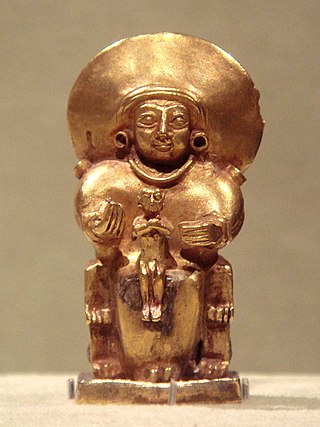
*Seh₂ul and *Meh₁not are the reconstructed Proto-Indo-European goddess of the Sun and god of the Moon. *Seh₂ul is reconstructed based on the solar deities of the attested Indo-European mythologies, although its gender is disputed, since there are deities of both genders. Likewise, *Meh₁not- is reconstructed based on the lunar deities of the daughter languages, but they differ in regards to their gender.
*Péh₂usōn ("Protector") was a proposed Proto-Indo-European pastoral god guarding roads and herds.
*H₂n̥gʷʰis is a reconstructed Proto-Indo-European term meaning 'serpent', as well as a possible name for a mythological entity, polycephalous sea serpent or dragon which was slain by a hero named Trito with a help of god Perkʷunos.
