
The adrenal medulla is part of the adrenal gland. It is located at the center of the gland, being surrounded by the adrenal cortex. It is the innermost part of the adrenal gland, consisting of chromaffin cells that secrete catecholamines, including epinephrine (adrenaline), norepinephrine (noradrenaline), and a small amount of dopamine, in response to stimulation by sympathetic preganglionic neurons.
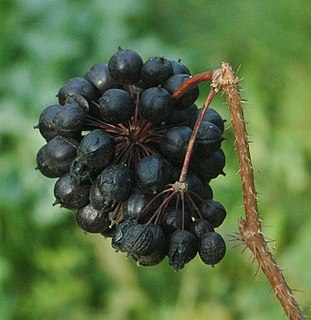
Eleutherococcus senticosus is a species of small, woody shrub in the family Araliaceae native to Northeastern Asia. It may be colloquially called devil's bush, Siberian ginseng, eleuthero, ciwujia, Devil's shrub, shigoka, touch-me-not, wild pepper, or kan jang. E. senticosus has a history of use in folklore and traditional Chinese medicine. Root extracts of E. senticosus are sold as a dietary supplement or cosmetic, usually under the name Siberian ginseng.
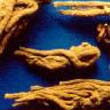
Angelica sinensis, commonly known as dong quai or female ginseng, is a herb belonging to the family Apiaceae, indigenous to China. Angelica sinensis grows in cool high altitude mountains in China, Japan, and Korea. The yellowish brown root of the plant is harvested in the fall and is a well-known Chinese medicine which has been used for thousands of years.
An oncolytic virus is a virus that preferentially infects and kills cancer cells. As the infected cancer cells are destroyed by oncolysis, they release new infectious virus particles or virions to help destroy the remaining tumour. Oncolytic viruses are thought not only to cause direct destruction of the tumour cells, but also to stimulate host anti-tumour immune system responses.

Treatments for influenza include a range of medications and therapies that are used in response to disease influenza. Treatments may either directly target the influenza virus itself; or instead they may just offer relief to symptoms of the disease, while the body's own immune system works to recover from infection.

Purinergic receptors, also known as purinoceptors, are a family of plasma membrane molecules that are found in almost all mammalian tissues. Within the field of purinergic signalling, these receptors have been implicated in learning and memory, locomotor and feeding behavior, and sleep. More specifically, they are involved in several cellular functions, including proliferation and migration of neural stem cells, vascular reactivity, apoptosis and cytokine secretion. These functions have not been well characterized and the effect of the extracellular microenvironment on their function is also poorly understood.
Flamingo is a member of the adhesion-GPCR family of proteins. Flamingo has sequence homology to cadherins and G protein-coupled receptors (GPCR). Flamingo was originally identified as a Drosophila protein involved in planar cell polarity. Mammals have three flamingo homologs, CELSR1, CELSR2, CELSR3. In mice all three have distinct expression patterns in the brain.

Activin receptor type-2A is a protein that in humans is encoded by the ACVR2A gene. ACVR2A is an activin type 2 receptor.
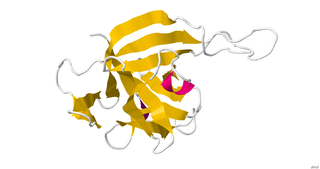
Interleukin 33 (IL-33) is a protein that in humans is encoded by the IL33 gene.

Paired box protein Pax-5 is a protein that in humans is encoded by the PAX5 gene.

Natural cytotoxicity triggering receptor 1 is a protein that in humans is encoded by the NCR1 gene. NCR1 has also been designated as CD335 (cluster of differentiation, NKP46, NKp46, NK-p46, and LY94.

Sialic acid-binding Ig-like lectin 7 is a protein that in humans is encoded by the SIGLEC7 gene. SIGLEC7 has also been designated as CD328.

T-cell acute lymphocytic leukemia 2, also known as TAL2, is a protein which in humans is encoded by the TAL2 gene.
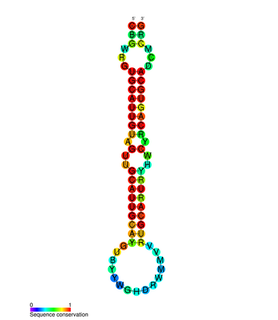
miR-33 is a family of microRNA precursors, which are processed by the Dicer enzyme to give mature microRNAs. miR-33 is found in several animal species, including humans. In some species there is a single member of this family which gives the mature product mir-33. In humans there are two members of this family called mir-33a and mir-33b, which are located in intronic regions within two protein-coding genes for Sterol regulatory element-binding proteins respectively.

Zinc transporter 3 also known as solute carrier family 30 member 3 is a protein in humans that is encoded by the SLC30A3 gene.

Encephalartos lebomboensis is a species of cycad in the family Zamiaceae. Native to the Lebombo Mountains of South Africa, the species was first described in 1949 by the South African botanist Inez Verdoorn. It is commonly known as the Lebombo cycad, although the name is also used for Encephalartos senticosus which also occurs in the same locality.

Many variants of herpes simplex virus have been considered for viral therapy of cancer; the early development of these was thoroughly reviewed in the journal Cancer Gene Therapy in 2002. This page describes the most notable variants—those tested in clinical trials: G207, HSV1716, NV1020 and Talimogene laherparepvec. These attenuated versions are constructed by deleting viral genes required for infecting or replicating inside normal cells but not cancer cells, such as ICP34.5, ICP6/UL39, and ICP47.

Encephalartos senticosus is a species of cycad in the family Zamiaceae native to the Lebombo Mountains of Mozambique, Eswatini (Swaziland) and the KwaZulu-Natal province of South Africa. Prior to its description in 1996, Encephalartos senticosus had been confused with the closely related and sympatric Encephalartos lebomboensis. Both species are commonly known as the Lebombo cycad.

Isofraxidin-7-glucoside (calycanthoside) is a constituent of Eleutherococcus senticosus that is classified as a coumarin. It is a glucoside of isofraxidin.


