| |||||||||||||||||||||||||||||||||||||||||||||||||||||||||||||||||||||||
This lists parties that won seats. See the complete results below. | |||||||||||||||||||||||||||||||||||||||||||||||||||||||||||||||||||||||
| |||||||||||||||||||||||||||||||||||||||||||||||||||||||||||||||||||||||
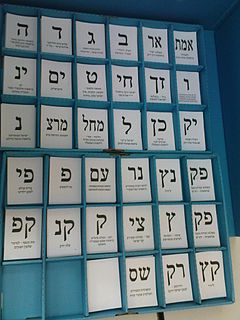
Elections for the sixth Knesset were held in Israel on 2 November 1965. [1] [2] Voter turnout was 85.9%. [3]
Elections in Israel are based on nationwide proportional representation. The electoral threshold is currently set at 3.25%, with the number of seats a party receives in the Knesset being proportional to the number of votes it receives. The Knesset is elected for a four-year term, although most governments have not served a full term and early elections are a frequent occurrence. Israel has a multi-party system based on coalition governments as no party has ever won a majority of seats in a national election, although the Alignment briefly held a majority following its formation by an alliance of several different parties prior to the 1969 elections. The legal voting age for Israeli citizens is 18. Elections are overseen by the Central Elections Committee and are held according to the Knesset Elections Law.
Israel, officially the State of Israel, is a country in Western Asia, located on the southeastern shore of the Mediterranean Sea and the northern shore of the Red Sea. It has land borders with Lebanon to the north, Syria to the northeast, Jordan on the east, the Palestinian territories of the West Bank and Gaza Strip to the east and west, respectively, and Egypt to the southwest. The country contains geographically diverse features within its relatively small area. Israel's economic and technological center is Tel Aviv, while its seat of government and proclaimed capital is Jerusalem, although the state's sovereignty over Jerusalem has only partial recognition.
Prior to the elections, two major alliances were formed; Mapai and Ahdut HaAvoda united to form the Alignment, whilst Herut and the Liberal Party had formed the Gahal alliance towards the end of the previous Knesset session. However, both Mapai and the Liberal Party had been hit by breakaway factions, the Ben-Gurion led Rafi and the Independent Liberals (largely composed of former Progressive Party members) respectively.
Mapai was a centre-left political party in Israel, and was the dominant force in Israeli politics until its merger into the modern-day Israeli Labor Party in 1968. During Mapai's time in office, a wide range of progressive reforms were carried out, as characterised by the establishment of a welfare state, providing minimum income, security, and free access to housing subsidies and health and social services.
Ahdut HaAvoda was the name used by a series of political parties. Ahdut HaAvoda in its first incarnation was led by David Ben-Gurion. It was first established during the period of British Mandate and later became part of the Israeli political establishment. It was one of the forerunners of the modern-day Israeli Labor Party.
Herut was the major right-wing nationalist political party in Israel from 1948 until its formal merger into Likud in 1988. It was an adherent of Revisionist Zionism, and was initially known in part for its militia actions; it became more moderate from 1951.
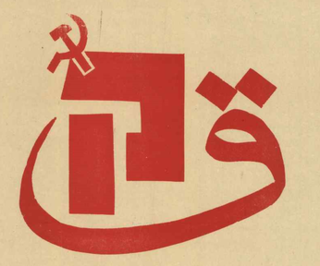
The communist Maki had also experienced a split earlier in the year, with most of its Arab members and some Jewish members breaking away to establish Rakah.
Maki was a communist political party in Israel. It is not the same party as the modern-day Maki, which split from it during the 1960s and later assumed its name.
A new Mapai-affiliated Arab party, Cooperation and Brotherhood was formed to contest the election, whilst the Arab Socialist List was prevented from running by the Central Elections Committee due to its links with the banned al-Ard organisation. Peace activist Abie Nathan entered a party list, Nes.
Cooperation and Brotherhood was an Arab satellite list in Israel.
Al-Ard was a Palestinian political movement made up of Arab citizens of Israel active between 1958 and some time in the 1970s which attracted international attention. Following unsuccessful efforts to secure registration of the organization as an Israeli NGO and secure it a publishing permit, it was outlawed in 1964. The political movement's goal was, according to political historian David McDowall, "to achieve complete equality and social justice for all classes of people in Israel" and "to find a just solution for the Palestine problem as a whole, and as an indivisible unit." Al-Ard's disappearance as a movement was linked both to governmental and popular resistance, with the Israeli Community Party denouncing the group and Palestinian Arab communities inside of Israel concerned that Al-Ard might destroy them.
Avraham "Abie" Nathan was an Israeli humanitarian and peace activist. He founded the Voice of Peace radio station. When he died the president of Israel Shimon Peres said about him: "He was one of the most prominent and special people in the country... He is the man who dedicated his life for other people and for a better humanity."
| Party | Votes | % | Seats | +/− |
|---|---|---|---|---|
| Alignment ¹ | 443,379 | 36.7 | 45 | −5 |
| Gahal ² | 256,957 | 21.3 | 26 | −1 |
| National Religious Party | 107,966 | 8.9 | 11 | −1 |
| Rafi ¹ | 95,328 | 7.9 | 10 | New |
| Mapam ¹ | 79,985 | 6.6 | 8 | −1 |
| Independent Liberals ¹ | 45,299 | 3.8 | 5 | New |
| Agudat Yisrael | 39,795 | 3.3 | 4 | 0 |
| Rakah | 27,413 | 2.3 | 3 | New |
| Progress and Development ³ | 23,430 | 1.9 | 2 | 0 |
| Poalei Agudat Yisrael | 22,066 | 1.8 | 2 | 0 |
| Cooperation and Brotherhood ³ | 16,464 | 1.3 | 2 | 0 |
| HaOlam HaZeh – Koah Hadash | 14,124 | 1.2 | 1 | New |
| Maki | 13,617 | 1.1 | 1 | −4 |
| Movement for Brotherhood | 11,244 | 0.9 | 0 | New |
| Peace List | 5,536 | 0.5 | 0 | New |
| Nes | 2,135 | 0.2 | 0 | New |
| Young Israel | 1,990 | 0.2 | 0 | New |
| Invalid/blank votes | 37,978 | – | – | – |
| Total | 1,244,706 | 100 | 120 | 0 |
| Source: Nohlen et al. | ||||
¹ Rafi, Mapai and Ahdut HaAvoda merged into the Labor Party in 1968, although David Ben-Gurion (Rafi) became an independent. In 1969 the Labor Party formed an alliance with Mapam also named the Alignment. In addition, Yizhar Harari left the Independent Liberals to join the Alignment.
The Israeli Labor Party, commonly known as HaAvoda, is a social democratic and Zionist political party in Israel. The Israeli Labor Party was established in 1968 by a merger of Mapai, Ahdut HaAvoda and Rafi. Until 1977, all Israeli Prime Ministers were affiliated with the Labor movement. The current party leader and candidate for prime minister is Avi Gabbay.
David Ben-Gurion was the primary national founder of the State of Israel and the first Prime Minister of Israel.
Yizhar Harari was a Zionist activist and Israeli politician.
² Four MKs broke away from Gahal to establish the Free Centre
The Free Centre was a political party in Israel, and is one of the ancestors of the modern-day Likud.
³ Progress and Development and Cooperation and Brotherhood merged to form Cooperation and Development, which then broke up into the two original parties, the Druze Party and Jewish-Arab Brotherhood, each with a single seat.
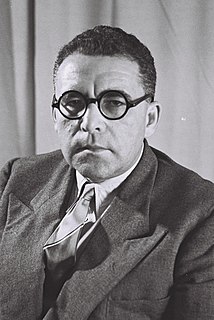
The sixth Knesset started with Levi Eshkol's Alignment forming the thirteenth government on 12 January 1966. His coalition included the National Religious Party, Mapam, the Independent Liberals, Poalei Agudat Yisrael, Progress and Development and Cooperation and Brotherhood, and had eighteen ministers. Kadish Luz of the Alignment retained his position as Knesset Speaker. At the end of August, 1966 the new Knesset at Givat Ram in Jerusalem was opened. When the Six-Day War broke out on 5 June 1967, Gahal and Rafi joined the coalition to form a national unity government with 21 ministers. The government was ended by Eshkol's death on 26 February 1969.
Golda Meir of the Alignment formed the fourteenth government, also a national unity government, on 17 March 1969. The coalition partners were Gahal, the National Religious Party, the Independent Liberals, Progress and Development and Cooperation and Brotherhood.
The sixth Knesset is notable for being the only one in which a party has ever held a majority of the seats by itself. By the end of the session, the merger of Mapam and Rafi into the Alignment left it with 63 seats (53% of the total). Although the party came close to equalling the feat in the 1969 elections, when it won 56 seats (which is still the best electoral performance on record), no party has managed it since.
Rafi was a center-left political party in Israel, founded by former Prime Minister, David Ben-Gurion in 1965. In 1968 it was one of three parties that merged to form the Israeli Labor Party.
Gahal was the major right-wing political alliance in Israel led by Menachem Begin from its founding in 1965 until the establishment of Likud in 1973.
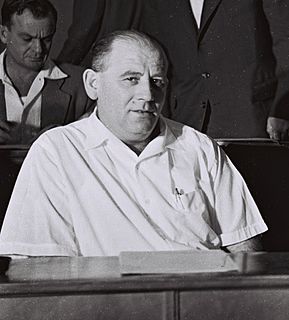
Yosef Aharon Almogi was an Israeli politician who served as a member of the Knesset between 1955 and 1977, as well as holding several ministerial posts.
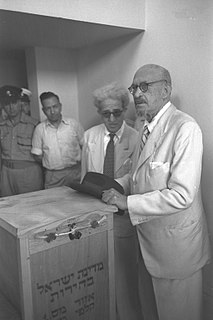
Elections for the second Knesset were held in Israel on 30 July 1951. Voter turnout was 75.1%.
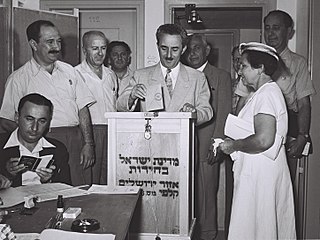
Elections for the third Knesset were held in Israel on 26 July 1955. Voter turnout was 82.8%.
Elections for the fourth Knesset were held in Israel on 3 November 1959. Voter turnout was 81.5%.
Elections for the fifth Knesset were held in Israel on 15 August 1961. Voter turnout was 81.6%.

The Alignment is the name of two political alliances in Israel. Each of these Alignment parties later merged into what is now the Israeli Labor Party.
The seventh government of Israel was formed by David Ben-Gurion on 3 November 1955 following the July 1955 elections. His coalition included Mapai, the National Religious Front, Mapam, Ahdut HaAvoda, and the Israeli Arab parties, the Democratic List for Israeli Arabs, Progress and Work and Agriculture and Development.
The eighth government of Israel was formed by David Ben-Gurion on 7 January 1958, and was the second government of the third Knesset. Ben-Gurion kept the same coalition partners as during the previous government, i.e. Mapai, the National Religious Party, Mapam, Ahdut HaAvoda, the Progressive Party, the Democratic List for Israeli Arabs, Progress and Work and Agriculture and Development. The only change to the cabinet was the addition of Shlomo-Yisrael Ben-Meir as a Deputy Minister.
The ninth government of Israel was formed by David Ben-Gurion on 17 December 1959 following the November 1959 elections. Ben-Gurion largely kept the same coalition partners as during the previous government, and added the new Israeli Arab parties Progress and Development and Cooperation and Brotherhood.
The tenth government of Israel was formed on 2 November 1961 following the August elections. Although David Ben-Gurion was appointed Prime Minister, the government was actually formed by Minister of Finance, Levi Eshkol. On 7 September Ben-Gurion had told President Yitzhak Ben-Zvi that he was unable to form a government; on 14 September Ben-Zvi asked Eshkol to form a government, with Eshkol subsequently announcing that he would do so with Ben-Gurion as PM. It turned out to be the last government led by Ben-Gurion.
The eleventh government of Israel was formed on 26 June 1963, midway through the fifth Knesset. It was the first government formed by Levi Eshkol following the second resignation of David Ben-Gurion.
The twelfth government of Israel was formed by Levi Eshkol on 22 December 1964, towards the end of the fifth Knesset.
The thirteenth government of Israel was formed by Levi Eshkol on 12 January 1966, following the November 1965 elections. His coalition included the Alignment, the National Religious Party, Mapam, the Independent Liberals, Poalei Agudat Yisrael, Progress and Development and Cooperation and Brotherhood, and had eighteen ministers.
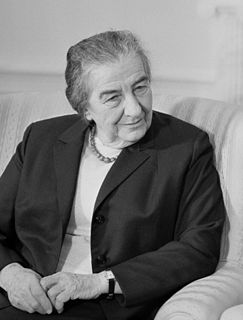
The fourteenth government of Israel was formed by Golda Meir on 17 March 1969, following the death of Prime Minister Levi Eshkol on 26 February. She kept the same national unity government coalition, including the newly formed Alignment alliance of the Labor Party and Mapam, as well as Gahal, the National Religious Party, the Independent Liberals, Poalei Agudat Yisrael, Progress and Development, Cooperation and Brotherhood. The only change to the cabinet was the scrapping of the Minister of Information post, with the previous post-holder Yisrael Galili becoming a Minister without Portfolio instead.
Mapam was a left-wing political party in Israel. The party is one of the ancestors of the modern-day Meretz party.