United Torah Judaism is an alliance of Degel HaTorah and Agudat Israel, two Ashkenazi Haredi (ultra-Orthodox) political parties in the Israeli Knesset. It was first formed in 1992.
The National Religious Party was a political party in Israel representing the religious Zionist movement. Formed in 1956, at the time of its dissolution in 2008, it was the second-oldest surviving party in the country after Agudat Yisrael, and was part of every government coalition until 1992. Traditionally a practical centrist party, in its later years, it drifted to the right, becoming increasingly associated with Israeli settlers, and towards the end of its existence, it was part of a political alliance with the strongly right-wing National Union. The 2006 elections saw the party slump to just three seats, the worst electoral performance in its history. In November 2008, party members voted to disband the party in order to join the new Jewish Home party created by a merger of the NRP and most of the National Union factions. However, most of the National Union left the merger shortly after its implementation.

Mapai was a centre-left political party in Israel, and was the dominant force in Israeli politics until its merger into the modern-day Israeli Labor Party in 1968. During Mapai's time in office, a wide range of progressive reforms were carried out, as characterised by the establishment of a welfare state, providing minimum income, security, and free access to housing subsidies and health and social services.

Agudat Yisrael is an ultra-Orthodox Jewish political party in Israel. It began as a political party representing ultra-Orthodox Jews in Poland, originating in the Agudath Israel movement in Upper Silesia. It later became the Party of many Haredim in Israel. It was the umbrella party for many, though not all, Haredi Jews in Israel until the 1980s, as it had been during the British Mandate of Palestine.

Zerach Warhaftig was an Israeli lawyer and politician. He was a signatory of Israel's Declaration of Independence.
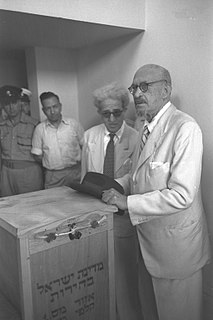
Elections for the second Knesset were held in Israel on 30 July 1951. Voter turnout was 75.1%.
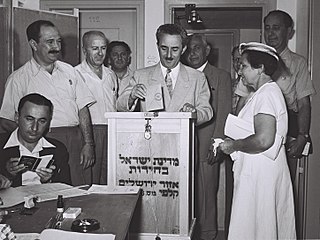
Elections for the third Knesset were held in Israel on 26 July 1955. Voter turnout was 82.8%.
Hapoel HaMizrachi was a political party and settlement movement in Israel and is one of the predecessors of the National Religious Party, which later became the modern-day Jewish Home Party.
Poalei Agudat Yisrael was a trade union and Jewish political party in Poland, and was a minor political party in Israel. It was also known as PAI or PAGI, its Hebrew acronym.

Kalman Kahana was a long-serving Israeli politician and journalist, and a signatory of the Israeli declaration of independence. He was the brother of Yitzhak Kahan, former President of the Supreme Court of Israel.

The third government of Israel was formed by David Ben-Gurion on 8 October 1951, more than two months after the elections. His Mapai party formed a coalition with Mizrachi, Hapoel HaMizrachi, Agudat Yisrael, Poalei Agudat Yisrael and the three Israeli Arab parties, the Democratic List for Israeli Arabs, Progress and Work and Agriculture and Development. There were 15 ministers.

Haim-Moshe Shapira was a key Israeli politician in the early days of the state's existence. A signatory of Israel's declaration of independence, he served continuously as a minister from the country's foundation in 1948 until his death in 1970 apart from a brief spell in the late 1950s.

David-Zvi Pinkas was a Zionist activist and Israeli politician. A signatory of the Israeli declaration of independence, he was the country's third Minister of Transport.

Mordechai Nurock was a Latvian-born Israeli who served in both the parliaments of Latvia and Israel. He was also Israel's first Minister of Postal Services, though he only held the post for just under two months.

The Assembly of Representatives was the elected parliamentary assembly of the Jewish community in Mandatory Palestine. It was established on 19 April 1920, and functioned until 13 February 1949, the day before the first Knesset, elected on 25 January, was sworn in. The Assembly met once a year to elect the executive body, the Jewish National Council, which was responsible for education, local government, welfare, security and defense. It also voted on the budgets proposed by the Jewish National Council and the Rabbinical Council.

Tova Sanhadray-Goldreich was an Israeli politician who served as a member of the Knesset for the National Religious Party between 1959 and 1974.
The Kehilla is the local Jewish communal structure that was reinstated in the early twentieth century as a modern, secular, and religious sequel of the Qahal in Central and Eastern Europe, more particularly in Poland's Second Republic, Estonia, Latvia, Lithuania, Ukrainian People's Republic, during the interwar period (1918–1940), in application of the national personal autonomy.
Elections to the Assembly of Representatives was an election for representatives of the Yishuv, the pre-state Jewish community in Mandate Palestine. The election took place on April 19, 1920. In Jerusalem, the vote took place on May 3.
Elections to the Assembly of Representatives were held in Mandate Palestine on 5 January 1931. Mapai emerged as the largest party.