| ||||||||||||||||
| ||||||||||||||||
| ||||||||||||||||
General elections were held in Israel on 29 May 1996. For the first time the Prime Minister was elected on a separate ballot from the remaining members of the Knesset.
Israel, officially the State of Israel, is a country in Western Asia, located on the southeastern shore of the Mediterranean Sea and the northern shore of the Red Sea. It has land borders with Lebanon to the north, Syria to the northeast, Jordan on the east, the Palestinian territories of the West Bank and Gaza Strip to the east and west, respectively, and Egypt to the southwest. The country contains geographically diverse features within its relatively small area. Israel's economic and technological center is Tel Aviv, while its seat of government and proclaimed capital is Jerusalem, although the state's sovereignty over Jerusalem has only partial recognition.
The Prime Minister of Israel is the head of government and chief executive of Israel.
The Knesset is the unicameral national legislature of Israel. As the legislative branch of the Israeli government, the Knesset passes all laws, elects the President and Prime Minister, approves the cabinet, and supervises the work of the government. In addition, the Knesset elects the State Comptroller. It also has the power to waive the immunity of its members, remove the President and the State Comptroller from office, dissolve the government in a constructive vote of no confidence, and to dissolve itself and call new elections. The Prime Minister may also dissolve the Knesset. However, until an election is completed, the Knesset maintains authority in its current composition. The Knesset is located in Givat Ram, Jerusalem.
The 1996 elections resulted in a surprise victory for Netanyahu by a margin of 29,457 votes, less than 1% of the total number of votes cast, and much smaller than the number of spoiled votes. This came after the initial exit polls had predicted a Peres win, [1] spawning the phrase "went to sleep with Peres, woke up with Netanyahu." [2] This election was Peres's fourth and last election defeat.
This section needs expansion. You can help by adding to it.(January 2012) |
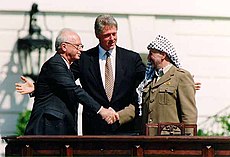
On 13 September 1993, Israel and the Palestine Liberation Organization (PLO) signed the Oslo Accords (a Declaration of Principles) [3] on the South Lawn of the White House. The principles established objectives relating to a transfer of authority from Israel to an interim Palestinian authority, as a prelude to a final treaty establishing a Palestinian state.
The Palestine Liberation Organization is an organization founded in 1964 with the purpose of the "liberation of Palestine" through armed struggle, with much of its violence aimed at Israeli civilians. It is recognized as the "sole legitimate representative of the Palestinian people" by over 100 states with which it holds diplomatic relations, and has enjoyed observer status at the United Nations since 1974. The PLO was considered by the United States and Israel to be a terrorist organization until the Madrid Conference in 1991. In 1993, the PLO recognized Israel's right to exist in peace, accepted UN Security Council resolutions 242 and 338, and rejected "violence and terrorism". In response, Israel officially recognized the PLO as the representative of the Palestinian people. However, the PLO has employed violence in the years since 1993, particularly during the 2000–2005 Second Intifada. On 29 October 2018, the Palestinian Central Council suspended the recognition of Israel and halted security and economic coordination in all its forms with it.
The Oslo Accords are a set of agreements between the Government of Israel and the Palestine Liberation Organization (PLO): the Oslo I Accord, signed in Washington, D.C., in 1993; and the Oslo II Accord, signed in Taba, Egypt, in 1995. The Oslo Accords marked the start of the Oslo process, a peace process aimed at achieving a peace treaty based on United Nations Security Council Resolutions 242 and 338, and at fulfilling the "right of the Palestinian people to self-determination." The Oslo process started after secret negotiations in Oslo, resulting in the recognition by the PLO of the State of Israel and the recognition by Israel of the PLO as the representative of the Palestinian people and as a partner in negotiations.
The White House is the official residence and workplace of the President of the United States. It is located at 1600 Pennsylvania Avenue NW in Washington, D.C. and has been the residence of every U.S. President since John Adams in 1800. The term "White House" is often used as a metonym for the president and his advisers.
On 25 July 1994, Jordan and Israel signed the Washington Declaration, which formally ended the state of war that had existed between them since 1948 and on 26 October the Israel–Jordan Treaty of Peace, witnessed by U.S. President Bill Clinton. [4] [5]
The Israel–Jordan peace treaty or in full "Treaty of Peace Between the State of Israel and the Hashemite Kingdom of Jordan", sometimes referred to as Wadi Araba Treaty, was signed in 1994. The signing ceremony took place at the southern border crossing of Arabah on 26 October 1994. Jordan was the second Arab country, after Egypt, to sign a peace accord with Israel.
War is a state of armed conflict between states, governments, societies and informal paramilitary groups, such as mercenaries, insurgents and militias. It is generally characterized by extreme violence, aggression, destruction, and mortality, using regular or irregular military forces. Warfare refers to the common activities and characteristics of types of war, or of wars in general. Total war is warfare that is not restricted to purely legitimate military targets, and can result in massive civilian or other non-combatant suffering and casualties.
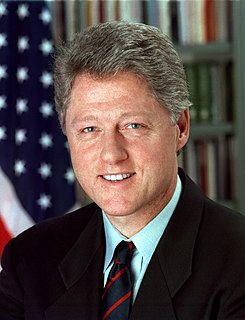
William Jefferson Clinton is an American politician who served as the 42nd president of the United States from 1993 to 2001. Prior to the presidency, he was the governor of Arkansas from 1979 to 1981, and again from 1983 to 1992, and the attorney general of Arkansas from 1977 to 1979. A member of the Democratic Party, Clinton was ideologically a New Democrat, and many of his policies reflected a centrist "Third Way" political philosophy.
Prime Minister Yitzhak Rabin and PLO Chairman Yasser Arafat signed the Israeli–Palestinian Interim Agreement on the West Bank and the Gaza Strip on 28 September 1995, in Washington. The agreement allowed the PLO leadership to relocate to the occupied territories and granted autonomy to the Palestinians with talks to follow regarding final status. In return the Palestinians promised to abstain from use of terror and changed the Palestinian National Covenant, which had called for the expulsion of all Jews who migrated after 1917 and the elimination of Israel. [6]
Yitzhak Rabin was an Israeli politician, statesman and general. He was the fifth Prime Minister of Israel, serving two terms in office, 1974–77 and 1992 until his assassination in 1995.
Mohammed Yasser Abdel Rahman Abdel Raouf Arafat al-Qudwa al-Husseini, popularly known as Yasser Arafat or by his kunya Abu Ammar, was a Palestinian political leader. He was Chairman of the Palestine Liberation Organization (PLO) from 1969 to 2004 and President of the Palestinian National Authority (PNA) from 1994 to 2004. Ideologically an Arab nationalist, he was a founding member of the Fatah political party, which he led from 1959 until 2004.
The Palestinian National Covenant or Palestinian National Charter is the covenant or charter of the Palestine Liberation Organization (PLO). The Covenant is an ideological paper, written in the early days of the PLO.
Tensions in Israel arising from the continuation of terrorism led to the assassination of Prime Minister Rabin by a right-wing Jewish radical on 4 November 1995 during at the end of a rally in support of the Oslo agreements held in the center of Tel Aviv. The murderer, Yigal Amir, was a law student at the Bar-Ilan University, believed that the Oslo Accords were an existential threat to Israel and hoped that by murdering Rabin he would prevent the implementation of the Oslo Accords. The assassination of Rabin was a shock to the Israeli public. Approximately 80 heads of state attend Rabin's funeral in Jerusalem.
The assassination of Yitzhak Rabin took place on 4 November 1995 at 21:30, at the end of a rally in support of the Oslo Accords at the Kings of Israel Square in Tel Aviv. The assassin, an Israeli ultranationalist named Yigal Amir, radically opposed Rabin's peace initiative and particularly the signing of the Oslo Accords.
Yigal Amir is an Israeli who assassinated Prime Minister of Israel Yitzhak Rabin. The assassination took place on November 4, 1995, at the conclusion of a rally in Tel Aviv, Israel. Amir is serving a life sentence for murder plus six years for injuring Rabin's bodyguard, Yoram Rubin, under aggravating circumstances. He was later sentenced to an additional eight years for conspiracy to murder.
Bar-Ilan University is a public research university in the city of Ramat Gan in the Tel Aviv District, Israel. Established in 1955, Bar Ilan is Israel's second-largest academic institution. It has some 33,000 students and 1,350 faculty members.
After taking over from Yitzhak Rabin following his assassination, Peres decided to call early elections in order to give the government a mandate to advance the peace process. [7]
Netanyahu's campaign was helped by Australian mining magnate Joseph Gutnick, who donated over $1 million to Likud.
Nevertheless, Labour and Peres were comfortably ahead in the polls early in 1996, holding a lead of 20%. However, the country was hit by a spate of suicide attacks by Hamas including the Jerusalem bus 18 massacres and other attacks in Ashkelon and the Dizengoff Center, which killed 59 people and severely damaged Peres' election chances. [8] Polls taken in mid-May showed Peres ahead by just 4-6%, [9] whilst two days before the election his lead was down to 2%. [10]
Several leading ultra-orthodox Rabbis, including Elazar Shach, called on their followers to vote for Netanyahu, [11] whilst Leah Rabin, Yitzhak's widow, called on Israelis to vote for Peres so that her husband's death "would not be in vain." [12] Netanyahu also warned that a Peres victory would lead to the division of Jerusalem in a final peace deal with the Palestinians.
Despite the national trauma which the assassination of Rabin caused, and although many blamed at the time the leaders of Israeli political right for the incitement that preceded the assassination, due to the series of suicide bombings carried out in Israel, and due to the failed military operation "Grapes of Wrath" conducted in Lebanon that caused many casualties among Lebanese civilians, a significant change occurred in the position of the Israeli voters which resulted eventually in 50.5% percent of voters supporting Netanyahu on election day. A significant number of Israeli Arabs boycotted the elections amidst rising Lebanese casualties, which became an advantage for Netanyahu as the vast majority of Arabs would have supported Peres but declined to vote. In addition, the intensive campaign conducted by Netanyahu versus the failed campaign of Shimon Peres, as well as the support Netanyahu got at the last moment from the Chabad movement, were all in Netanyahu's favor.
| Candidate | Party | Votes | % |
|---|---|---|---|
| Binyamin Netanyahu | Likud | 1,501,023 | 50.50% |
| Shimon Peres | Labor | 1,471,566 | 49.50% |
| Invalid/blank votes | 148,681 | – | |
| Total | 3,121,270 | 100% | |
Netanyahu's win was bolstered by large support from the ultra-orthodox community, 91.2% of whom voted for him. Peres on the other hand, gained overwhelming support from the country's Arab community, 97.5% of which backed him. [13]
| Party | Votes | % | Seats | +/– |
|---|---|---|---|---|
| Labor Party 1 2 | 818,741 | 26.8 | 34 | −10 |
| Likud-Gesher-Tzomet 2 3 | 767,401 | 25.1 | 32 | −8 |
| Shas | 259,796 | 8.5 | 10 | +4 |
| National Religious Party 4 | 240,271 | 7.8 | 9 | +3 |
| Meretz 5 | 226,275 | 7.4 | 9 | −3 |
| Yisrael BaAliyah 6 | 174,994 | 5.7 | 7 | New |
| Hadash-Balad 7 | 129,455 | 4.2 | 5 | +2 |
| United Torah Judaism 8 | 98,657 | 3.2 | 4 | 0 |
| The Third Way 9 | 96,474 | 3.1 | 4 | New |
| United Arab List–Arab Democratic Party | 89,514 | 2.9 | 4 | +2 |
| Moledet 10 | 72,002 | 2.4 | 2 | −1 |
| Unity for the Defence of New Immigrants | 22,741 | 0.7 | 0 | New |
| Gil | 14,935 | 0.5 | 0 | New |
| Progressive Confederation | 13,983 | 0.5 | 0 | New |
| Telem Emuna | 12,737 | 0.4 | 0 | New |
| Settlement Party | 5,533 | 0.2 | 0 | New |
| Yamin Yisrael | 2,845 | 0.1 | 0 | New |
| Man's Rights in the Family Party | 2,388 | 0.1 | 0 | New |
| Ta'al | 2,087 | 0.1 | 0 | New |
| Organization for Democratic Action | 1,351 | 0.0 | 0 | New |
| Invalid/blank votes | 67,702 | – | – | – |
| Total | 3,119,832 | 100 | 120 | 0 |
| Registered voters/turnout | 3,933,250 | 79.3 | – | – |
| Source: Nohlen et al. [14] | ||||
1 Three MKs left the Labor Party to establish One Nation.
2 Two MKs from the Labor Party and four from Likud left to form the Centre Party. Eliezer Sandberg later broke away from the Centre Party and formed HaTzeirim before joining Shinui.
3 Three MKs left Likud to establish Herut – The National Movement. Three members of Gesher and two members of Tzomet also left alliance.
4 Two MKs left the National Religious Party to establish Tkuma.
5 Avraham Poraz left Meretz to establish Shinui, whilst David Zucker also left the party.
6 Two MKs left Yisrael BaAliyah to establish Aliyah.
7 Balad left its alliance with Hadash.
8 United Torah Judaism split into Agudat Yisrael (three seats) and Degel HaTorah (one seat).
9 Emanuel Zisman left The Third Way.
10 Moshe Peled broke away from Tzomet and formed Mekhora before joining Moledet.
Despite winning the election for Prime Minister, Netanyahu's Likud (in an alliance with Gesher and Tzomet) lost the Knesset elections to Labour, winning only 32 seats compared to Labour's 34.
The objective of strengthening the position of Prime Minister by having separate elections was also a failure, as the election saw both major parties lose around ten seats compared to the 1992 election (Likud held only 24 of the 32 seats it won in its alliance) as many gave their Knesset votes to smaller parties; Labour received 818,570 votes to Peres' 1.47 million, (56%), whilst the Likud–Gesher–Tzomet alliance managed even less—767,178 compared to 1.50 million for Netanyahu (51%).
With only 32 seats, the Likud–Gesher–Tzomet alliance was, at the time, the smallest faction to lead a government in Israeli political history (the previous low had been Mapai's 40 seats in the 1955 election; since then, the 2006 elections saw Kadima emerge as the largest party with just 29 seats, and the 2009 election was won by Kadima with 28 seats, but Likud with 27 formed the government). This meant Netanyahu had to form a coalition with several smaller parties, including the ultra-orthodox parties Shas and United Torah Judaism whose financial policies (generous child benefits and state funding for religious activities) were in direct opposition to his capitalistic outlook.
After several defections from his party, Netanyahu was forced to call early elections in 1999.
Labour retained its position as the largest party, but Likud's Netanyahu won the election for Prime Minister, meaning he had the power to form the 27th government, which he did on 18 June 1996.
Alongside his Likud–Gesher–Tzomet alliance, Netanyahu formed a coalition with Shas, the National Religious Party, Yisrael BaAliyah, United Torah Judaism and The Third Way, with 18 ministers.
Gesher broke away from the alliance with Likud and left the government coalition in January 1998.
Netanyahu faced several issues; the left argued the peace process was advancing too slowly, but signing the Hebron Agreement and the Wye River Memorandum also caused him problems with the right-wing.
Eventually problems passing the state budget for 1999 led to early elections for both the Knesset and Prime Minister being called, which were held in May 1999.
Benjamin "Bibi" Netanyahu is an Israeli politician serving as the 9th and current Prime Minister of Israel since 2009, previously holding the position from 1996 to 1999. Netanyahu is also currently a member of the Knesset and the Chairman of the Likud party. He is the first Israeli Prime Minister born in Israel after the establishment of the state.
Likud, officially the Likud-National Liberal Movement, is a centre-right to right-wing political party in Israel. A secular party, it was founded in 1973 by Menachem Begin and Ariel Sharon in an alliance with several right-wing parties. Likud's landslide victory in the 1977 elections was a major turning point in the country's political history, marking the first time the left had lost power. In addition, it was the first time in Israel that a right-wing party won the plurality of the votes. However, after ruling the country for most of the 1980s, the party lost the Knesset election in 1992. Nevertheless, Likud's candidate Benjamin Netanyahu did win the vote for Prime Minister in 1996 and was given the task of forming a government after the 1996 elections. Netanyahu's government fell apart after a vote of no confidence, which led to elections being called in 1999 and Likud losing power to the One Israel coalition led by Ehud Barak.
Tzomet is a small secular, right-wing political party in Israel.
David Levy is an Israeli politician who served as a member of the Knesset between 1969 and 2006, as well as Deputy Prime Minister, Minister of Foreign Affairs, Minister of Immigrant Absorption, Minister of Housing and Construction and as a Minister without Portfolio. Although most of his time as a Knesset member was spent with Likud, he also led the breakaway Gesher faction, which formed part of Ehud Barak's Labor-led government between 1999 and 2001.
Elections for the 17th Knesset were held in Israel on 28 March 2006. The voting resulted in a plurality of seats for the then-new Kadima party, followed by the Labor Party, and a major loss for the Likud party.
Elections for the 16th Knesset were held in Israel on 28 January 2003. The result was a resounding victory for Ariel Sharon's Likud.

Early general elections for both the Prime Minister and the Knesset were held in Israel on 17 May 1999 following a vote of no confidence in the government; the incumbent Likud Prime Minister Benjamin Netanyahu, ran for re-election.

Kadima was a centrist and liberal political party in Israel. It was established on 24 November 2005 by moderates from Likud largely to support the issue of Ariel Sharon's unilateral disengagement plan, and was soon joined by like-minded Labor politicians.
Gesher, officially the Gesher National Social Movement, was a political party in Israel between 1996 and 2003.
Legislative elections were held in Israel on 17 May 1977 to elect the ninth Knesset. For the first time in Israeli political history, the right-wing, led by Likud, won a plurality of seats, ending almost 30 years of rule by the left-wing Alignment and its predecessor, Mapai. The dramatic shift in Israeli politics caused by the outcome led to it becoming known as "the revolution", a phrase coined by TV anchor Haim Yavin when he announced the election results live on television with the words "Ladies and gentlemen—a revolution!". The election saw the beginning of a period lasting almost two decades where the left- and right-wing blocs held roughly equal numbers of seats in the Knesset.

The Alignment is the name of two political alliances in Israel. Each of these Alignment parties later merged into what is now the Israeli Labor Party.
Elections for the 13th Knesset were held in Israel on 23 June 1992. The election resulted in the formation of a Labor government, led by Yitzhak Rabin, helped by the failure of several small right wing parties to pass the electoral threshold. Voter turnout was 77.4%.
One Israel was an alliance of the Labor Party, Meimad and Gesher created to run for the 1999 Knesset elections.
Elections for the 18th Knesset were held in Israel on 10 February 2009. These elections became necessary due to the resignation of Prime Minister Ehud Olmert as leader of the Kadima party, and the failure of his successor, Tzipi Livni, to form a coalition government. Had Olmert remained in office or had Livni formed a coalition government, the elections would have been scheduled for 2010 instead.
The twenty-seventh government of Israel was formed by Benjamin Netanyahu of Likud on 18 June 1996. Although his Likud-Gesher-Tzomet alliance won fewer seats that the Labor Party, Netanyahu formed the government after winning the country's first ever direct election for Prime Minister, narrowly defeating incumbent Shimon Peres. This government was the first formed by an Israeli national born in the state after independence in 1948.
Early elections for the nineteenth Knesset were held in Israel on 22 January 2013. Public debate over the Tal Law had nearly led to early elections in 2012, but they were aborted at the last moment after Kadima briefly joined the government. The elections were later called in early October 2012 after failure to agree on the budget for the 2013 fiscal year.
Early elections for the twentieth Knesset were held in Israel on 17 March 2015. Disagreements within the governing coalition, particularly over the budget and a "Jewish state" proposal, led to the dissolution of the government in December 2014. The Labor Party and Hatnuah formed a coalition, called Zionist Union, with the hope of defeating the Likud party, which had led the previous governing coalition along with Yisrael Beiteinu, Yesh Atid, The Jewish Home and Hatnuah.
The Israeli Labor Party, commonly known as HaAvoda, is a social democratic and Zionist political party in Israel. The Israeli Labor Party was established in 1968 by a merger of Mapai, Ahdut HaAvoda and Rafi. Until 1977, all Israeli Prime Ministers were affiliated with the Labor movement. The current party leader and candidate for prime minister is Avi Gabbay.
Politics in Israel is dominated by Zionist parties. They traditionally fall into three camps, the first two being the largest: Labor Zionism, Revisionist Zionism (conservative) and Religious Zionism. There are also several non-Zionist Orthodox religious parties, non-Zionist left-wing groups as well as non-Zionist and anti-Zionist Israeli Arab parties.