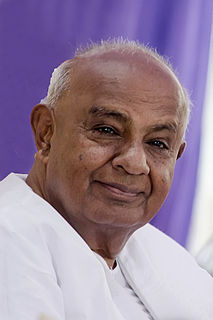
The Bharatiya Janata Party is one of the two major political parties in India, along with the Indian National Congress. As of 2018, it is the country's largest political party in terms of representation in the national parliament and state assemblies, and it is the world's largest party in terms of primary membership. BJP is a right-wing party, and its policy has historically reflected Hindu nationalist positions. It has close ideological and organisational links to the Rashtriya Swayamsevak Sangh (RSS).

The Jammu & Kashmir National Conference (JKNC) is a state political party in the Indian state of Jammu and Kashmir. Founded as the All Jammu and Kashmir Muslim Conference by Sheikh Abdullah and Chaudhry Ghulam Abbas in 1932 in the princely state of Jammu and Kashmir, the organisation renamed itself to "National Conference" in 1939 in order to represent all the people of the state. It supported the accession of the princely state to India in 1947. Prior to that, in 1941, a group led by Ghulam Abbas broke off from the National Conference and revived the old Muslim Conference. The revived Muslim Conference supported the accession of the princely state to Pakistan and led the movement for Azad Kashmir.
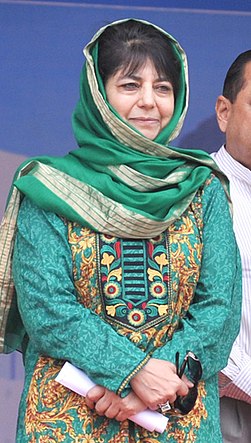
Mehbooba Mufti is an Indian politician who served as the Chief Minister of Jammu and Kashmir, from 4th April 2016 to 19th June 2018. She is a supporter of the article 35A and 370 of the Indian Constitution. She resigned on June 19 2018 after BJP withdrew support from the coalition government. She was the first woman to hold the office. Mehbooba Mufti is India's second Muslim woman chief minister after Syeda Anwara Taimur of Assam. She is the president of the Jammu and Kashmir Peoples Democratic Party (PDP) and was a member of the Indian parliament, representing Anantnag in the 16th Lok Sabha; before she was sworn in as the Chief Minister of J&K. She had previously represented Anantnag in the 14th Lok Sabha (2004–09) but did not contest the 2009 election for the 15th Lok Sabha. She is a supporter of Jamaat e Islami
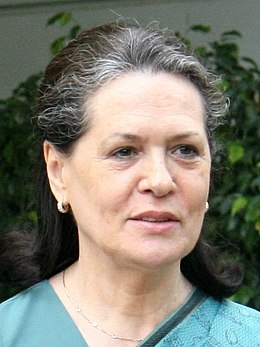
Legislative elections were held in India in four phases between 20 April and 10 May 2004. Over 670 million people were eligible to vote, electing 543 members of the 14th Lok Sabha. The Lok Sabha, or "House of the People," is the directly elected lower house of the Parliament of India.

The All India Trinamool Congress is a national level political party in India. Founded on 1 January 1998, the party is led by its founder Mamata Banerjee, who is the current chief minister of West Bengal. Following the 2014 general election, it is currently the fourth largest party in the Lok Sabha with 36 seats.
United Progressive Alliance (UPA) is a coalition of centre-left political parties in India formed after the 2004 general election. The largest member party of the UPA is the INC, whose Former National President Sonia Gandhi is chairperson of the UPA. It formed a government with support from some other left-aligned parties in 2004.
The Indian National Lok Dal (INLD) is a political party in India, in the state of Haryana. INLD was founded in October 1996 as Haryana Lok Dal (Rashtriya) by Choudhary Devi Lal, who served as Deputy Prime Minister of India in the V.P. Singh's Cabinet and Chief Minister of Haryana twice. His son Om Prakash Chautala is the president.

The Jammu and Kashmir Peoples Democratic Party (JKPDP) is a state political party in Jammu and Kashmir, India. The PDP was headed and founded by Mufti Mohammed Sayeed. His daughter, Mehbooba Mufti, succeeded him as party leader and as Chief Minister of Jammu and Kashmir following his death in January 2016.

The Jammu & Kashmir National Panthers Party is a state political party in the state of Jammu and Kashmir, India. The party was founded on 23 March 1982 by Prof. Bhim Singh and a few prominent youth political personalities of the time including Jay Mala, former President of the Indian Students Congress. Its aim is to "demolish corruption, communalism, criminalization, drug menace" and to establish a real democracy through ultimate revolution.
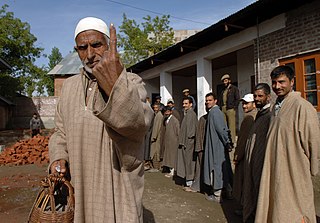
Elections in Jammu and Kashmir include elections to the Parliament of India, both houses of the bicameral state legislature, and various other local level bodies such as municipalities and Panchayat constituencies. The legal authority to conduct elections in Jammu and Kashmir is drawn from provisions in both the Constitution of India and the Constitution of Jammu and Kashmir.
The Jammu and Kashmir Awami League is a political party in Jammu and Kashmir. The party was founded by members of different counter-insurgent groups in November 1995. Mohammad Yusuf Parray, the chief of Ikhwan-ul-Musalmoon, was the founding chairman of the party. Mir Niyazi, a former Hizbul Mujahideen commander, became the general secretary of the party and Javed Hussain Shah its vice chairman. It supports article 370 of the Indian constitution, granting special status to Jammu and Kashmir. The party argues that the people of Jammu and Kashmir have the right to self-determination within the Indian constitutional framework, but not accession to Pakistan nor independence.

The Jammu and Kashmir Legislative Assembly election, 2014 was held in the Indian state of Jammu and Kashmir in five phases from 25 November – 20 December 2014. Voters elected 87 members to the Jammu and Kashmir Legislative Assembly, which ends its six-year term on 19 January 2015. The results were declared on 23 December 2014. Voter-verified paper audit trail (VVPAT) along with EVMs were used in 3 assembly seats out of 87 in Jammu Kashmir elections.

Nirmal Kumar Singh is an Indian politician and present Speaker of the Jammu and Kashmir Legislative Assembly. He is a former Deputy Chief Minister of Jammu and Kashmir. He is a leader of Bharatiya Janata Party. On 1 March 2015 he assumed the charge as Minister for Power Development and Housing and Urban Development.
Elections for the Indian state of Jammu and Kashmir were held in February 1967. Ghulam Mohammed Sadiq was appointed Chief Minister of Jammu and Kashmir.
Elections in the Republic of India in 2018 included by-elections to the Lok Sabha, elections to the Rajya Sabha, elections to legislative assemblies of eight states and numerous other by-elections to state legislative assemblies, councils and local bodies.
Elections in India in 1977 included Legislative Assembly elections in several Indian states, including Goa, Himachal Pradesh, Jammu and Kashmir, Tamil Nadu, and West Bengal.
The elections in India in 2019 that include general election, by-elections to the Lok Sabha, elections to the Rajya Sabha, elections to six state legislative assemblies and numerous other by-elections to the state legislative assemblies, councils and local bodies.
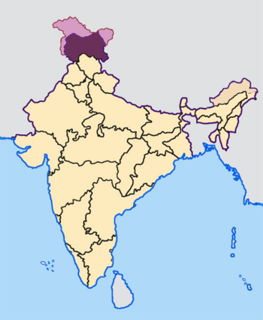
The Indian general election, 1996 in Jammu and Kashmir to the 11th Lok Sabha were held for 6 seats. Bharatiya Janata Party won 1 seat, Indian National Congress won 4 seats and Janta Dal won 1 seat.