Jammu and Kashmir Legislative Assembly election, 2008

Last updated

Jammu and Kashmir state assembly elections, 2008
Flag of India.svg
  2002 17 November 2008 to 24 December 2008 2014  

all 87 seats in Legislative Assembly
44 seats needed for a majority
Turnout 60.5%

  First party Second party Third party
  Omar Abdullah (cropped).jpg Flag of the JKPDP.png Flag of the Indian National Congress.svg
Leader Omar Abdullah Mehbooba Mufti
Party JKN PDP INC
Last election 28 16 20
Seats won 28 21 17
Seat change noneIncrease2.svg 5Decrease2.svg 3

  Fourth party Fifth party
 
Leader Bhim Singh
Party BJP JKNPP
Last election 1 4
Seats won 11 3
Seat changeIncrease2.svg 10Decrease2.svg 1

Chief Minister before election

Ghulam Nabi Azad
INC

Elected Chief Minister

Omar Abdullah
JKN

Elections for the Indian state of Jammu and Kashmir were held over seven days in November and December 2008. The previous government led by the Jammu and Kashmir People's Democratic Party (PDP) in coalition with the Indian National Congress (INC) collapsed when the PDP withdrew. Following the election, the Jammu & Kashmir National Conference (NC) agreed a coalition with Congress and their leader, Omar Abdullah became the state's youngest ever Chief Minister at 38.

India Country in South Asia

India, also known as the Republic of India, is a country in South Asia. It is the seventh largest country by area and with more than 1.3 billion people, it is the second most populous country as well as the most populous democracy in the world. Bounded by the Indian Ocean on the south, the Arabian Sea on the southwest, and the Bay of Bengal on the southeast, it shares land borders with Pakistan to the west; China, Nepal, and Bhutan to the northeast; and Bangladesh and Myanmar to the east. In the Indian Ocean, India is in the vicinity of Sri Lanka and the Maldives, while its Andaman and Nicobar Islands share a maritime border with Thailand and Indonesia.

Jammu and Kashmir State in India

Jammu and Kashmir is a state in northern India, often denoted by its acronym, J&K. It is located mostly in the Himalayan mountains, and shares borders with the states of Himachal Pradesh and Punjab to the south. The Line of Control separates it from the Pakistani-administered territories of Azad Kashmir and Gilgit-Baltistan in the west and north respectively, and a Line of Actual Control separates it from the Chinese-administered territory of Aksai Chin in the east. The state has special autonomy under Article 370 of the Constitution of India.

Indian National Congress Major political party in India

The Indian National Congress(pronunciation ) is a broadly based political party in India. Founded in 1885, it was the first modern nationalist movement to emerge in the British Empire in Asia and Africa. From the late 19th century, and especially after 1920, under the leadership of Mahatma Gandhi, Congress became the principal leader of the Indian independence movement. Congress led India to independence from Great Britain, and powerfully influenced other anti-colonial nationalist movements in the British Empire.

Contents

Background

Elections for the Jammu and Kashmir state Assembly were due in 2008, following the end of the term of the Assembly elected in 2002. However the PDP withdrew from the INC-led state government in protest at the Amarnath land transfer decision. The INC government resigned in July 2008 and the state was brought under direct rule of the central government pending the elections. [1]

On 26 May 2008, the government of India and the state Government of Jammu and Kashmir reached an agreement to transfer 99 acres (0.40 km2) of forest land to the Shri Amarnathji Shrine Board (SASB) in the main Kashmir valley to set up temporary shelters and facilities for Hindu pilgrims. This caused a controversy, with demonstrations from the Kashmir valley against the land transfer and protests from the Jammu region supporting it. The largest demonstration saw more than 500,000 protesters at a single rally, among the largest in Kashmir's history.

Boycott

The main Kashmiri separatist group, the All Parties Hurriyat Conference called on Kashmiris to boycott the elections, saying the elections were a "futile exercise" that would never "fulfill the aspirations of the people". [2]

All Parties Hurriyat Conference (APHC) is an alliance of 26 political, social and religious organizations formed on 9 March 1993, as a united political front to raise the cause of Kashmiri separatism. This alliance has historically been viewed positively by Pakistan as it contests the claim of the Indian government over the State of Jammu and Kashmir. Mirwaiz Umar Farooq is its chairman and Ghulam Muhammad Safi was elected as its convener in Pakistan on January 2010.

Despite these boycott calls, NC leaders claimed that activists from Jamaat-e-Islami had comeout and voted for the PDP. [3]

Jamaat-e-Islami Kashmir Cadre-based religio-political organisation in Jammu and Kashmir

The Jamaat-e-Islami Kashmir or Jamaat-e-Islami Jammu and Kashmir (JIJK) is a cadre-based religio-political organisation in Jammu and Kashmir, distinct from the Jamaat-e-Islami Hind. The organisation's stated position on the Kashmir conflict is that Jammu and Kashmir is a disputed territory and the issue must be sorted as per UN or through tripartite talks between India and Pakistan and the real representatives of Jammu and Kashmir.

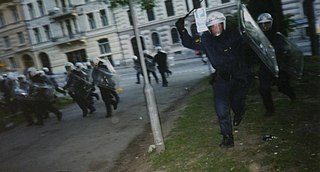
There were scattered separatist protests throughout the elections, including hundreds who protested in Srinagar. Police prevented these protestors from marching to the centre of the city which led to protestors throwing stones at the police who fired tear gas and used baton charges. [4]

Srinagar City in Jammu and Kashmir, India

Srinagar is the largest city and the summer capital of the Indian state of Jammu and Kashmir. It lies in the Kashmir Valley on the banks of the Jhelum River, a tributary of the Indus, and Dal and Anchar lakes. The city is known for its natural environment, gardens, waterfronts and houseboats. It is also known for traditional Kashmiri handicrafts and dried fruits. It is the northernmost city of India with over 1 million people.

Tear gas non-lethal chemical weapon

Tear gas, formally known as a lachrymator agent or lachrymator, sometimes colloquially known as mace, is a chemical weapon that causes severe eye and respiratory pain, skin irritation, bleeding, and even blindness. In the eye, it stimulates the nerves of the lacrimal gland to produce tears. Common lachrymators include pepper spray, PAVA spray (nonivamide), CS gas, CR gas, CN gas, bromoacetone, xylyl bromide, syn-propanethial-S-oxide, and Mace, and household vinegar.

Baton charge

A baton charge is a coordinated tactic for dispersing crowds of people, usually used by police or military during public order situations.

Security

Indian election officials voiced major concerns about the security of the elections given the calls for boycott and protest from separatist leaders and the recent violence over the Amarnath land transfer controversy. Voting was staggered so that security forces could maintain control. Thousands of security forces were deployed during the voting. In Srinagar, security forces were posted at junctions, patrolled the streets and guarded polling stations. An unofficial curfew was enforced, gatherings of more than five people banned and neighbourhoods were sealed off with steel barricades and razor wire. [4]

Police also arrested three men they accused of being Jaish-e-Mohammed members planning suicide attacks in Jammu. [5] One of those arrested was a soldier in the Army of Pakistan, who Pakistan said had deserted in 2006. [4] However following the polls the NC leader, Farooq Abdullah, thanked the Pakistan government for their "non-interference" with the polls. [6]

Results

The seven stages of the elections were held as follows:

Voting stages Jammu Kashmir state elections, 2008 stages.svg
Voting stages
Date Seats Turnout
Monday 17 November 10 69.02%
Sunday 23 November 6 68.29%
Sunday 30 November 5 68.22%
Sunday 7 December 18 59.24%
Saturday 13 December 11 58.5%
Wednesday 17 December 16 65.93%
Wednesday 24 December 21 52.0%
Total 87 60.5%
Source: [7] [8]

Turnout rose by 17%, despite calls from Kashmiri separatists and Pakistan for Kashmiris to boycott the election. [8] [9] INC head Sonia Gandhi described the polls as "a triumph of Indian democracy".

Separatist supporters were said to have backed the PDP. [9] The BJP's increase in support was said to be due to polarisation arising from the Amarnath land transfer controversy, which led it to increase its seat tally from 1 to 11 seats. [10]

1,354 candidates stood for election including 517 independents and nominees from 43 political parties. [11]

Summary

e    d  Summary of the November - December 2008 Jammu and Kashmir state assembly election results
PartyFlagSeats+/–
National Conference JKNC-flag.svg 28 0
People's Democratic Party Flag of the JKPDP.png 21 +5
Indian National Congress Flag of the Indian National Congress.svg 17 -3
Bharatiya Janata Party 11 +10
Jammu & Kashmir National Panthers Party Indian Election Symbol Cycle.png 3 -1
Communist Party of India (Marxist) CPI-M-flag.svg 1 -1
People's Democratic Front 1
Jammu & Kashmir Democratic Party Nationalist 1
Independents 4
Total (turnout 60.5%) 87
Source: Electoral Commission of India

Government formation

Former National Conference Chief Minister, Farooq Abdullah, said he did not want to return as it "required the energy of a younger man", and nominated his son, Omar Abdullah, and the head of the Jammu & Kashmir National Conference instead. [12]

Congress debated forming a coalition with either Conference or the PDP. It was reported that the PDP had offered to support a Congress candidate for Chief Minister if they joined with them. However, Prime Minister Manmohan Singh and Congress chairperson Sonia Gandhi were reported to favour the largest party to "honour the mandate" of the election. [13]

On 30 December Congress and the National Conference agreed to form a coalition government, with Omar Adbullah as Chief Minister. [14]

Related Research Articles

Jammu & Kashmir National Conference Political party of India

The Jammu & Kashmir National Conference (JKNC) is a state political party in the Indian state of Jammu and Kashmir. Founded as the All Jammu and Kashmir Muslim Conference by Sheikh Abdullah and Chaudhry Ghulam Abbas in 1932 in the princely state of Jammu and Kashmir, the organisation renamed itself to "National Conference" in 1939 in order to represent all the people of the state. It supported the accession of the princely state to India in 1947. Prior to that, in 1941, a group led by Ghulam Abbas broke off from the National Conference and revived the old Muslim Conference. The revived Muslim Conference supported the accession of the princely state to Pakistan and led the movement for Azad Kashmir.
Mufti Mohammad Sayeed Indian politician

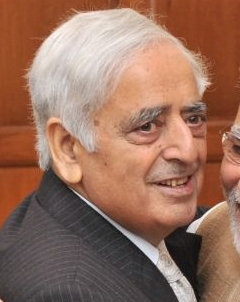
Mufti Mohammad Sayeed (12 January 1936 – 7 January 2016) was a politician from the Indian state of Jammu and Kashmir. He served twice as the Chief Minister of Jammu and Kashmir, from November 2002 to November 2005 and again from March 2015 to January 2016. He was also Home Minister of India from December 1989 to November 1990. He founded the Jammu and Kashmir Peoples Democratic Party in July 1999 to "persuade the Government of India to initiate an unconditional dialogue with Kashmiris for resolution of the Kashmir problem."

Syed Ali Shah Geelani Kashmiri Politician, Islamic Figure

Syed Ali Shah Geelani is a Kashmiri separatist Hurriyat leader. He was previously a member of Jamaat-e-Islami Kashmir but later on founded his own party by the name of Tehreek-e-Hurriyat. He has served as the chairman of All Parties Hurriyat Conference, a conglomerate of separatist parties in Jammu and Kashmir. He was an MLA from the Sopore constituency of Jammu and Kashmir three times.

Farooq Abdullah Indian politician

Farooq Abdullah is an Indian politician and chairman of Jammu & Kashmir National Conference. He has served as the Chief Minister of Jammu and Kashmir on several occasions since 1982, and as the union minister for New and Renewable Energy between 2009 and 2014. He is the father of former Chief Minister of Jammu and Kashmir Omar Abdullah.

Omar Abdullah Indian politician

Omar Abdullah is an Indian politician and the scion of one of the most prominent political families of Jammu and Kashmir, the Abdullah family, he became the 11th and the youngest Chief Minister of the State of Jammu and Kashmir, after forming a government in coalition with the Congress party, on 5 January 2009.

Insurgency in Jammu and Kashmir

The insurgency in Jammu and Kashmir or the Kashmiri Insurgency is a conflict between various Kashmiri separatists and the Government of India. There are some groups that support the complete independence of Kashmir, while others seek Kashmir's accession to Pakistan. The conflict in Jammu and Kashmir has strong Islamist elements among the insurgents, with many of the "ultras" identifying with Jihadist movements and supported by such.

Jammu and Kashmir Peoples Democratic Party Political party of India

The Jammu and Kashmir Peoples Democratic Party (JKPDP) is a state political party in Jammu and Kashmir, India. The PDP was headed and founded by Mufti Mohammed Sayeed. His daughter, Mehbooba Mufti, succeeded him as party leader and as Chief Minister of Jammu and Kashmir following his death in January 2016.

Jammu and Kashmir National Panthers Party Political party of India

The Jammu & Kashmir National Panthers Party is a state political party in the state of Jammu and Kashmir, India. The party was founded on 23 March 1982 by Prof. Bhim Singh and a few prominent youth political personalities of the time including Jay Mala, former President of the Indian Students Congress. Its aim is to "demolish corruption, communalism, criminalization, drug menace" and to establish a real democracy through ultimate revolution.

Kashmir conflict conflict

The Kashmir conflict is a territorial conflict primarily between India and Pakistan over the Kashmir region. The conflict started after the partition of India in 1947 as a dispute over the former princely state of Jammu and Kashmir and escalated into three wars between India and Pakistan and several other armed skirmishes. China has also been involved in the conflict in a third-party role. Both India and Pakistan claim the entirety of the former princely state of Jammu and Kashmir. India controls approximately 43% of the land area of the region and 70% of its population, Pakistan controls approximately 37% of the land, while China controls the remaining 20%. India administers Jammu, the Kashmir Valley, Ladakh, and the Siachen Glacier. Pakistan administers Azad Kashmir and Gilgit-Baltistan. China administers the mostly uninhabited Shaksgam Valley, and the Aksai Chin region.

Politics of Jammu and Kashmir

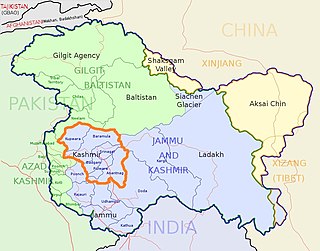
The state of Jammu and Kashmir has historically consisted of four political regions. Ladakh towards the east bordering China, Jammu towards the south bordering the states of Himachal Pradesh, Punjab and Pakistan, Kashmir Valley towards the west bordering Pakistan administered Kashmir and Baltistan areas towards the North bordering Xinjiang and Gilgit Baltistan. Baltistan and a part of Kashmir are under Pakistan control. Aksai Chin, claimed by India to be a part of Ladakh, is under Chinese control, while the rest is under Indian control. Pakistan and Indian controlled parts are separated by Line of Control (LOC).

The Gawkadal massacre was named after the Gawkadal bridge in Srinagar, Kashmir, where, on 21 January 1990, the Indian paramilitary troops of the Central Reserve Police Force opened fire on a group of Kashmiri protesters in what has been described by some authors as "the worst massacre in Kashmiri history" along with the Bijbehara Massacre in 1993. At least 50 people were killed The massacre happened just a day after the Government of India appointed Jagmohan as the Governor for a second time in a bid to control the mass protests by Kashmiris.

Mohammad Abbas Ansari is a prominent political leader and Shia cleric from Indian-administered Jammu and Kashmir. He is a Kashmiri separatist, ex-chairman of the All Parties Hurriyat Conference, and founder of the Jammu & Kashmir Ittihadul Muslimeen (JKIM) political party. He is considered a moderate and has called for an end to violence in that region.
2010 Kashmir unrest

The 2010 Kashmir unrest was a series of violent protests and riots in the Kashmir Valley which started in June 2010 after the Indian Army claimed to have killed three "Pakistani infiltrators" but it was later revealed to be a case of a fake encounter in which a soldier of the Territorial Army, a counter-insurgent and a former special police officer had lured three young men from their Nadihal village in Baramulla district and killed them in a staged encounter at Sona Pindi. The protests occurred in a movement launched by Hurriyat Conference led by Syed Ali Shah Geelani and Mirwaiz Umar Farooq in the Indian state of Jammu and Kashmir in June 2010, who called for the complete demilitarisation of Jammu and Kashmir. The All Parties Hurriyat Conference made this call to a strike, citing human rights abuses by security forces. Rioters shouting pro-independence slogans, defied curfew, attacked riot police with stones and burnt vehicles and buildings. The protests started out as anti India protests but later were also targeted against the United States following the 2010 Qur'an-burning controversy. The riot police consisting of Jammu and Kashmir Police and Indian Para-military forces fired teargas shells rubber bullets and also live ammunition on the protesters, resulting in 112 deaths, including many teenagers and an 11-year-old boy. The protests subsided after the Indian government announced a package of measures aimed at defusing the tensions in September 2010.
Elections in Jammu and Kashmir

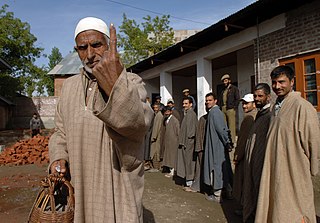
Elections in Jammu and Kashmir include elections to the Parliament of India, both houses of the bicameral state legislature, and various other local level bodies such as municipalities and Panchayat constituencies. The legal authority to conduct elections in Jammu and Kashmir is drawn from provisions in both the Constitution of India and the Constitution of Jammu and Kashmir.

2014 Jammu and Kashmir Legislative Assembly election

The Jammu and Kashmir Legislative Assembly election, 2014 was held in the Indian state of Jammu and Kashmir in five phases from 25 November – 20 December 2014. Voters elected 87 members to the Jammu and Kashmir Legislative Assembly, which ends its six-year term on 19 January 2015. The results were declared on 23 December 2014. Voter-verified paper audit trail (VVPAT) along with EVMs were used in 3 assembly seats out of 87 in Jammu Kashmir elections.

2002 Jammu and Kashmir Legislative Assembly election

Elections for the Indian state of Jammu and Kashmir were held in September -October 2002 in four phases. Mufti Mohammad Sayeed became Chief Minister of Jammu Kashmir after the elections. In 2005 under a coalition agreement INC's Ghulam Nabi Azad became Chief Minister. He was the first Indian National Congress party Chief Minister of Jammu and Kashmir. In reaction terrorist group Jaish-e-Mohammad had conducted a suicide car bomb attack in Srinagar killing six people just hours before Azad's swearing-in. Panthers Party formed part of the ruling coalition with Harsh Dev Singh becoming the party's first cabinet minister.

2016–17 Kashmir unrest

The 2016–17 unrest in Kashmir, also known as the Burhan aftermath, refers to a series of violent protests in the Kashmir Valley of the Indian state of Jammu and Kashmir. It started with the killing of Burhan Wani, a commander of the Kashmir-based Islamic militant organisation Hizbul Mujahideen, by Indian security forces on 8 July 2016. After his killing, anti-Indian protests started in all 10 districts of the Kashmir Valley. Protesters defied curfew with attacks on security forces and public properties.

A by-election was held in the Lok Sabha constituency of Srinagar on 9 April 2017 with repolling in 38 polling on 13 April. It was triggered by the resignation of Tariq Hameed Karra after his defection from Jammu and Kashmir Peoples Democratic Party to the Indian National Congress.

References

  1. Amarnath row divides Jammu and Kashmir Archived 2008-08-10 at the Wayback Machine . NDTV, 16 August 2008
  2. APHC to boycott Kashmir elections later this year Pakistan Times, 11 May 2008
  3. Despite boycott call, Jamaat cadres come out in support of PDP Indian Express, 23 December 2008
  4. 1 2 3 Voting ends in Indian Kashmir amid heavy security International Herald Tribune, 24 December 2008
  5. Clashes mark final Kashmir poll BBC News, 24 December 2008
  6. Pakistan conundrum hangs over Kashmir poll success The Hindu, 30 December 2008
  7. "7-phase poll in J&K from November 17". Rediff. 19 October 2008. Retrieved 24 April 2018.
  8. 1 2 Low voter turnout in final phase, Rediff India, 2008-12-24
  9. 1 2 Abdullahs back in J&K Times of India, 29 December 2009
  10. BJP fields more Muslim candidates in J&K to shrug off communal tag
  11. 35 political parties failed to win a seat in J&K polls Rediff India, 29 December 2008
  12. Kashmiri parties in coalition bid BBC News, 29 December 2008
  13. Cong dilemma: young Omar or PDP Calcutta Telegraph, 29 December 2008
  14. Pro-India parties to take power in Indian Kashmir International Herald Tribune, 30 December 2008