| |||||||||||||||||||||||||||||||||||||||||||||||||||||||
All 87 seats in Legislative Assembly 44 seats needed for a majority | |||||||||||||||||||||||||||||||||||||||||||||||||||||||
|---|---|---|---|---|---|---|---|---|---|---|---|---|---|---|---|---|---|---|---|---|---|---|---|---|---|---|---|---|---|---|---|---|---|---|---|---|---|---|---|---|---|---|---|---|---|---|---|---|---|---|---|---|---|---|---|
| Turnout | 65.23% | ||||||||||||||||||||||||||||||||||||||||||||||||||||||
| |||||||||||||||||||||||||||||||||||||||||||||||||||||||
| |||||||||||||||||||||||||||||||||||||||||||||||||||||||
The Jammu and Kashmir Legislative Assembly election, 2014 was held in the Indian state of Jammu and Kashmir in five phases from 25 November – 20 December 2014. Voters elected 87 members to the Jammu and Kashmir Legislative Assembly, which ends its six-year term on 19 January 2015. The results were declared on 23 December 2014. [1] [2] Voter-verified paper audit trail (VVPAT) along with EVMs were used in 3 assembly seats out of 87 in Jammu Kashmir elections. [3] [4] [5]
India, also known as the Republic of India, is a country in South Asia. It is the seventh largest country by area and with more than 1.3 billion people, it is the second most populous country as well as the most populous democracy in the world. Bounded by the Indian Ocean on the south, the Arabian Sea on the southwest, and the Bay of Bengal on the southeast, it shares land borders with Pakistan to the west; China, Nepal, and Bhutan to the northeast; and Bangladesh and Myanmar to the east. In the Indian Ocean, India is in the vicinity of Sri Lanka and the Maldives, while its Andaman and Nicobar Islands share a maritime border with Thailand and Indonesia.
Jammu and Kashmir is a state in northern India, often denoted by its acronym, J&K. It is located mostly in the Himalayan mountains, and shares borders with the states of Himachal Pradesh and Punjab to the south. The Line of Control separates it from the Pakistani-administered territories of Azad Kashmir and Gilgit-Baltistan in the west and north respectively, and a Line of Actual Control separates it from the Chinese-administered territory of Aksai Chin in the east. The state has special autonomy under Article 370 of the Constitution of India.

The Jammu and Kashmir Legislative Assembly also known as the Jammu and Kashmir Vidhan Sabha is the lower house of the bicameral legislature of the Indian state of Jammu and Kashmir, which is known as the Jammu and Kashmir State Legislature. It has 87 members.
Before the election, Indian National Congress broke its alliance with Jammu and Kashmir National Conference and contested on all seats in the assembly. [6]
The Indian National Congress(
Campaigning before the elections was aggressive and robust. Following the huge victory of Bharatiya Janata Party in the Indian parliamentary election, the BJP turned its attention towards J&K and campaigned on the promise of 'development'. This included a visit from the Prime Minister of India, Narendra Modi in support of the local BJP campaign.
The Bharatiya Janata Party is one of the two major political parties in India, along with the Indian National Congress. As of 2018, it is the country's largest political party in terms of representation in the national parliament and state assemblies, and it is the world's largest party in terms of primary membership. BJP is a right-wing party, and its policy has historically reflected Hindu nationalist positions. It has close ideological and organisational links to the Rashtriya Swayamsevak Sangh (RSS).
Narendra Damodardas Modi is an Indian politician serving as the 14th and current Prime Minister of India since 2014. He was the Chief Minister of Gujarat from 2001 to 2014, and is the Member of Parliament for Varanasi. Modi is a member of the Bharatiya Janata Party (BJP), and of the Rashtriya Swayamsevak Sangh (RSS), a Hindu nationalist volunteer organisation.
All Parties Hurriyat Conference (APHC) is an alliance of 26 political, social and religious organizations formed on 9 March 1993, as a united political front to raise the cause of Kashmiri separatism. This alliance has historically been viewed positively by Pakistan as it contests the claim of the Indian government over the State of Jammu and Kashmir. Mirwaiz Umar Farooq is its chairman and Ghulam Muhammad Safi was elected as its convener in Pakistan on January 2010.

Syed Ali Shah Geelani is a Kashmiri separatist Hurriyat leader. He was previously a member of Jamaat-e-Islami Kashmir but later on founded his own party by the name of Tehreek-e-Hurriyat. He has served as the chairman of All Parties Hurriyat Conference, a conglomerate of separatist parties in Jammu and Kashmir. He was an MLA from the Sopore constituency of Jammu and Kashmir three times.
Facebook, Inc. is an American online social media and social networking service company. It is based in Menlo Park, California. It was founded by Mark Zuckerberg, along with fellow Harvard College students and roommates Eduardo Saverin, Andrew McCollum, Dustin Moskovitz and Chris Hughes. It is considered one of the Big Four technology companies along with Amazon, Apple, and Google.
The polls were carried out in five phases. Despite several boycott calls by hurriyat leaders, elections recorded highest voters turnout in last 25 years. Voters turnout was more than 65% which is higher than usual voting percentage in other states of India. [9] [10] [11] [12]
| Date | Seats | Turnout | |
|---|---|---|---|
| Tuesday 25 November | 15 | 71.28% | |
| Tuesday 2 December | 18 | 71% | |
| Tuesday 9 December | 16 | 58.89% | |
| Sunday 14 December | 18 | 49% | |
| Saturday 20 December | 20 | 76% | |
| Total | 87 | 65.23% | |
| Source: [13] [14] [15] [16] [17] | |||
The European Parliament, on the behalf of European Union, welcomed the smooth conduct of the State Legislative Elections in the Jammu and Kashmir. [18] The EU in its message said that, "The high voter turnout figure proves that democracy is firmly rooted in India. The EU would like to congratulate India and its democratic system for conduct of fair elections, unmarred by violence, in the state of Jammu and Kashmir". [18] [19] [20] The European Parliament also takes cognizance of the fact that a large number of Kashmiri voters turned out despite calls for the boycott of elections by certain separatist forces. [19] However, elected Jammu and Kashmir Chief Minister Mufti Muhammad Sayeed said, "If God forbid the Hurriyat and the militants tried to disrupt the elections these would not have been as participative as they had been. They (Pakistan) also allowed these elections to take place." Ruling Party president Mehbooba Mufti also defended Mufti's remarks. [21] While taking dig at Mufti's statement former Chief minister of Jammu and Kashmir and leader of opposition in Rajya Sabha Ghulam Nabi Azad said that, "In fact, Pakistan and militant groups tried their best to destabilise the democratic process in the state." [22] [23]
The European Parliament (EP) is the only parliamentary institution of the European Union (EU) that is directly elected by EU citizens aged 18 or older. Together with the Council of the European Union, which should not be confused with the European Council and the Council of Europe, it exercises the legislative function of the EU. The Parliament is composed of 751 members (MEPs), that will become 705 starting from the 2019–2024 legislature, who represent the second-largest democratic electorate in the world and the largest trans-national democratic electorate in the world.
The European Union (EU) is a political and economic union of 28 member states that are located primarily in Europe. It has an area of 4,475,757 km2 (1,728,099 sq mi) and an estimated population of about 513 million. The EU has developed an internal single market through a standardised system of laws that apply in all member states in those matters, and only those matters, where members have agreed to act as one. EU policies aim to ensure the free movement of people, goods, services and capital within the internal market, enact legislation in justice and home affairs and maintain common policies on trade, agriculture, fisheries and regional development. For travel within the Schengen Area, passport controls have been abolished. A monetary union was established in 1999 and came into full force in 2002 and is composed of 19 EU member states which use the euro currency.
The Rajya Sabha or Council of States is the upper house of the Parliament of India. Membership of Rajya Sabha is limited by the Constitution to a maximum of 250 members and current laws have provision for 245 members. Most of the members of the House are indirectly elected by the members of States and union territories of India state and territorial legislatures using single transferable votes, while the President can appoint 12 members for their contributions to art, literature, science, and social services. Members sit for staggered terms lasting six years, with a third of the members up for election every two years.
| Party | Seats | Previously | +/– | Vote % | Vote Share | ||||||
|---|---|---|---|---|---|---|---|---|---|---|---|
| People's Democratic Party | 28 | 21 | +7 | 22.7% | 10,92,203 | ||||||
| Bharatiya Janata Party | 25 | 11 | +14 | 23.0% | 11,07,194 | ||||||
| National Conference | 15 | 28 | -13 | 20.8% | 10,00,693 | ||||||
| Indian National Congress | 12 | 17 | -5 | 18.0% | 8,67,883 | ||||||
| Jammu & Kashmir People's Conference | 2 | 0 | +2 | ||||||||
| Communist Party of India (Marxist) | 1 | 1 | 0 | 0.5% | |||||||
| Jammu and Kashmir People's Democratic Front | 0 | 0 | 0 | ||||||||
| Jammu & Kashmir National Panthers Party | 0 | 3 | -3 | ||||||||
| People's Democratic Front | 1 | 1 | 0 | - | - | ||||||
| Jammu & Kashmir Democratic Party Nationalist | 0 | 1 | -1 | % | |||||||
| Independents | 3 | 4 | -1 | % | |||||||
| Total (turnout 65.23%) | 87 | 87 | - | - | |||||||
| Source: Electoral Commission of India [24] | |||||||||||
PDP became the single largest party with 28 seats. BJP became the second largest party with 25 seats. [25]
Omar Abdullah resigned as a chief minister on 24 December 2014. [26]
This article needs additional citations for verification .(June 2016) (Learn how and when to remove this template message) |
Three days after the results, the JKN approached the BJP for a meeting to try and form a government[ citation needed ]. As part of the deal, Nirmal Kumar Singh was to be the chief minister and JKN's MLA Ali Mohammad Sagar was to be his deputy[ citation needed ]. The deal fell through after a revolt in the JKN. The BJP also rejected this deal, citing morality issues[ citation needed ].
In the following days, the JKN also announced its intention to support the PDP from outside by submitting a letter to governor Narinder Nath Vohra after the dialogue with the BJP fell through. The PDP refused.
A week after the results, the PDP and the BJP officially started talks. Both parties had a two-member team to form a Common Minimum Programme (CMP). The PDP was represented by Naeem Akhtar and Haseeb Drabu, while Ram Madhav and Nirmal Kumar Singh represented the BJP. Minister of State in the PMO, Jitendra Singh, supervised the dialogue.
Omar Abdullah resigned as chief minister on 24 December. The Governor[ who? ] accepted his resignation, but asked him to continue in an interim capacity until the formation of a new government. President's rule was imposed on 1 January 2015.
After dealing with issues, both parties turned their attention to the composition of the cabinet. The PDP was initially reluctant for a three-year rotation of the chief minister's post, but later agreed. There were also issues related to the joining of the government by separatist-turned-politician Sajjad Lone. In the run-up to the election, he met Prime Minister Narendra Modi and praised him by calling him "big brother." The BJP reciprocated by not running a candidate against Lone for the Handwara seat, from where he won, and got elected to the assembly for the first time.
Both parties announced on 25 February that the CMP was almost ready, in a joint press conference called by BJP national President Amit Shah and PDP President Mehbooba Mufti. They also stated that the ideological differences had been "ironed out" and both parties were now working on the formation of a cabinet. The dialogue between both parties ended successfully on 18 February - two months and 5 days after beginning of talks.
The new PDP-BJP government took the oath of office on 1 March in the Zorawar Singh Stadium of Jammu, with Mufti Mohammad Sayeed as chief minister for the full term of six years and Nirmal Kumar Singh as his deputy. Modi was also present for the occasion. Twelve cabinet ministers from each party were also sworn-in. This was the first time that the BJP was a coalition partner in the Jammu and Kashmir government. Lone and independent MLA for Udhampur, Pawan Kumar Gupta, were also sworn-in as cabinet ministers from the BJP's quota.
The CMP was then released in a press conference. The CMP gave a vision of "all-round development of Jammu and Kashmir" and "Sabka Saath, Sabka Vikas" (with everyone, everyone's development). Contentious issues like Article 370 and AFSPA would be referred to a high-power committee, with representation from both parties and civil society. The PDP also agreed to join the NDA's central, with Mehbooba Mufti's induction into the union cabinet, at a later date, and also support the Modi government in both houses of parliament.

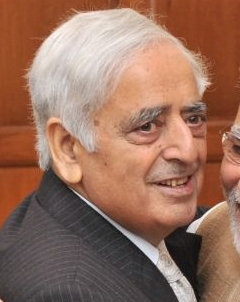
Mufti Mohammad Sayeed (12 January 1936 – 7 January 2016) was a politician from the Indian state of Jammu and Kashmir. He served twice as the Chief Minister of Jammu and Kashmir, from November 2002 to November 2005 and again from March 2015 to January 2016. He was also Home Minister of India from December 1989 to November 1990. He founded the Jammu and Kashmir Peoples Democratic Party in July 1999 to "persuade the Government of India to initiate an unconditional dialogue with Kashmiris for resolution of the Kashmir problem."
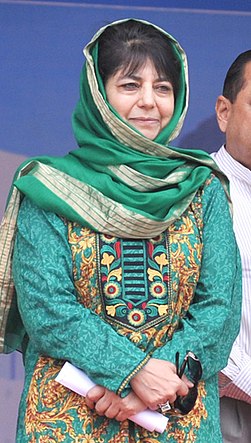
Mehbooba Mufti is an Indian politician who served as the Chief Minister of Jammu and Kashmir, from 4th April 2016 to 19th June 2018. She is a supporter of the article 35A and 370 of the Indian Constitution. She resigned on June 19 2018 after BJP withdrew support from the coalition government. She was the first woman to hold the office. Mehbooba Mufti is India's second Muslim woman chief minister after Syeda Anwara Taimur of Assam. She is the president of the Jammu and Kashmir Peoples Democratic Party (PDP) and was a member of the Indian parliament, representing Anantnag in the 16th Lok Sabha; before she was sworn in as the Chief Minister of J&K. She had previously represented Anantnag in the 14th Lok Sabha (2004–09) but did not contest the 2009 election for the 15th Lok Sabha. She is a supporter of Jamaat e Islami
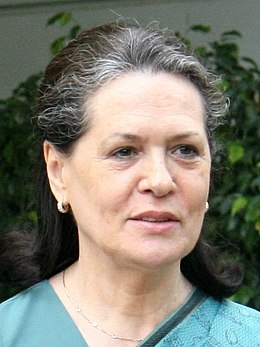
Legislative elections were held in India in four phases between 20 April and 10 May 2004. Over 670 million people were eligible to vote, electing 543 members of the 14th Lok Sabha. The Lok Sabha, or "House of the People," is the directly elected lower house of the Parliament of India.
United Progressive Alliance (UPA) is a coalition of centre-left political parties in India formed after the 2004 general election. The largest member party of the UPA is the INC, whose Former National President Sonia Gandhi is chairperson of the UPA. It formed a government with support from some other left-aligned parties in 2004.
The Jammu and Kashmir Peoples Democratic Party (JKPDP) is a state political party in Jammu and Kashmir, India. The PDP was headed and founded by Mufti Mohammed Sayeed. His daughter, Mehbooba Mufti, succeeded him as party leader and as Chief Minister of Jammu and Kashmir following his death in January 2016.
The state of Jammu and Kashmir has historically consisted of four political regions. Ladakh towards the east bordering China, Jammu towards the south bordering the states of Himachal Pradesh, Punjab and Pakistan, Kashmir Valley towards the west bordering Pakistan administered Kashmir and Baltistan areas towards the North bordering Xinjiang and Gilgit Baltistan. Baltistan and a part of Kashmir are under Pakistan control. Aksai Chin, claimed by India to be a part of Ladakh, is under Chinese control, while the rest is under Indian control. Pakistan and Indian controlled parts are separated by Line of Control (LOC).
The Indian general election, 2014 was held to constitute the 16th Lok Sabha, electing members of parliament for all 543 parliamentary constituencies. Running in nine phases from 7 April to 12 May 2014, it was the longest election in the country's history. According to the Election Commission of India, 814.5 million people were eligible to vote, with an increase of 100 million voters since the last general election in 2009, making it the largest ever election in the world. Around 23.1 million or 2.7% of the total eligible voters were aged 18–19 years. A total of 8,251 candidates contested for the 543 Lok Sabha seats. The average election turnout over all nine phases was around 66.38%, the highest ever in the history of Indian general elections.
On 26 May 2008, the government of India and the state Government of Jammu and Kashmir reached an agreement to transfer 99 acres (0.40 km2) of forest land to the Shri Amarnathji Shrine Board (SASB) in the main Kashmir valley to set up temporary shelters and facilities for Hindu pilgrims. This caused a controversy, with demonstrations from the Kashmir valley against the land transfer and protests from the Jammu region supporting it. The largest demonstration saw more than 500,000 protesters at a single rally, among the largest in Kashmir's history.
Elections for the Indian state of Jammu and Kashmir were held over seven days in November and December 2008. The previous government led by the Jammu and Kashmir People's Democratic Party (PDP) in coalition with the Indian National Congress (INC) collapsed when the PDP withdrew. Following the election, the Jammu & Kashmir National Conference (NC) agreed a coalition with Congress and their leader, Omar Abdullah became the state's youngest ever Chief Minister at 38.
Mohammad Akbar Lone is an Indian politician in the state of Jammu and Kashmir and belongs to National Conference political party. He was a cabinet minister in the Omar Abdullah government and had portfolio of higher education..
Dr Mehboob Beg Mirza is an Indian politician,Currently Peoples Democratic Party (PDP)party’s Chief Spokesperson previously belonging to Jammu & Kashmir National Conference. However, on 16 November 2014, Beigh announced his support to Mufti Mohammad Sayeed, patron of the opposition Peoples Democratic Party (PDP). He also decided to withdraw his candidature for 2014 Assembly elections from Anantnag constituency and instead campaign for Sayeed. In the 2009 election he was elected to the 15th Lok Sabha from the Anantnag Lok Sabha constituency of Jammu & Kashmir. On 16 November, Mehboob Beg declares support to rival People's Democratic Party saying that would campaign ‘door-to-door’ for Peoples Democratic Party (PDP) patron Mufti Mohammad Sayeed during the forthcoming assembly polls in Jammu and Kashmir.
Rafi Ahmad Mir is a veteran politician and the Chief Spokesman of Jammu and Kashmir People's Democratic Party. In Mehbooba Mufti led government, he was the Vice Chairman of J&K Tourism Development Corporation.
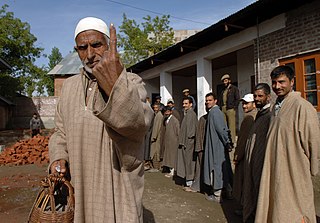
Elections in Jammu and Kashmir include elections to the Parliament of India, both houses of the bicameral state legislature, and various other local level bodies such as municipalities and Panchayat constituencies. The legal authority to conduct elections in Jammu and Kashmir is drawn from provisions in both the Constitution of India and the Constitution of Jammu and Kashmir.
The Jharkhand Legislative Assembly election, 2014 was held in five phases between November 25, and December 20, counting of votes and results were announced on December 23, 2014. The Bhartiya Janata Party (BJP) won the elections defeating The Indian National Congress (INC) and its major allies Rashtriya Janata Dal, Janata Dal (United), and Jharkhand Mukti Morcha (JMM). This was the first time, since Jharkhand was created, for a single-party majority in the state assembly, with BJP getting 42 out of 81, 1 more that required majority. This has provided for a stable government in the state for past 4 years.
Elections for the Indian state of Jammu and Kashmir were held over September–October 1996. Farooq Abdullah became Chief Minister of Jammu Kashmir after the elections.The 1996 Lok Sabha elections and assembly elections in the state were possible due to efforts of counter-insurgents like Kuka Parray,(head of Ikhwan-ul-Muslemoon).
Elections for the Indian state of Jammu and Kashmir were held in September -October 2002 in four phases. Mufti Mohammad Sayeed became Chief Minister of Jammu Kashmir after the elections. In 2005 under a coalition agreement INC's Ghulam Nabi Azad became Chief Minister. He was the first Indian National Congress party Chief Minister of Jammu and Kashmir. In reaction terrorist group Jaish-e-Mohammad had conducted a suicide car bomb attack in Srinagar killing six people just hours before Azad's swearing-in. Panthers Party formed part of the ruling coalition with Harsh Dev Singh becoming the party's first cabinet minister.
Anantnag is one of the 87 constituencies in the Jammu and Kashmir Legislative Assembly of Jammu and Kashmir a north state of India. Anantnag is also part of Anantnag Lok Sabha constituency.
A by-election was held in the Lok Sabha constituency of Srinagar on 9 April 2017 with repolling in 38 polling on 13 April. It was triggered by the resignation of Tariq Hameed Karra after his defection from Jammu and Kashmir Peoples Democratic Party to the Indian National Congress.