India, also known as the Republic of India, is a country in South Asia. It is the seventh largest country by area and with more than 1.3 billion people, it is the second most populous country as well as the most populous democracy in the world. Bounded by the Indian Ocean on the south, the Arabian Sea on the southwest, and the Bay of Bengal on the southeast, it shares land borders with Pakistan to the west; China, Nepal, and Bhutan to the northeast; and Bangladesh and Myanmar to the east. In the Indian Ocean, India is in the vicinity of Sri Lanka and the Maldives, while its Andaman and Nicobar Islands share a maritime border with Thailand and Indonesia.
Jammu and Kashmir is a state in northern India, often denoted by its acronym, J&K. It is located mostly in the Himalayan mountains, and shares borders with the states of Himachal Pradesh and Punjab to the south. The Line of Control separates it from the Pakistani-administered territories of Azad Kashmir and Gilgit-Baltistan in the west and north respectively, and a Line of Actual Control separates it from the Chinese-administered territory of Aksai Chin in the east. The state has special autonomy under Article 370 of the Constitution of India.
Farooq Abdullah is an Indian politician and chairman of Jammu & Kashmir National Conference. He has served as the Chief Minister of Jammu and Kashmir on several occasions since 1982, and as the union minister for New and Renewable Energy between 2009 and 2014. He is the father of former Chief Minister of Jammu and Kashmir Omar Abdullah.
The insurgency in Jammu and Kashmir or the Kashmiri Insurgency is a conflict between various Kashmiri separatists and the Government of India. There are some groups that support the complete independence of Kashmir, while others seek Kashmir's accession to Pakistan. The conflict in Jammu and Kashmir has strong Islamist elements among the insurgents, with many of the "ultras" identifying with Jihadist movements and supported by such.
The 1987 election in a way was a watershed in the politics of the Jammu and Kashmir state.[8][9][10][11]
Mohammed Abdullah Sheikh was a Kashmiri politician who played a central role in the politics of Jammu and Kashmir, the northernmost Indian state. The self-styled "Sher-e-Kashmir", Abdullah was the founding leader of the Jammu & Kashmir National Conference and the 2nd Chief Minister of Jammu and Kashmir. He agitated against the rule of the Maharaja Hari Singh and urged self-rule for Kashmir. However, in his letter to Maharaja Hari Singh dated September 26, 1947 he apologized Maharaja probably for instigating people on communal lines, and promised his loyalty to him and throne.
The Indian National Congress(pronunciation) is a broadly based political party in India. Founded in 1885, it was the first modern nationalist movement to emerge in the British Empire in Asia and Africa. From the late 19th century, and especially after 1920, under the leadership of Mahatma Gandhi, Congress became the principal leader of the Indian independence movement. Congress led India to independence from Great Britain, and powerfully influenced other anti-colonial nationalist movements in the British Empire.
After Abdullah's release and his accord with Indira Gandhi, the Congress party accepted him as its own Head and elected him as the State's Chief Minister. However, during the 1977 election, Abdullah shunned the Congress party and revived a new National Conference party from the erstwhile Plebiscite Front. He won the election handsomely.
After Sheikh Abdullah's death, the Congress party agains sought an alliance with the National Conference for the 1983 election. It was again shunned and the new leader Farooq Abdullah won the election independently. Congress however emerged as the de facto party of the Jammu region. Congress exploited the internal squabbles in the National Conference and teamed up with Farooq's brother-in-law G. M. Shah to topple Farooq's government. This lead to a period of instability during which the Governor's Rule was imposed.
Jammu is one of the three administrative divisions within Jammu and Kashmir, the northernmost state in India. It consists of the districts of Jammu, Doda, Kathua, Ramban, Reasi, Kishtwar, Poonch, Rajouri, Udhampur and Samba. Most of the land is hilly or mountainous, including the Pir Panjal Range which separates it from the Kashmir Valley and part of the Great Himalayas in the eastern districts of Doda and Kishtwar. Its principal river is the Chenab. Chenab Valley is another important division in Jammu region.
Ghulam Mohammad Shah or G.M. Shah was an Indian politician who was Chief Minister of the state of Jammu and Kashmir from 2 July 1984 to 6 March 1986. He succeeded his brother-in-law Farooq Abdullah. Shah's father-in-law was Sheikh Mohammad Abdullah, the founder of the Jammu and Kashmir National Conference, of which Shah was once a senior member. Shah died 6 January 2009 at the Sher-e-Kashmir Institute of Medical Sciences in Srinagar. He was 88.
After Rajiv Gandhi became the leader of the Indian National Congress, another accord was reached with Farooq Abdullah. The Governor's Rule was lifted and Farooq returned to power in 1986, but with the understanding that Congress and the National Conference would form an alliance for the 1987 election. In the view of scholar Steve Widmalm, the State's two largest parties had formed an 'election cartel' so that discontent could not be channeled.[12]
Before the election, various anti-establishment groups including Jamaat-e-Islami joined hands to form a Muslim United Front (MUF) mainly pointing out that the NC had capitulated before the Centre for the sake of power and bartered away the special status of the State. Efforts were made to arouse Muslim sentiments along communal lines.[citation needed] MUF's election manifesto stressed the need for a solution to all outstanding issues according to Simla Agreement, work for Islamic unity and against political interference from the centre. Their slogan was wanting the law of the Quran in the Assembly.[13]
The NC-Congress(I) combine contested all the 76 seats and the MUF, 43 seats.[14][1]
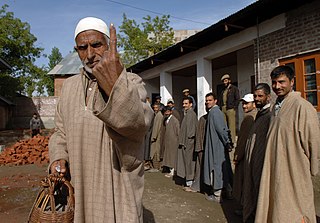
Voting
The election were held on 23 March 1987. Nearly 75 percent of the voters participated, highest recorded participation in the state. Nearly eighty per cent of the people in the Valley voted.[15][16]
Elections for Bhadrawah, Leh and Kargil were held in June 1987.[17]
Electoral malpractices
The India Today reported that ″starting about two weeks before the election, 600 opposition workers were arrested in areas where the MUF, independents, and PC candidates were showing strength″.[18]
In the Amira Kadal constituency of Srinagar, MUF's Syed Mohammed Yusuf Shah was a candidate. As the vote counting began, it was becoming clear that Yusuf Shah was winning by a landslide. His opponent, Ghulam Mohiuddin Shah, went home dejected. But he was summoned back by the electoral officials and declared the winner. When the crowds protested, the police arrived and arrested Yusuf Shah and his supporters. They were held in custody till the end of 1987.[19]
Leader of the People's Conference, Abdul Ghani Lone, complained that vote counting in the constituency of Handwara was tampered with by the deputy inspector-general of police, A.M. Watali. There were several cases like this with other candidates but the petitions to the courts did not lead to any action. There was no response from the central government, courts or the election commission to the demands that the allegations of rigging be investigated. Kashmir's High Court chose not to probe the allegations and the Election Commission was inactive at the time.[18]
Balraj Puri has noted three constituencies where the MUF lost narrowly: Bijbehara, Wachi and Shopian. The number of rejected votes in these constituencies was far higher than the margin of victory for the alliance, indicating that the vote counting could have been easily manipulated.[20]
Vote counting in seats where the MUF held influence took longer than the three hours of vote counting in Farooq Abdullah's seat. In the vital district of Anantnag it was reported that the results were delayed for 2 and a half days while the polling station was surrounded by hundreds of policemen. In Bijbehara the polling officers simply refused to count on when they found that a MUF candidate had taken an early lead. An NC candidate with a lead of 300 votes was declared the winner in Doru even though more than a thousand votes remained to be counted. Counting in the Pulwama constituency took no account of the strategic Tahab belt. Counting in Shopian and Sopore went on for three days until MUF candidates were declared the losers.[21]
BBC reported that Khem Lata Wukhloo, who was a leader of the Congress party at the time, admitted the widespread rigging in Kashmir. He stated:
"I remember that there was a massive rigging in 1987 election. The losing candidates were declared winners. It shook the ordinary people's faith in the elections and the democratic process."[22]
Governor Jagmohan is reported to have been appalled at what was being done, but he said that he was ordered by the central government in Delhi not to interfere.[21]
Many see this rigged election as a cause of militancy in Kashmir.[23] Abdul Ghani Lone became a separatist leader after the 1987 election and stated that many young people, out of frustration with the democratic process, decided to go for an armed struggle.[18]
Extent of electoral malpractice
This section needs expansion. You can help by adding to it.(February 2018)
The extent of election malpractice has been debated.
Scholar Victoria Schofield has stated that the MUF might have won four more seats if there was no electoral fraud.[24] On the other hand, an anonymous source in the Intelligence Bureau has advanced the estimate that the MUF may have lost approximately 13 seats due to electoral malpractice.[25] Other journalists and commentators have estimated a loss of fifteen to twenty seats.[4]Farooq Abdullah himself has admitted that MUF might have been able to win 20 seats in the absence of rigging.[26]
Results
The NC-Congress alliance won 66 seats in the Assembly: NC winning 40 seats of the 45 it contested, and Congress winning 26 out of 31 (5 out of 6 contested seats in the Valley).[27][15] The alliance received only 53% of the popular vote but garnered 87% of the seats.[28]
The BJP won 2 seats, in Jammu.[16][29] The MUF hoped to win 10 seats out of the 44 seats it contested. But it won only 4 seats, even though it had polled 31% votes.[16] The MUF gained a 'huge' number of votes of 470580 in spite of the rigging.[30]Syed Ali Shah Geelani was able to win the election from his Sopore seat.[31]
The disparity between the popular vote and the seat wins was very high. (In comparison, in 1983, the NC and Congress garnered 95% of the seats on the strength 78% of the vote).[28]
Journalist Balraj Puri states that the MUF emerged as the main alternative to the NC-Congress alliance in all parts of the Valley, except the four constituencies of the Kupwara district where Jammu and Kashmir People's Conference came in the second place.[20] Even though the People's Conference did not win a seat despite having been expected to do well in the constituencies of Bandipora, Sangrama, Handwara, and Kupwara they still managed to capture 93949 votes.[21]
Aftermath
Farooq Abdullah was elected Chief Minister and formed a coalition government. However, the Government lacked legitimacy in the eyes of the people in the Valley. Rebels stamped the election as a "thoroughly made one".[32] The Valley sank into a "morass of frustration and radicalization", states scholar Sumantra Bose. In June 1988, there were protests against a hike in the electricity tariffs, resulting in police firings. In July, the Jammu and Kashmir Liberation Front launched its first bomb attack in Srinagar.[33] A cycle of violence and protests took hold, steadily rising in tempo. In January 1990, the Farooq Abdullah government was dismissed and Governor's Rule was declared.
The Jammu & Kashmir National Conference (JKNC) is a state political party in the Indian state of Jammu and Kashmir. Founded as the All Jammu and Kashmir Muslim Conference by Sheikh Abdullah and Chaudhry Ghulam Abbas in 1932 in the princely state of Jammu and Kashmir, the organisation renamed itself to "National Conference" in 1939 in order to represent all the people of the state. It supported the accession of the princely state to India in 1947. Prior to that, in 1941, a group led by Ghulam Abbas broke off from the National Conference and revived the old Muslim Conference. The revived Muslim Conference supported the accession of the princely state to Pakistan and led the movement for Azad Kashmir.
All Parties Hurriyat Conference (APHC) is an alliance of 26 political, social and religious organizations formed on 9 March 1993, as a united political front to raise the cause of Kashmiri separatism. This alliance has historically been viewed positively by Pakistan as it contests the claim of the Indian government over the State of Jammu and Kashmir. Mirwaiz Umar Farooq is its chairman and Ghulam Muhammad Safi was elected as its convener in Pakistan on January 2010.
Omar Abdullah is an Indian politician and the scion of one of the most prominent political families of Jammu and Kashmir, the Abdullah family, he became the 11th and the youngest Chief Minister of the State of Jammu and Kashmir, after forming a government in coalition with the Congress party, on 5 January 2009.
The Jammu & Kashmir National Panthers Party is a state political party in the state of Jammu and Kashmir, India. The party was founded on 23 March 1982 by Prof. Bhim Singh and a few prominent youth political personalities of the time including Jay Mala, former President of the Indian Students Congress. Its aim is to "demolish corruption, communalism, criminalization, drug menace" and to establish a real democracy through ultimate revolution.
Yasin Malik is a Kashmiri separatist leader who advocates the separation of Kashmir from both India and Pakistan. He is the Chairman of Jammu Kashmir Liberation Front, which originally spearheaded armed militancy in the Kashmir Valley. Malik renounced violence in 1994 and adopted peaceful methods to come to a settlement on the Kashmir conflict.
The Jamaat-e-Islami Kashmir or Jamaat-e-Islami Jammu and Kashmir (JIJK) is a cadre-based religio-political organisation in Jammu and Kashmir, distinct from the Jamaat-e-Islami Hind. The organisation's stated position on the Kashmir conflict is that Jammu and Kashmir is a disputed territory and the issue must be sorted as per UN or through tripartite talks between India and Pakistan and the real representatives of Jammu and Kashmir.
Elections for the Indian state of Jammu and Kashmir were held over seven days in November and December 2008. The previous government led by the Jammu and Kashmir People's Democratic Party (PDP) in coalition with the Indian National Congress (INC) collapsed when the PDP withdrew. Following the election, the Jammu & Kashmir National Conference (NC) agreed a coalition with Congress and their leader, Omar Abdullah became the state's youngest ever Chief Minister at 38.
Sheikh Mustafa Kamal is a Kashmiri politician and one of the leaders of the National Conference party in India's state of Jammu and Kashmir. He served in the state cabinets formed in 1983, 1987 and 1996.
Elections in Jammu and Kashmir include elections to the Parliament of India, both houses of the bicameral state legislature, and various other local level bodies such as municipalities and Panchayat constituencies. The legal authority to conduct elections in Jammu and Kashmir is drawn from provisions in both the Constitution of India and the Constitution of Jammu and Kashmir.
Abdul Sattar Ranjoor was a Kashmiri politician, and a renowned revolutionary poet and writer. He was a veteran leader of the Communist Party of India (CPI). Ranjoor was the founding state secretary of the party in Jammu and Kashmir. He served as a National Council member of the party.
The Jammu and Kashmir Legislative Assembly election, 2014 was held in the Indian state of Jammu and Kashmir in five phases from 25 November – 20 December 2014. Voters elected 87 members to the Jammu and Kashmir Legislative Assembly, which ends its six-year term on 19 January 2015. The results were declared on 23 December 2014. Voter-verified paper audit trail (VVPAT) along with EVMs were used in 3 assembly seats out of 87 in Jammu Kashmir elections.
Elections for the Indian state of Jammu and Kashmir were held over October 1983. The Jammu & Kashmir National Conference leader Farooq Abdullah was appointed Chief Minister.
Elections for the Indian state of Jammu and Kashmir were held over June 1977, which are generally regarded as the first 'free and fair' elections in the state. Jammu & Kashmir National Conference, newly revived from the former Plebiscite Front, won an overwhelming majority and re-elected Sheikh Abdullah as the Chief Minister.
The Jammu & Kashmir People's Conference is a state political party in Jammu and Kashmir, India, founded by the separatist leader Abdul Ghani Lone and Molvi Iftikhar Hussain Ansari in 1978. It is currently led by Sajjad Lone. It won two seats in the Jammu and Kashmir Legislative Assembly in the 2014 elections.
The Muslim United Front (MUF) was a 'polyglot coalition' of Islamic Kashmiri political parties that contested the Jammu and Kashmir Legislative Assembly election, 1987 in the Indian state of Jammu and Kashmir. The Jamaat-e-Islami of Jammu and Kashmir was a key constituent party of the coalition. The MUF won four Assembly seats in the 1987 election. However, widespread rigging of the election by the ruling National Conference party was reported. In the absence of such rigging, commentators believe that it could have won fifteen to twenty seats, a contention admitted by the National Conference leader Farooq Abdullah.
Elections for the Indian state of Jammu and Kashmir were held in February 1967. Ghulam Mohammed Sadiq was appointed Chief Minister of Jammu and Kashmir.
The first elections for the Legislative Assembly of the Indian state of Jammu and Kashmir under its own Constitution were held in March–June 1957. Bakshi Ghulam Mohammad was appointed Prime Minister of Jammu and Kashmir.
Elections for the Constituent Assembly of the Indian state of Jammu and Kashmir were held in September–October 1951. Sheikh Abdullah was appointed Prime Minister of Jammu and Kashmir. Following frictions with various groups, Abdullah was dismissed in August 1953 and imprisoned. Bakshi Ghulam Mohammad was appointed as the next Prime Minister.
A by-election was held in the Lok Sabha constituency of Srinagar on 9 April 2017 with repolling in 38 polling on 13 April. It was triggered by the resignation of Tariq Hameed Karra after his defection from Jammu and Kashmir Peoples Democratic Party to the Indian National Congress.
↑ Hussain, Masood (2016-03-23). "MUFfed". Kashmir Life. Retrieved 2018-02-21. Despite all this, MUF polled huge. It took 470580 votes making 30.96 percent of the popular vote.
This page is based on this Wikipedia article Text is available under the CC BY-SA 4.0 license; additional terms may apply. Images, videos and audio are available under their respective licenses.