The 1975 Indira–Sheikh accord between Kashmiri politician Sheikh Abdullah and Indian Prime Minister Indira Gandhi allowed the former to become Chief Minister of Jammu and Kashmir again after 22 years.

The state of Jammu and Kashmir has historically consisted of four political regions. Ladakh towards the east bordering China, Jammu towards the south bordering the states of Himachal Pradesh, Punjab and Pakistan, Kashmir Valley towards the west bordering Pakistan administered Kashmir and Baltistan areas towards the North bordering Xinjiang and Gilgit Baltistan. Baltistan and a part of Kashmir are under Pakistan control. Aksai Chin, claimed by India to be a part of Ladakh, is under Chinese control, while the rest is under Indian control. Pakistan and Indian controlled parts are separated by Line of Control (LOC).
Elections for the Indian state of Jammu and Kashmir were held over seven days in November and December 2008. The previous government led by the Jammu and Kashmir People's Democratic Party (PDP) in coalition with the Indian National Congress (INC) collapsed when the PDP withdrew. Following the election, the Jammu & Kashmir National Conference (NC) agreed a coalition with Congress and their leader, Omar Abdullah became the state's youngest ever Chief Minister at 38.
The All Jammu and Kashmir Plebiscite Front, or Plebiscite Front, was a political party in the Indian state of Jammu and Kashmir that called for a "popular plebiscite" to decide if the state should remain part of India, join Pakistan or become independent. The patron of the party was Sheikh Abdullah, the former Prime Minister of Jammu and Kashmir and chief of the Jammu and Kashmir National Conference, even though he never formally joined it.
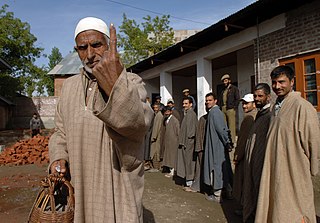
Elections in Jammu and Kashmir include elections to the Parliament of India, both houses of the bicameral state legislature, and various other local level bodies such as municipalities and Panchayat constituencies. The legal authority to conduct elections in Jammu and Kashmir is drawn from provisions in both the Constitution of India and the Constitution of Jammu and Kashmir.
Abdul Sattar Ranjoor was a Kashmiri politician, and a renowned revolutionary poet and writer. He was a veteran leader of the Communist Party of India (CPI). Ranjoor was the founding state secretary of the party in Jammu and Kashmir. He served as a National Council member of the party.
Election for the Indian state of Jammu and Kashmir were held on 23 March 1987. Farooq Abdullah was reappointed as the Chief Minister.
Elections for the Indian state of Jammu and Kashmir were held over June 1977, which are generally regarded as the first 'free and fair' elections in the state. Jammu & Kashmir National Conference, newly revived from the former Plebiscite Front, won an overwhelming majority and re-elected Sheikh Abdullah as the Chief Minister.
The Jammu & Kashmir People's Conference is a state political party in Jammu and Kashmir, India, founded by the separatist leader Abdul Ghani Lone and Molvi Iftikhar Hussain Ansari in 1978. It is currently led by Sajjad Lone. It won two seats in the Jammu and Kashmir Legislative Assembly in the 2014 elections.
The Jammu Praja Parishad was a political party active in the Jammu Division of the Indian-administered Jammu and Kashmir. It was founded in November 1947 by the Rashtriya Swayamsevak Sangh activist Balraj Madhok, and served as the main opposition party in the state. It maintained close ties with Bharatiya Jana Sangh during its lifetime and merged with the latter in 1963. Its main activity was to campaign for the close integration of Jammu and Kashmir with India and oppose the special status granted to the state under the Article 370 of the Indian constitution. After its merger with the Bharatiya Jana Sangh, the precursor of the present day Bharatiya Janata Party, the party gradually rose in stature. As an integral part of the Bharatiya Janata Party, it is currently a partner in the ruling coalition led by the People's Democratic Party.
The Muslim United Front (MUF) was a 'polyglot coalition' of Islamic Kashmiri political parties that contested the Jammu and Kashmir Legislative Assembly election, 1987 in the Indian state of Jammu and Kashmir. The Jamaat-e-Islami of Jammu and Kashmir was a key constituent party of the coalition. The MUF won four Assembly seats in the 1987 election. However, widespread rigging of the election by the ruling National Conference party was reported. In the absence of such rigging, commentators believe that it could have won fifteen to twenty seats, a contention admitted by the National Conference leader Farooq Abdullah.
Elections for the Indian state of Jammu and Kashmir were held in February 1967. Ghulam Mohammed Sadiq was appointed Chief Minister of Jammu and Kashmir.
Elections for the Indian state of Jammu and Kashmir were held in the early months of 1962. Bakshi Ghulam Mohammad was appointed Prime Minister of Jammu and Kashmir.
The first elections for the Legislative Assembly of the Indian state of Jammu and Kashmir under its own Constitution were held in March–June 1957. Bakshi Ghulam Mohammad was appointed Prime Minister of Jammu and Kashmir.
Elections for the Constituent Assembly of the Indian state of Jammu and Kashmir were held in September–October 1951. Sheikh Abdullah was appointed Prime Minister of Jammu and Kashmir. Following frictions with various groups, Abdullah was dismissed in August 1953 and imprisoned. Bakshi Ghulam Mohammad was appointed as the next Prime Minister.
Elections in India in 1977 included Legislative Assembly elections in several Indian states, including Goa, Himachal Pradesh, Jammu and Kashmir, Tamil Nadu, and West Bengal.