Related Research Articles
Freemasonry or Masonry consists of fraternal organisations that trace their origins to the local fraternities of stonemasons that from the end of the fourteenth century regulated the qualifications of stonemasons and their interaction with authorities and clients. The degrees of Freemasonry retain the three grades of medieval craft guilds, those of Apprentice, Journeyman or fellow, and Master Mason. The candidate of these three degrees is progressively taught the meanings of the symbols of Freemasonry, and entrusted with grips, signs and words to signify to other members that he has been so initiated. The degrees are part allegorical morality play and part lecture. Three degrees are offered by Craft Freemasonry, and members of any of these degrees are known as Freemasons or Masons. There are additional degrees, which vary with locality and jurisdiction, and are usually administered by their own bodies.
The history of Freemasonry encompasses the origins, evolution and defining events of the fraternal organisation known as Freemasonry. It covers three phases. Firstly, the emergence of organised lodges of operative masons during the Middle Ages, then the admission of lay members as "accepted" masons or speculative masons, and finally the evolution of purely speculative lodges, and the emergence of Grand Lodges to govern them. The watershed in this process is generally taken to be the formation of the first Grand Lodge in London in 1717. The two difficulties facing historians are the paucity of written material, even down to the 19th century, and the misinformation generated by masons and non-masons alike from the earliest years.

Johann CasparBluntschli was a Swiss jurist and politician. Together with fellow liberals Francis Lieber and Édouard René de Laboulaye, he developed one of the first codes of international law and war.
Anti-Masonry is "avowed opposition to Freemasonry". However, there is no homogeneous anti-Masonic movement. Anti-Masonry consists of radically differing criticisms from sometimes incompatible groups who are hostile to Freemasonry in some form.
While many Christian denominations take no stance on or openly acknowledge and allow Freemasonry, some are outwardly opposed to it, and either discourage or outright prohibit their members from joining the fraternity.

The Order of the Pug was a para-Masonic society founded by Roman Catholics. It is believed that it was founded in 1740 by Klemens August of Bavaria to bypass the papal bull In eminenti apostolatus of 1738. The constitution of the Order of the Pug allowed women to become members, as long as they were Catholic. The Pug was chosen as a symbol of loyalty, trustworthiness and steadiness.
The Declaration on Masonic Associations is a declaration by the Congregation for the Doctrine of the Faith re-iterating the prohibition of Catholics from joining Masonic organizations. Its Latin title is Declaratio de associationibus massonicis. The document states that Catholics who join Masonic organizations are in a state of grave sin and may not receive Holy Communion. It was issued in 1983 by the prefect of the congregation, Joseph Cardinal Ratzinger, who became Pope Benedict XVI on April 19, 2005.
In Craft Freemasonry, sometimes known as Blue Lodge Freemasonry, every Masonic Lodge elects or appoints Masonic Lodge Officers to execute the necessary functions of the lodge's life and work. The precise list of such offices may vary between the jurisdictions of different Grand Lodges, although certain factors are common to all, and others are usual in most.

For the last seven years of his life Wolfgang Amadeus Mozart was a Mason. The Masonic order played an important role in his life and work.
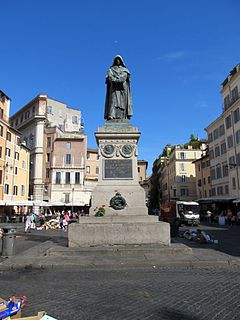
The Statue of Giordano Bruno, created by Ettore Ferrari, was erected at Campo de' Fiori in Rome, Italy, in 1889.
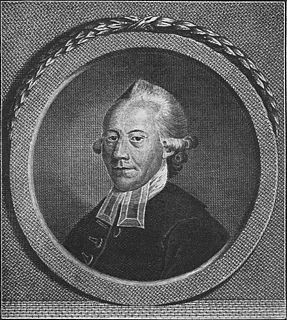
Johann August Starck also Stark was a prolific author and controversial Königsberg theologian, as well as a widely read political writer now best remembered for arguing that an Illuminati-led conspiracy brought about the French revolution. Immanuel Kant and Johann Georg Hamann were among his acquaintances in Königsberg. His broadly deistic approach emphasized natural religion and smoothed over doctrinal differences among the various faiths.

Daniel Gottlob Türk was a German composer, organist and music professor of the Classical period.
The Grand Lodge of British Freemasons in Germany is a Masonic Grand Lodge in Germany working in the English language and following English Masonic traditions. It was founded as a District Lodge in 1957 and after various transformations was eventually recognised as Grand Lodge in 1980. This Grand Lodge is one of the five United Grand Lodges of Germany (VGLvD). It currently has members from a variety of nations and in addition to the "resident members" in Germany, there are "non-resident members" all over the world. Currently, 18 lodges work under the GL BFG, mainly in North Rhine-Westphalia, but also in Lower Saxony, Hamburg, Munich, Berlin and also near Frankfurt.
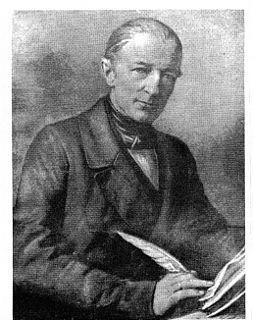
Georg Franz Burkhard Kloss was a German historian of freemasonry.

The United Grand Lodges of Germany is an association (confederation) of the five Grand Lodges of Freemasons in Germany which are recognized as regular by the United Grand Lodge of England, and represents them all at an international level.
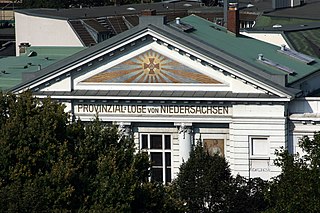
The Grand Landlodge of the Freemasons of Germany, also: Order of Freemasons is a Masonic Grand Lodge in Germany. It is one of the founding members of the United Grand Lodges of Germany and as such it is one of the five German Grand Lodges recognized as "regular" Grand Lodges by the United Grand Lodge of England (UGLE). The Grand Lodge was established in 1770 by Johann Wilhelm Kellner von Zinnendorf, a Prussian army physician. It is one of three so called Old Prussian Grand Lodges.

Karl Gotthelf, Baron von Hund und Altengrotkau was a German freemason. In 1751, he founded the Rite of Strict Observance.

Masonic Lodge "Zum Leuchtthurm an der Ostsee " was established on November 17, 1866. in the former Lauenburg, which today Lębork. That lodge was subject to the National Grand Lodge of Freemasons of German and her full name was: Höchstleuchtende Hochwürdigste Grosse Landes - Loge von der Freimaurer Deutschland zu Berlin Johannis - Loge genannt "Zum Leuchtthurm an der Ostsee " zu Lauenburg in Pommern. Honorary members belonging to the lodge Lębork personalities were as follows: Prof. Czwalina, Generalmajor von Flotow, Dr. Fewson, Dr. Hieber, Dr. Mulert, while the other members of this lodge is in the majority of the inhabitants Lębork, its surrounding area and nearby cities such as Słupsk or Gdańsk.Ówczesna lodge focused in their ranks many great entrepreneurs, such as Hermann Priester, who had his own match factory - which is one of the largest workplaces across the regency of Koszalin, Wilhelm Hertzberg was also having its own brewery, family Lenz having department stores, family Casper factory possessing spirit, then Ernst Heinemann who owned one of the largest construction companies in the city, the company has built most of the public buildings in the former Lauenburg, moreover family Katschke owned by the well-known hotel Katschke 's Hotel, were also pharmacists, the owner of the mill, teachers and government officials and a relative of Paul Nipkow or Theodor Nipkow. Lodge had also its own library. One of the old and the survivors seats Lębork Masonic Lodge is an old house located on the street Stryjewskiego 58, 1908.

The Grand National Mother Lodge "The Three Globes" is the oldest recognized Masonic Grand Lodge in Germany, being found in Berlin in 1740. In 1933, being one of eight national Grand Lodges, it had 22,700 members in 177 lodges. in 1935 freemasonry in Nazi Germany was suppressed. The Mother Lodge "The Three Globes" was reactivated in 1946 and is currently a member of the umbrella organization United Grand Lodges of Germany.
Freemasonry in Germany started in several places during the second quarter of the Eighteenth century. After the extinction of the Rite of Strict Observance, which had a wide following and claimed Templar origins for its higher degrees, the several Grand Lodges in Germany defied all attempts at unification, although a largely ineffectual central organisation came into being with the unification of Germany. During the 1920s Freemasons were harassed alongside Jews by those taken in by the Protocols of the Elders of Zion, and blamed for the German surrender of 1918. This culminated with the suppression of Freemasonry by the Nazis in 1935, with many Masons in Germany and occupied countries being executed or sent to concentration camps. Freemasonry returned to Germany after World War Two. A single central body now represents five "regular" Grand Lodges. Liberal, women's, and mixed lodges also exist.
References
- 1 2 Gottlieb Joseph Gabriel Findel Archived 2015-08-13 at the Wayback Machine Taken from: Eugen Lennhoff, Oskar Posner and Dieter A. Binder, Internationales Freimaurerlexikon. Nachdruck der Ausgabe 1932. Reprint of the edition in 1932. Sonderdruck München 2003. Reprint Munich 2003. ISBN 3-7766-2161-3
- ↑ William R. Denslow, Harry S. Truman: 10,000 Famous Freemasons from A to J, Part One, Kessinger Publishing, ISBN 1-4179-7578-4
- ↑ Eugen Lennhoff, Oskar Posner, Dieter A. Binder: Internationales Freimaurer Lexikon. Herbig Verlag, 5. Auflage, ISBN 978-3-7766-2478-6.
