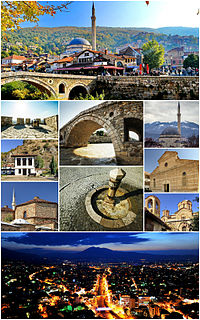
Gjilan or Gnjilane, is a city and municipality located in the Gjilan District in eastern Kosovo. According to the 2011 census, the city of Gjilan has 54,239 inhabitants, while the municipality has 90,178 inhabitants.
The political divisions of Bosnia and Herzegovina were created by the Dayton Agreement, which recognized a second tier of government in Bosnia and Herzegovina, comprising two entities: the Federation of Bosnia and Herzegovina (FBiH), with mostly Bosniaks and Croats, and the Republika Srpska (RS) with mostly Serbs – each governing roughly one half of the state's territory. The Federation of Bosnia and Herzegovina itself has a federal structure and consists of 10 autonomous cantons.
This is the history of Croatia since the end of the Croatian War of Independence.

The Democratic Party of Kosovo is the largest political party in Kosovo. It was originally a social-democratic party coming out of demilitarized KLA after the war, with most of the leadership coming from Albanian nationalists and former members of PMK. However, during its congress in January 2013, it positioned itself as a center-right party. It is the main center-right party in Kosovo. The party shows strong national conservative, socially liberal and economically liberal tendencies.
Parliamentary elections to the Assembly of Kosovo have been held four times since 1999 with the latest in December 2010. The Assembly was an institution within the Provisional Institutions of Self-Government (PISG) established by the United Nations Interim Administration Mission in Kosovo (UNMIK) to provide 'provisional, democratic self-government' in advance of a decision on the final status of Kosovo. Kosovo, formerly a province of Serbia, came under UN administration in 1999 and unilaterally declared its independence in February 2008. The Assembly elected in 2007 continued in office after the declaration of independence.

Hashim Thaçi is a Kosovar politician who has been the President of Kosovo since April 2016. He was the first Prime Minister of Kosovo and the Foreign Minister and Deputy Prime Minister in the new cabinet led by Isa Mustafa, which assumed office on 12 December 2014.

Football Club Drita, commonly known as Drita, is a professional football club based in Gjilan, Kosovo. The club play in the Football Superleague of Kosovo, which is the top tier of football in the country and is the most successful Kosovan team in European competitions since Kosovo was accepted in UEFA.
Municipal elections were held in Kosovo on November 17, 2007, at the same time as elections to the Assembly of Kosovo, with a second round for the mayoral elections held on 2007-12-08. The date was originally set for September 1, 2007 by the Special Representative of the Secretary-General of the United Nations, Joachim Rücker.

Local elections were held in Romania on 1 June 2008, with a runoff for mayors on 15 June 2008.
The 2008 Serbian local elections in Kosovo were held on 11 May 2008, together with Serbia's parliamentary elections and elections in Vojvodina. UNMIK authorities have criticized Serbia organizing elections saying only the UN can organize elections in Kosovo. Kosovo's President Fatmir Sejdiu accused Serbia of trying to challenge Kosovo's statehood.

Early parliamentary elections were held in Macedonia on 1 June 2008, after the Assembly voted to dissolve itself on 12 April 2008. The result was a victory for the VMRO-DPMNE-led alliance, which won 63 of the 120 seats in the Assembly.
The Kosovar Cup for sponsorship reasons, is the major football national cup tournament in Kosovo. It was established in 1991, and is organized by the Football Federation of Kosovo. Prishtina are the current holders, who won their 5th Kosovar Cup against Vëllaznimi at the 2017–18 Kosovar Cup Final held at the Olympic Stadium Adem Jashari.

Municipal elections were held in Bosnia and Herzegovina on 5 October 2008. Parties and independent candidates had to register by 23 May 2008, party or coalition lists by 25 June 2008. These were the first local elections were representatives of minorities were elected to the municipal assemblies.
In 1991, the Socialist Party of Albania, with specific social democratic ideology took control of the country through democratic elections. One year later the Democratic Party of Albania won the new elections. After 1990, Albania has been seeking a closer relationship with the West. What followed were deliberate programs of economic and democratic reform, but Albanian inexperience with capitalism led to the proliferation of pyramid schemes – which were not banned due to the corruption of the government. Chaos in late 1996 to early 1997, as a result of the collapse of these pyramid schemes, alarmed the world and prompted the influx of international peacekeeping forces. In 1995, Albania was accepted into the Council of Europe and requested membership in NATO and is a potential candidate country for accession to the European Union. The workforce of Albania has continued to emigrate to Western countries, especially Greece and Italy.
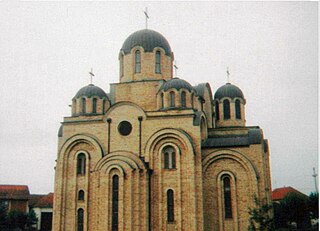
Parteš or Partesh, is a town and municipality located in the Gjilan District of Kosovo. The municipality was established on 19 August 2010. It is inhabited by Serbs, and as of 2013, it has an estimated population of 5,300 inhabitants.

Agim Ramadani was a commander of the Kosovo Liberation Army (KLA), an ethnic Albanian paramilitary organization that sought the independence of Kosovo from Serbia. He was killed in action.
A referendum on modifying the size and structure of the Parliament from the current bicameral one with 137 senators and 334 deputies to a unicameral one with a maximum of 300 seats was held in Romania on 22 November 2009, at the same time as the first round of the 2009 presidential election. Electors were asked two questions on two separate ballots:
- Do you agree to Romania's adoption of a unicameral Parliament?
- Do you agree to the reduction of the number of parliamentarians to a maximum of 300 persons?

The Kosovan parliamentary election was held in Kosovo on 12 December 2010, following a vote of no-confidence in the government that brought forward the election.
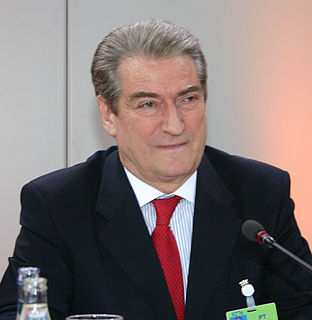
The Albanian local elections of 2011 took place on 8 May 2011 in Albania. Electors were asked to elect their municipality's mayor, municipal council members, municipal unit mayor, and municipal unit members. The elections were administrated by the Central Election Commission of Albania. Only 9 of the 384 winning candidates were women.

Local elections were held in Kosovo on 3 November 2013. These were the first elections which the Serbs of Northern Kosovo participated in since the Republic of Kosovo declared independence in 2008; polls were monitored by the OSCE. There were violent reactions in Serb-majority areas of northern Kosovo.