The President of the Republic of North Macedonia is the head of state of North Macedonia. The institution of the Presidency of the modern North Macedonia state began after the Macedonian declaration of independence on 8 September 1991. Its first president was Kiro Gligorov, the oldest president in the world until his resignation in 1999. The North Macedonia presidency is largely a ceremonial post and the Prime Minister of North Macedonia is the country's leading political figure and de facto chief executive.
The Republic of Kosova was a self-declared proto-state in 1992. During its peak, it tried to establish its own parallel political institutions in opposition to the institutions of the Autonomous Province of Kosovo and Metohija held by the Republic of Serbia.

Hashim Thaçi is a Kosovar politician who has been the President of Kosovo since April 2016. He was the first Prime Minister of Kosovo and the Foreign Minister and Deputy Prime Minister in the new cabinet led by Isa Mustafa, which assumed office on 12 December 2014.

An independence referendum was held in Montenegro on 21 May 2006. It was approved by 55.5% of voters, narrowly passing the 55% threshold. By 23 May, preliminary referendum results were recognized by all five permanent members of the United Nations Security Council, suggesting widespread international recognition if Montenegro were to become formally independent. On 31 May, the referendum commission officially confirmed the results of the referendum, verifying that 55.5% of the population of Montenegrin voters had voted in favor of independence. Because voters met the controversial threshold requirement of 55% approval set by the European Union, the referendum was incorporated into a declaration of independence during a special parliamentary session on 31 May. The Assembly of the Republic of Montenegro made a formal Declaration of Independence on Saturday 3 June.
The Kosovo national football team represents Kosovo in international men's football. It is controlled by the Football Federation of Kosovo, the governing body for football in Kosovo.
The political status of Kosovo, also known as the Kosovo question is the subject of a long-running political and territorial dispute between the Serbian government and the Kosovar leadership in the Assembly of Kosovo, stemming from the breakup of Yugoslavia (1991-92) and the ensuing Kosovo War (1998–99). In 1999 the administration of the province was handed on an interim basis to the United Nations under the terms of UNSCR 1244 which ended the Kosovo conflict of that year. That resolution reaffirmed the sovereignty of Serbia over Kosovo but required the UN administration to promote the establishment of 'substantial autonomy and self-government' for Kosovo pending a 'final settlement' for negotiation between the parties.
A referendum on a proposed draft of the new Serbian constitution was held on October 28 and 29 October 2006 and resulted in the draft constitution being approved by the Serbian electorate. The constitution is Serbia's first as an independent state since the Kingdom of Serbia's 1903 constitution. Over 6.6 million people were entitled to vote in the national referendum.
A referendum on changing the Danish Act of Succession, the rules governing the succession to the Danish throne, was held in Denmark, the Faroe Islands, and Greenland on 7 June 2009, simultaneously with the election to the European Parliament, in Denmark proper.
Since its declaration of independence from Serbia, enacted on 17 February 2008, international recognition of Kosovo has been mixed, and the international community continues to be divided on the issue.

The Republic of Ilirida is a proposed state declared twice by politician Nevzat Halili, once in 1992 and once in 2014. The idea has been declared unconstitutional by the Macedonian government. The secessionist concept of Ilirida emerged in the early 1990s and was advocated by some Albanian politicians as a solution to concerns and disputes the Albanian community had regarding constitutional recognition and minority rights within Macedonia.

Albania–Kosovo relations refer to the current, cultural and historical relations of Albania and Kosovo. Albania has an embassy in Pristina and Kosovo has an embassy in Tirana. There are 1.6 million Albanians living in Kosovo - officially 92.93% of Kosovo's entire population - and Albanian is an official language of Kosovo. Likewise, the peoples of the two countries share common traditions and folklore.

Kosovan–Maldivian relations are foreign relations between Kosovo and the Maldives. Kosovo declared its independence from Serbia on 17 February 2008 and the Maldives recognised it on 19 February 2009. On the 16 April 2009, Kosovo and the Maldives established diplomatic relations with one another.
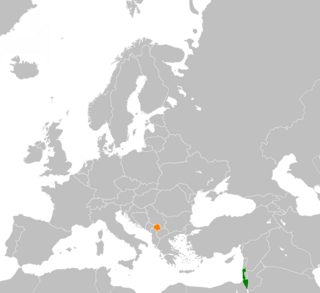
Israel–Kosovo relations refer to bilateral relations between Israel and the Republic of Kosovo. Although Kosovo declared its independence from Serbia on 17 February 2008, Israel has not recognised sovereign Kosovo, but in 2015, gave indications that its stance could change in the future.

Egyptian–Kosovan relations are foreign relations between Egypt and Kosovo.
Kosovo's declaration of independence from Serbia was enacted on Sunday, 17 February 2008 by a unanimous vote of the Assembly of Kosovo. All 11 representatives of the Serb minority boycotted the proceedings. International reaction was mixed, and the world community continues to be divided on the issue of the international recognition of Kosovo. Slovakia's reaction to the 2008 Kosovo declaration of independence is one of non-recognition, but it has given indications that its stance could change in the future.
Kosovo's declaration of independence from Serbia was enacted on Sunday, 17 February 2008 by a unanimous vote of the Assembly of Kosovo. All 11 representatives of the Serb minority boycotted the proceedings. International reaction was mixed, and the world community continues to be divided on the issue of the international recognition of Kosovo. Bosnia and Herzegovina's reaction to the 2008 Kosovo declaration of independence is mixed. Bosniak and Croat members of the Presidency want to recognise Kosovo, but Serb members refuse.
Kosovo's declaration of independence from Serbia was enacted on Sunday, 17 February 2008 by a unanimous vote of the Assembly of Kosovo. All 11 representatives of the Serb minority boycotted the proceedings. International reaction was mixed, and the global community continues to be divided on the issue of the international recognition of Kosovo. Greece's reaction to the 2008 Kosovo declaration of independence in general is neutral.

Kosovo's declaration of independence from Serbia was enacted on Sunday, 17 February 2008 by a unanimous vote of the Assembly of Kosovo. All 11 representatives of the Serb minority boycotted the proceedings. International reaction was mixed, and the world community continues to be divided on the issue of the international recognition of Kosovo. Libya extended official diplomatic recognition to Kosovo on 25 September 2013.