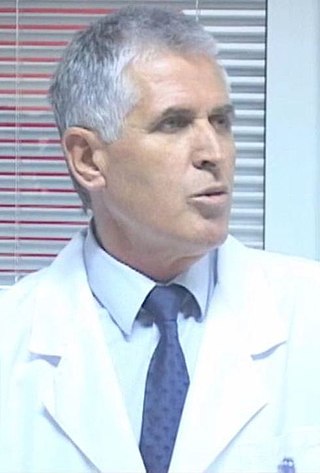
Bajram Rexhepi, was a Kosovar politician who served as the first elected post-war prime minister and later as interior minister of the Republic of Kosovo and as a member of the Kosovo Assembly. He was a member of the second largest political party in Kosovo, the Democratic Party of Kosovo (PDK).
The Democratic League of Kosovo is the second-largest political party in Kosovo.

The Democratic Party of Kosovo is the largest political party in Kosovo. It was originally a social-democratic party coming out of demilitarized KLA after the war, with most of the leadership coming from Albanian nationalists and former members of PMK. However, during its congress in January 2013, it positioned itself as a center-right party. It is the main center-right party in Kosovo. The party shows strong national conservative, socially liberal and economically liberal tendencies.

The Alliance for the Future of Kosovo is a political party in Kosovo. It was formed on 29 April 2001.
The politics of Kosovo, a disputed territory recognized by 102 out of 193 (52.8%) United Nations (UN) member states as an de facto independent state situated de jure within Serbia, takes place in a framework of a multi-party parliamentary representative democratic republic, whereby the President (Presidenti) is the head of state and the Prime Minister (Kryeministri) the head of government. Parliamentary elections are held every four years, the most recent in 2017.
Vetëvendosje is a progressive, social democratic, and Albanian nationalist political party in Kosovo that opposes foreign involvement in the country's internal affairs, and campaigns for the principle of equal rights and fair equality of opportunity and for the sovereignty exercised by the people, as part of the right to self-determination.

Hashim Thaçi is a Kosovar politician who has been the President of Kosovo since April 2016. He was the first Prime Minister of Kosovo and the Foreign Minister and Deputy Prime Minister in the new cabinet led by Isa Mustafa, which assumed office on 12 December 2014.

NorthKosovo, also known as the Ibar Kolašin, is a region in the northern part of Kosovo, composed of four municipalities with ethnic Kosovo Serbs majority: North Mitrovica, Leposavić, Zvečan and Zubin Potok.

New Kosovo Alliance is a liberal political party in Kosovo that is in the current coalition government made up by the PDK and AKR. The party was founded on 3 May 2006, by Behgjet Pacolli, a businessman. He is the founding owner of Mabetex, the Swiss-based project-engineering firm that has managed significant engineering projects ranging from restorations in the White House in the United States to the rebuilding of the Kremlin in Moscow.

Parliamentary elections to the unicameral Assembly of Kosovo were held on 17 November 2007, together with municipal elections. The Assembly of Kosovo is the legislative branch of the Provisional Institutions of Self-Government that the United Nations Interim Administration Mission in Kosovo (UNMIK) created to help administration in Kosovo. The elections were scheduled by the Special Representative of the Secretary-General of the United Nations, Joachim Rücker on 1 September 2007.
The 2008 Serbian local elections in Kosovo were held on 11 May 2008, together with Serbia's parliamentary elections and elections in Vojvodina. UNMIK authorities have criticized Serbia organizing elections saying only the UN can organize elections in Kosovo. Kosovo's President Fatmir Sejdiu accused Serbia of trying to challenge Kosovo's statehood.
The Kosovan parliamentary election was held in Kosovo on 12 December 2010, following a vote of no-confidence in the government that brought forward the election.

Isa Mustafa is a Kosovar politician who is the leader of the Democratic League of Kosovo (LDK). Mustafa was Mayor of Pristina from December 2007 to December 2013 and served as Prime Minister of Kosovo between December 2014 and September 2017.

The Community of Serb Municipalities, or Association of Serb Municipalities, is a planned self-governing association of municipalities with majority Serb population in Kosovo.

Fadil Ferati was a Kosovar political leader, he was the Mayor of Istog and vice-president of Democratic League of Kosovo and he was widely known as a politician who never lost any election.

Local elections were held in Kosovo on 3 November 2013. These were the first elections which the Serbs of Northern Kosovo participated in since the Republic of Kosovo declared independence in 2008; polls were monitored by the OSCE. There were violent reactions in Serb-majority areas of northern Kosovo.
Pristina is the capital city of Kosovo. In the preliminary results of the 2011 census the population of Pristina was around 198,000. The majority of the population is Albanian, but there are also smaller communities including Bosniaks, Serbs, Romani and others. The surface of Pristina is 854 km². Pristina is known as the center of cultural, economical and political developments. Since 2014 the current mayor is Shpend Ahmeti. The city is home of the University of Pristina, Pristina International Airport, the Government Building and the Parliament of the Republic of Kosovo.
Parliamentary elections were held in Kosovo on 8 June 2014, after incumbent Prime Minister Hashim Thaçi announced his intention to hold elections.
The PANA Coalition is a political alliance between three political parties in Kosovo: The Democratic Party of Kosovo, the Alliance for the Future of Kosovo and the Initiative for Kosovo, which stood in the 2017 elections. After the election, the New Kosovo Alliance joined the coalition.
Slaviša Ristić is a politician in Serbia. He is a prominent figure in the Kosovo Serb community and served for many years as president of the municipality of Zubin Potok, a Serb community in Kosovo on the border with Central Serbia. He was elected to the National Assembly of Serbia in 2016 as a member of the Democratic Party of Serbia, although he left the party later in the same year and now serves as an independent.