Related Research Articles

Barnacles are a type of arthropod constituting the subclass Cirripedia in the subphylum Crustacea, and are hence related to crabs and lobsters. Barnacles are exclusively marine, and tend to live in shallow and tidal waters, typically in erosive settings. They are sessile (nonmobile) and most are suspension feeders, but those in infraclass Rhizocephala are highly specialized parasites on crustaceans. They have four nektonic larval stages. Around 1,000 barnacle species are currently known. The name Cirripedia is Latin, meaning "curl-footed". The study of barnacles is called cirripedology.

Thoracica is an infraclass of crustaceans which contains the most familiar species of barnacles found on rocky coasts, such as Semibalanus balanoides and Chthamalus stellatus. They have six well-developed limbs, and may be either stalked or sessile. The carapace is heavily calcified. The group includes free-living and commensal species.

Thecostraca is a class of marine invertebrates containing over 2,200 described species. Many species have planktonic larvae which become sessile or parasitic as adults.

The Balanidae comprise a family of barnacles of the order Balanomorpha. As a result of research published in 2021 by Chan et al., the members of the family Archaeobalanidae were merged with this family.
The Chthamalidae are a family of chthamaloid barnacles, living entirely in intertidal/subtidal habitats, characterized by a primary shell wall of eight, six, or four plates, lacking imbricating plate whorls, and either membraneous or more rarely calcareous basis. They are not found below immediate subtidal habitats, and more likely are found in the highest tier of shallow-water barnacle fauna. They can be found in the most rigorous wave-washed locations, and some species are found in the surf zone above high tide mark, only receiving water from wave action at high tide.
Sessilia is an unranked clade of barnacles, comprising the barnacles without stalks, or acorn barnacles. They form a monophyletic group and are probably derived from stalked or goose barnacles. Sessilia is divided into two orders. The Verrucomorpha contain two families, Verrucidae and Neoverrucidae, and the remaining 14 families are in the order Balanomorpha.
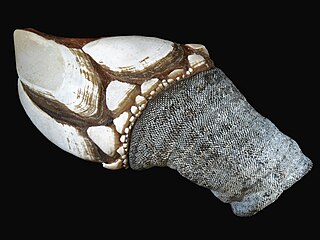
Pollicipedidae is a family of goose barnacles.
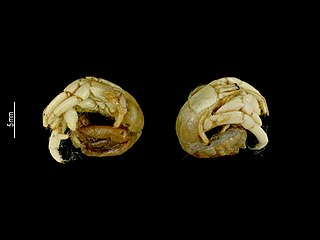
The Peltogastridae are a family of barnacles belonging to the bizarre parasitic and highly apomorphic infraclass Rhizocephala. The Peltogastridae are by far the largest family of Rhizocephala. They comprise 14 genera, 3 of which were moved from the family Lernaeodiscidae.

Lepadidae is a family of goose barnacles, erected by Charles Darwin in 1852. There are about five genera and more than 20 described species in Lepadidae.
In the past, Archaeobalanidae has been considered a family of barnacles of the order Sessilia. Research published in 2021 by Chan et al. resulted in the genera of Archaeobalanidae being merged with that of Balanidae, which now contains the members of both families. In the same work, Sessilia was not retained as an order of barnacles.
In the past, Anelasmatidae has been considered a family of barnacles of the order Lepadiformes. Research published in 2021 by Chan et al. resulted in the sole genus of this family, Anelasma, being moved to the family Pollicipedidae, and this family is no longer used.
In the past, Notochthamalinae has been considered a subfamily of barnacles of the family Chthamalidae. Research published in 2021 by Chan et al. resulted in the genera of the three subfamilies Euraphiinae, Chthamalinae, and Notochthamalinae being assigned directly to the family, without subfamily groupings, and this subfamily is no longer used.
The Catophragmidae are a family of barnacles in the superfamily Chthamaloidea with eight shell wall plates, surrounded by several whorls of imbricating plates. The basis is membranous.
In the past, Platylepadidae has been considered a family of barnacles of the order Sessilia. Research published in 2021 by Chan et al. resulted in the genera of Platylepadidae being merged with that of Balanidae, except Stephanolepas which was moved to Chelonibiidae. In the same work, Sessilia was not retained as an order of barnacles.
Kentrogonida was formerly a suborder of barnacles belonging to the group Rhizocephala, now an infraclass. In research published by Chan et al. in 2021, the suborders Kentrogonida and Akentrogonida were removed from the infraclass Rhizocephala, leaving 13 families as children of Rhizocephala without intermediate orders or suborders.
Scalpellomorpha is an order of acorn barnacles in the class Thecostraca. There are about 11 families in 3 superfamilies and more than 450 described species in Scalpellomorpha.
In the past, Koleolepadidae has been considered a family of barnacles with a single genus, Koleolepas. Research published in 2021 by Chan et al. resulted in Koleolepas being moved to the family Heteralepadidae. The family Koleolepadidae is not longer active.
In the past, Microlepadidae has been considered a family of barnacles. Research published in 2021 by Chan et al. resulted in the genera of Microlepadidae being merged with that of Poecilasmatidae, which now contains the members of both families.
Eolepadomorpha is an extinct order of barnacles in the class Thecostraca. There are 2 families and about 14 described species in Eolepadomorpha.
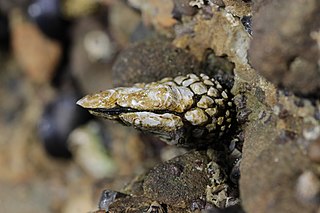
Pollicipedomorpha is an order of pedunculated barnacles in the class Thecostraca. There are 3 families and more than 30 described species in Pollicipedomorpha.
References
- ↑ Chan, Benny K. K.; Dreyer, Niklas; Gale, Andy S.; Glenner, Henrik; et al. (2021). "The evolutionary diversity of barnacles, with an updated classification of fossil and living forms". Zoological Journal of the Linnean Society. 193 (3): 789–846. doi: 10.1093/zoolinnean/zlaa160 .