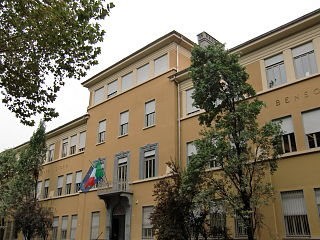
Liceo scientifico statale Camillo Cavour

Last updated

Liceo Scientifico Statale Camillo Cavour
Vittorino da Feltre 3.jpg
Location
Liceo scientifico statale Camillo Cavour
via delle Carine, 1

Rome
,
00184

Italy
Coordinates 41°53′34″N12°29′29″E / 41.892757°N 12.491297°E / 41.892757; 12.491297
Information
Type liceo scientifico
Established1871 (1871)
PrincipalClaudia Sabatano
Number of students1002
Sports
  • orienteering
  • chess
  • athletics
NewspaperCavò
Website liceocavour.edu.it

Liceo scientifico statale Camillo Cavour ( Italian for 'State scientific lyceum Camillo Cavour') is a liceo scientifico located in Rome, in via delle Carine 1, in Rione Monti. It was the first scientific high school in Rome, and potentially in the whole Italy. [1]

Contents

History

Construction of the second building Vittorino da Feltre 1887.jpg
Construction of the second building

The Liceo Cavour was established in 1871 as the Physics and Mathematics branch of the Regio Istituto Tecnico di Roma (which later became the Istituto Tecnico-Commerciale Leonardo Da Vinci). After the Gentile Reform in 1923, this school became the Regio Liceo Scientifico di Roma, [2] under the royal legislative decree of 9 September 1923, n. 1915. [3] It was founded in 1923–24, as the scientific branch of liceo classico Ennio Quirino Visconti , the first liceo classico in Rome. In 1926 the Regio Liceo Scientifico di Roma was established as an independent body, starting teaching in 1926–27. In 1946, with the inauguration of the Liceo Scientifico Statale Augusto Righi (a branch of the Regio Liceo), the school was renamed Liceo Scientifico Camillo Cavour. [2]

Among the more famous people to have worked here were the poet Margherita Guidacci, English language and literature teacher from 1965 to 1975, Gioacchino Gesmundo, History and Philosophy teacher from 1934 to 1944, and the physicist Bruno Pontecorvo (who was part of the group of physicists and scientists named I Ragazzi di Via Panisperna', ' Via Panisperna Boys ') with his younger brother Umberto. Notable former students include Franca Falcucci, the future Minister of public education, [4] and Marta Russo, whose murder garnered huge media attention. [5]

Structure

The two buildings: on the left side "palazzina B
" and on the right side "palazzina A
" (the oldest one) Vittorino da Feltre 2.jpg
The two buildings: on the left side "palazzina B" and on the right side "palazzina A" (the oldest one)

Since its foundation until 1962, the liceo was based at 'ITC Leonardo da Vinci', in via Cavour 258. In October 1962 it moved to the new building in via Vittorino da Feltre 6, near the Colosseum. The building was built between 1884 and 1887 by architect Luca Carimini, and it initially housed the Missionary Oblates of Mary Immaculate college. In 1905, when the headquarters of the Oblates was moved to Rome, a second building was constructed close to the first one, and the access on via delle Carine was opened. [6] The school is housed in both buildings. [4]

Inside the liceo, in addition to several classrooms, there are a Chemistry laboratory and a Physics laboratory, Technical drawing classrooms, a language laboratory, a ICT laboratory, a lecture hall, a library, two gyms, two volleyball courts, a basketball court and a cafe.

Curriculum

The liceo offers the traditional study plan of liceo scientifico. Until their abolition in 2010 as a result of the Gelmini Reform, a PNI trial (National plan of Computer Studies) and a bilingualism trial were activated; after the reform, they were blocked till depletion. [7]

Philately

On 29 September 2001, to celebrate the 75th anniversary of the school, Poste Italiane issued a postage stamp that portrayed the Liceo. Designed by Luigi Vangelli, it was produced in 3,500,000 copies. [8]

Metropolitana di Roma - logo linea B.svg It can be reached from Colosseo and Cavour stations.
Metropolitana di Roma C.svg It will be reachable, by 2025, from Fori Imperiali/Colosseo station.

See also

Related Research Articles

<span class="mw-page-title-main">EUR, Rome</span> District in Italy

EUR is a residential area and the major business district in Rome, Italy, part of the Municipio IX.

Cavour usually refers to Camillo Benso, Count of Cavour (1810–1861), Italian politician who was a leading figure in the unification of Italy and became Italy's first Prime Minister. It may also refer to eponymous places and ships, among others.

Ludovisi (<i>rione</i> of Rome) Rione of Rome in Lazio, Italy

Ludovisi is the 16th rione of Rome, Italy, identified by the initials R. XVI and located within the Municipio I.

<i>Liceo scientifico</i> Type of secondary school in Italy

Liceo scientifico is a type of secondary school in Italy. It is designed to give students the skills to progress to any university or higher educational institution. Students can attend the liceo scientifico after successfully completing middle school.

<i>Liceo classico</i> Italian secondary school

The liceo classico or ginnasio is the oldest public secondary school type in Italy. Its educational curriculum spans over five years, when students are generally about 14 to 19 years of age.

The Liceo Ginnasio Statale "J. Sannazaro", commonly called the Liceo Sannazaro, is a co-educational state secondary school in the Vomero hill quarter of Naples. The c. 1,200 pupils are drawn from across the Neapolitan urban area, although preference is given to children from Vomero and the adjacent Arenella quarter. As a liceo classico it offers a traditional classical curriculum with a strong concentration on Italian, Latin and Greek. Alternative syllabi are available for some degree of specialisation in foreign languages, mathematics and computer science, or history of art.

<span class="mw-page-title-main">Cinzia Giorgio</span> Italian writer (born 1975)

Cinzia Giorgio is an Italian writer.

<span class="mw-page-title-main">Liceo classico Cavour</span>

Liceo Ginnasio statale "Camillo Benso di Cavour" is the oldest Liceo classico in Turin and one among the oldest and most prominent high schools in Italy, for pupils aged 14 to 19. It was transferred to its present location in 1931.

Liceo Classico “Quinto Orazio Flacco” is the oldest institution for secondary education in the city of Bari, Apulia, Italy. Commonly known as Flacco, this liceo classico welcomes students from 14 to 19 years of age. The scholastic environments are still located in the original building, which was built along a stretch of Bari’s Lungomare in 1933.

<span class="mw-page-title-main">Camillo Benso, Count of Cavour</span> First Prime Minister of the Kingdom of Italy from March to June in 1861

Camillo Paolo Filippo Giulio Benso, Count of Cavour, Isolabella and Leri, generally known as the Count of Cavour or simply Cavour, was an Italian politician, statesman, businessman, economist, and noble, and a leading figure in the movement towards Italian unification. He was one of the leaders of the Historical Right and Prime Minister of the Kingdom of Sardinia from 1852, a position he maintained until his death, throughout the Second Italian War of Independence and Giuseppe Garibaldi's campaigns to unite Italy. After the declaration of a united Kingdom of Italy, Cavour took office as the first Prime Minister of Italy; he died after only three months in office and did not live to see the Roman Question solved through the complete unification of the country after the Capture of Rome in 1870.

Liceo Español Cervantes, named for Miguel de Cervantes, is a Spanish international school in Gianicolo, Rome, Italy, operated by the Spanish Ministry of Education. It serves classes from primary school up to the bachillerato level. It is owned by the Spanish government and was established in 1973.

<span class="mw-page-title-main">Istituto Statale Italiano Leonardo Da Vinci</span> Primary & secondary school in Paris, France

The Istituto Statale Italiano Leonardo Da Vinci is an Italian government-owned Italian international school in Paris, France. Its scuola media and liceo scientifico, along with the school administration, occupies one campus in the 7th arrondissement. The elementary school is housed in a different campus in the same arrondissement.

<span class="mw-page-title-main">Carla Capponi</span> Italian politician

Carla Capponi aka The Little English Girl was an Italian partisan and politician who received the Gold Medal of Military Valour for her participation in the Italian resistance movement.

<span class="mw-page-title-main">Liceo scientifico Filippo Masci</span> State liceo scientifico school in Italy

Liceo scientifico Filippo Masci is an Italian state secondary school in Chieti, Abruzzo, offering different liceo scientifico curricula to students typically aged from 14 to 19 years old.

The ginnasio liceo moderno was a high school of the Kingdom of Italy, established in 1911 on the initiative of the Minister of Public Education Luigi Credaro, who partially accepted the proposal of the Real commission, a parliamentary commission established in 1906 in order to enrich the Italian lyceum offer.

<span class="mw-page-title-main">Liceo ginnasio statale Emanuele Duni</span> School in Italy

The Liceo ginnasio Emanuele Duni is an Italian high school located in Matera, in the region of Basilicata in Southern Italy. It is named after Italian philosopher Emanuele Duni, professor of canon and civil law at the University of Rome. It is best known for having been the school where the Italian poet Giovanni Pascoli worked as a teacher in the two-year period 1882–1884.

<span class="mw-page-title-main">Collegio Ghislieri (Rome)</span> College grounded by Giuseppe Ghislieri

The Collegio Ghislieri was a building in Rome, seat of the eponymous charitable institution, important for architectural and historical reasons.

<span class="mw-page-title-main">Liceo Statale Niccolò Machiavelli</span> Secondary school in Florence, Italy

The Liceo statale "Niccolò Machiavelli" is a high school named after Niccolò Machiavelli located in the historic Oltrarno quarter of Florence, Italy. In the 2020 academic year it offered the secondary schools Liceo classico, Liceo delle Scienze Umane, Liceo Linguistico and Liceo Scientifico. It has a student population of over 1700, making it the second largest high school in the province. Initially based in the Fortezza da Basso, the school was moved Palazzo Rinuccini, in Via S. Spirito, in 2004. The branch of the school housing the international linguistic and international scientific departments is located in Palazzo Frescobaldi, also known as Della Missione. It is one of the oldest Italian normal schools for girls and has hosted the courses of one of the two Royal Higher Education Institutes.

The Istituto magistrale statale Santa Rosa di Viterbo is a high school focused on training teachers with specialties in human sciences, music, and dance, with main campus located on Via San Pietro # 27 in central Viterbo, region of Lazio, Italy. It stands across from the Monastero della Visitazione.

References

  1. Cartocci 2010 , p. 159
  2. 1 2 Cartocci 2010 , p. 161
  3. "Regio decreto legislativo 9 settembre 1923 n. 1915" [Royal legislative decree, 9 September 1923, n. 1915] (in Italian). Retrieved 26 July 2012.
  4. 1 2 "Storia dell'Istituto" [Institute history] (in Italian). Liceo Cavour – Official website. Retrieved 26 July 2012.
  5. Picozza, Carlo (26 November 2011). "Scattone in cattedra nel liceo di Marta Russo" [Scattone on chair at Marta Russo's school] (in Italian). repubblica.it. Retrieved 26 August 2012.
  6. Cartocci 2010 , p. 164
  7. "Piano dell'Offerta Formativa 2012–2013" (PDF). Liceo Cavour – Official website. Retrieved 26 July 2012.
  8. Poste Italiane 2001 , pp. 82–85

Bibliography