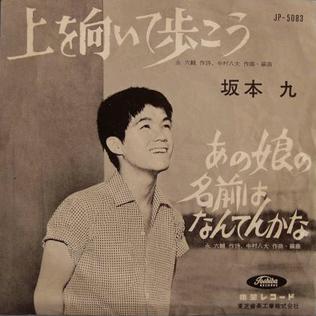
"Ue o Muite Arukō", alternatively titled "Sukiyaki", is a song by Japanese crooner Kyu Sakamoto, first released in Japan in 1961. The song topped the charts in a number of countries, including the U.S. Billboard Hot 100 in 1963. The song grew to become one of the world's best-selling singles of all time, selling over 13 million copies worldwide.
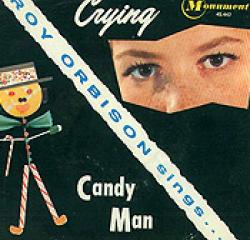
"Crying" is a song written by Roy Orbison and Joe Melson for Orbison's third studio album of the same name (1962). Released in 1961, it was a number 2 hit in the US for Orbison and was covered in 1978 by Don McLean, whose version went to number 1 in the UK in 1980.

"Head over Feet" is a song by Canadian singer-songwriter Alanis Morissette, taken from her third studio album Jagged Little Pill (1995). Written by Alanis and Glen Ballard, and produced by Ballard, it was released as the album's fifth single outside of the United States in July 1996 and presented a softer sound than the previous singles from the album. "Head over Feet" talks about being best friends and lovers with someone at the same time, with Alanis thanking them for their manners, love and devotion.

"Amanda" is a power ballad by American rock band Boston written by Tom Scholz. The song was released as the first single from the band's third album, Third Stage, in 1986, six years after it was recorded.

"Arthur's Theme (Best That You Can Do)" is a song performed and co-written by American singer-songwriter Christopher Cross as the main theme for the 1981 film Arthur, starring Dudley Moore and Liza Minnelli. It was recognized as the year's Best Original Song at both the 54th Academy Awards and 39th Golden Globe Awards.
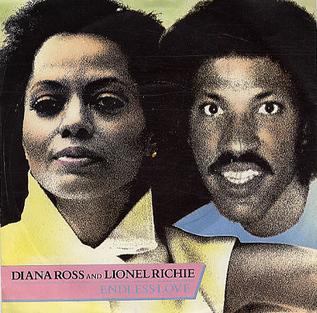
"Endless Love" is a song written by Lionel Richie and originally recorded as a duet between Richie and singer/actress Diana Ross. In this ballad, the singers declare their "endless love" for one another. It was covered by Luther Vandross with R&B-pop singer Mariah Carey, and also by country music singer Shania Twain. Billboard has named the original version as the greatest song duet of all time.
"The First Cut Is the Deepest" is a 1967 song written by British singer-songwriter Cat Stevens, originally released by P. P. Arnold in April 1967. Stevens's own version originally appeared on his album New Masters in December 1967.

"Mull of Kintyre" is a song by the English-American rock band Wings. It was written by Paul McCartney and Denny Laine in tribute to the Kintyre peninsula in Argyll and Bute in the south-west of Scotland and its headland, the Mull of Kintyre, where McCartney has owned High Park Farm since 1966.
"Don't Know Much" is a song written by Barry Mann, Cynthia Weil and Tom Snow. Mann was the first to record the song in 1980, gaining a minor chart hit in the US. The song was made famous when it was covered as a duet by Linda Ronstadt and Aaron Neville in 1989. Their version was a worldwide success, topping the Irish Singles Chart and reaching the top 10 in several territories.

Barbra Streisand is an American actress and singer. Her discography consists of 118 singles, 36 studio albums, 12 compilations, 11 live albums, and 15 soundtracks. According to the Recording Industry Association of America, Streisand is the second-best-selling female album artist in the United States with 68.5 million certified albums in the country, and a career total ranging from 150 to 200 million making her one of the best-selling music artists of all time.

Canadian singer Celine Dion has released 137 singles in both English and French as a lead artist. According to Billboard magazine, Dion is the world's best-selling contemporary female artist of all time. As of 2021, she has reportedly sold around 200 to 250 million records worldwide. Referred to as the "Queen of Power Ballads", Dion has released a string of worldwide hits, with "My Heart Will Go On" being her career's biggest hit, with estimated physical sales of over 18 million worldwide, making it the 2nd best-selling physical single by a woman in history. It reached over 117 million radio impressions during its peak, becoming the most-played radio hit in history and became the best-selling single of 1998 worldwide. "Because You Loved Me" is her biggest hit on the US Billboard Hot 100, spending six weeks atop the chart and selling six million copies in its first six months of availability worldwide. "Pour que tu m'aimes encore" was the 4th biggest hit of the 1990s in France and has sold over four million copies worldwide.

"Show Me Love" is a song by Swedish singer and songwriter Robyn. It was first released in Sweden in February 1997 as the fourth single from her debut studio album, Robyn Is Here (1995). The song was her third UK and second US single. Robyn wrote it with Max Martin, who also produced the song with Denniz Pop. Its music video was directed by Kevin Bray. The song is sometimes confused with Robin S.'s 1993 single "Show Me Love" because of identical song titles and similar first names; however, the two songs are not related.
Jack Hennig is a Canadian singer-songwriter. Hennig is best known for his Canadian hits "Lady Highway" (1976), "George the Hermit" (1978), "Mindy" (1978), and "Caught in the Middle" (1979). During the peak of his career between 1970 and 1980, Hennig placed nine songs on the Canadian RPM charts.
Jim Mancel was a Canadian singer, producer, composer and arranger who had several hits from the early 1970s and another in the early 1980s. He has recorded for the Polydor, Apex, and Quality labels, and Quality's subsidiary, Celebration. His hits include, "I Could Give You the World" which was a hit on the MAPL chart in 1970, and his 1975 single "Let the Phone Ring" which was also commercially successful in Canada. He hit the adult contemporary chart in 1977 with "Just Be Yourself". He was also a member of the Canadian band, Chester who had a hit in 1973 with "Make My Life a Little Bit Brighter".
