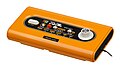
List of dedicated consoles

Last updated

This is a list of dedicated video game consoles in chronological order. Only officially licensed consoles are listed in the retro style sections.

Contents

Most first generation video game consoles are dedicated consoles, i.e. they have a single game or limited list of games built into the console itself, and are not equipped for additional games. Starting in the 2000s, there has been a new wave of dedicated consoles focusing on retrogaming. These newer consoles usually have at least 10 games that were made in the 1970s, 1980s, or 1990s.

A video game console is a computer device that outputs a video signal or visual image to display a video game that one or more people can play.

A dedicated console is a video game console that is dedicated to a built in game or games, and is not equipped for additional games, via cartridges, discs or other media.

Retrogaming playing or collecting older video and computer games

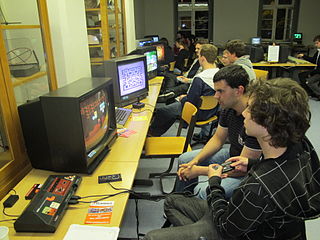
Retrogaming, also known as classic gaming and old school gaming, is the playing or collecting of older personal computer, console, and arcade video games in contemporary times. Usually retrogaming is based upon systems that are obsolete or discontinued.

List by date order

Early dedicated home consoles (1974–1983)

Also see: Pong home version

Telstar (game console) video game console series

The Telstar is a series of video game consoles produced by Coleco from 1976 to 1978. Starting with Telstar Pong clone based on General Instrument's AY-3-8500 chip in 1976, there were 14 consoles released in the Telstar branded series. One million Telstar units were sold.

APF TV Fun video game console

The APF TV Fun is a series of dedicated consoles manufactured by APF Electronics Inc. and built in Japan starting in 1976. The systems were among the first built on the General Instrument 'Pong on a chip', the AY-3-8500, that allowed many manufacturers to compete against the Atari home pong. The APF TV Fun consoles were one of the eraliest pong clone consoles.

NameRelease dateManufacturer
Ping-o-Tronic 1974 [1] [2] Zanussi Flag of Italy.svg
Odyssey 100 1975 Magnavox Flag of the United States.svg
Odyssey 200 1975 Magnavox Flag of the United States.svg
Sears Tele-Games 1975 Atari Flag of the United States.svg
TV Tennis Electrotennis 1975 Epoch Co. Flag of Japan.svg
APF TV Fun 1976 APF Flag of the United States.svg
Odyssey 200 1976 Philips Flag of the Netherlands.svg
Odyssey 300 1976 Magnavox Flag of the United States.svg
Odyssey 400 1976 Magnavox Flag of the United States.svg
Odyssey 500 1976 Magnavox Flag of the United States.svg
Sportsman T101 1976 Unisonic Flag of the United States.svg
Super PONG 1976 Atari Flag of the United States.svg
Telstar 1976 Coleco Flag of the United States.svg
Tournament 100 1976 Unisonic Flag of the United States.svg
Tournament 102 1976 Unisonic Flag of the United States.svg
Tournament 150 1976 Unisonic Flag of the United States.svg
Tournament 200 1976 Unisonic Flag of the United States.svg
Radio Shack TV Scoreboard 1976 Radio Shack Flag of the United States.svg
Wonder Wizard 1976 General Home Products
Binatone TV Master Mk IV 1977 [3] Binatone Flag of the United Kingdom.svg
Color TV Game 6 (Japan only)1977 Nintendo Flag of Japan.svg
Odyssey 2001 1977 Philips Flag of the Netherlands.svg
Odyssey 2000 1977 Magnavox Flag of the United States.svg
Odyssey 3000 1977 Magnavox Flag of the United States.svg
Odyssey 4000 1977 Magnavox Flag of the United States.svg
Stunt Cycle 1977 Atari Flag of the United States.svg
Tournament 1000 1977 Unisonic Flag of the United States.svg
Tournament 2000 1977 Unisonic Flag of the United States.svg
Tournament 2501 1977 Unisonic Flag of the United States.svg
Colorsport VIII 1978 Granada Flag of the United Kingdom.svg
Color TV Game 15 (Japan only)1978 Nintendo Flag of Japan.svg
Color TV Racing 112 (Japan only)1978 Nintendo Flag of Japan.svg
Odyssey 2100 1978 Philips Flag of the Netherlands.svg
Olympian 2600 1978 Unisonic Flag of the United States.svg
Video Pinball 1978 Atari Flag of the United States.svg
Color TV Game Block Breaker (Japan only)1979 Nintendo Flag of Japan.svg
Computer TV Game (Japan only)1980 Nintendo Flag of Japan.svg
BSS 01 (GDR only)1980 VEB Kombinat Mikroelektronik Erfurt Flag of East Germany.svg
TV játék 1980 Videoton Flag of Hungary.svg
Compu-Vision 1983 [4] Bentley Flag of the United States.svg

Early dedicated console handhelds (1976–1998)

Also see: Handheld game console

NameRelease dateManufacturer
Mattel Handheld Games original series1976-1982 [5] Mattel Flag of the United States.svg
Game & Watch series1980-1991 Nintendo Flag of Japan.svg
Tiger Electronics Handheld Games series1987-1998 Tiger Electronics Flag of the United States.svg
Acclaim Handheld Games series1988-1991 [6] Acclaim Entertainment Flag of the United States.svg

Retro style dedicated home consoles (2001–present)

Also see: Modern retrogaming revival

NameRelease dateManufacturer
Activision TV Games 2001 [7] Toymax International Flag of the United States.svg
Atari 10 in 1 TV Games 2002 Jakks Pacific Flag of the United States.svg
Ms. Pac-Man TV Games 2003 Jakks Pacific Flag of the United States.svg
Pac-Man TV Games 2003 Jakks Pacific Flag of the United States.svg
Atari Paddle 2004 Jakks Pacific Flag of the United States.svg
Activision 10 in 1 TV Games 2004 Jakks Pacific Flag of the United States.svg
Atari Flashback 2004 Atari Flag of the United States.svg
Atari Flashback 2 2005 Atari Flag of the United States.svg
Atari Flashback 3 2011 AtGames Flag of the United States.svg
Atari Flashback 4 2012 AtGames Flag of the United States.svg
Atari Flashback 64 2013 AtGames Flag of the United States.svg
Atari Flashback 5 2014 AtGames Flag of the United States.svg
Atari Flashback 6 2015 AtGames Flag of the United States.svg
Atari Flashback 7 2016 AtGames Flag of the United States.svg
Nintendo Entertainment System: NES Classic Edition 2016 Nintendo Flag of Japan.svg
Retro-Bit Generations 2016 Retro-Bit Flag of the United States.svg
Atari Flashback 8 2017 AtGames Flag of the United States.svg
Super Nintendo Entertainment System: SNES Classic Edition 2017 Nintendo Flag of Japan.svg
Sega Genesis Classic Game Console 2017 AtGames Flag of the United States.svg
Atari Flashback 9 2018 AtGames Flag of the United States.svg
THEC64Mini 2018 Retro Games Ltd. Flag of the United Kingdom.svg
Legends Flashback 2018 AtGames Flag of the United States.svg
PlayStation Classic 2018 Sony Flag of Japan.svg
Retro-Bit Super Retro-Cade 2018 Retro-Bit Flag of the United States.svg
Sega Mega Drive Mini 2019TBD

Retro style dedicated console handhelds (2001–present)

NameRelease dateManufacturer
Mattel Handheld Games re-release series2001-2003 [5] Mattel Flag of the United States.svg
Atari Flashback Portable 2016 AtGames Flag of the United States.svg
Sega Genesis Ultimate Portable Game Player 2016 AtGames Flag of the United States.svg
Atari Flashback Portable 2.0 2017 AtGames Flag of the United States.svg

See also

Related Research Articles

Coleco Industries, Inc. was an American company founded in 1932 by Maurice Greenberg as The Connecticut Leather Company. It became a highly successful toy company in the 1980s, known for its mass-produced version of Cabbage Patch Kids dolls and its video game consoles, the Coleco Telstar dedicated consoles and ColecoVision. While the company disappeared in 1988 as a result of bankruptcy, the Coleco brand was revived in 2005, and remains active to this day.

Handheld game console lightweight, portable electronic device used for gaming

A handheld game console, or simply handheld console, is a small, portable self-contained video game console with a built-in screen, game controls, and speakers. Handheld game consoles are smaller than home video game consoles and contain the console, screen, speakers, and controls in one unit, allowing people to carry them and play them at any time or place.

Intellivision video game console

The Intellivision is a home video game console released by Mattel Electronics in 1979. The name Intellivision is a portmanteau of "intelligent television". Development of the console began in 1977, the same year as the introduction of its main competitor, the Atari 2600. In 1984 Mattel sold their video game assets to a former Mattel Electronics executive and investors that would become INTV Corporation. Games development started in 1978 and continued until 1990 when the Intellivision was discontinued. From 1980 to 1983 over 3 million Intellivision units were sold.

The video game crash of 1983 was a large-scale recession in the video game industry that occurred from 1983 to 1985, primarily in America. The crash was attributed to several factors, including market saturation in the number of game consoles and available games, and waning interest in console games in favor of personal computers. Revenues peaked at around $3.2 billion in 1983, then fell to around $100 million by 1985. The crash was a serious event which abruptly ended what is retrospectively considered the second generation of console video gaming in North America.

1983 has seen many sequels and prequels in video games and several new titles such as Mario Bros., Pole Position II and Spy Hunter.

In the history of computer and video games, the third generation began on July 15, 1983, with the Japanese release of two systems: the Nintendo Family Computer and Sega SG-1000. This generation marked the end of the North American video game crash, and a shift in the dominance of home video games from the United States to Japan. Handheld consoles were not a major part of this generation, although the Game & Watch line from Nintendo had started in 1980 and the Milton Bradley Microvision came out in 1979.

In the history of video games, the second-generation era refers to computer and video games, video game consoles, and handheld video game consoles available from 1976 to 1992. Notable platforms of the second generation include the Fairchild Channel F, Atari 2600, Intellivision, Odyssey², and ColecoVision. This generation began in November 1976 with the release of the Fairchild Channel F; followed by the Atari 2600 in 1977; Magnavox Odyssey² in 1978; Intellivision in 1980; and then the Emerson Arcadia 2001, ColecoVision, Atari 5200, and Vectrex. But, by the end of the era, there were over 15 different consoles. It coincided with, and was partly fueled by, the golden age of arcade video games, a peak era of popularity and innovation for the medium. Many games for second generation home consoles were ports of arcade games. The Atari 2600 was the first to port a game in 1980, with Space Invaders, and ColecoVision bundled in Nintendo's Donkey Kong for the system when it was released in August 1982.

ROM cartridge removable enclosure containing read-only memory devices

A ROM cartridge, usually referred to simply as a cartridge or cart, is a removable memory card containing ROM designed to be connected to a consumer electronics device such as a home computer, video game console and to a lesser extent, electronic musical instruments. ROM cartridges can be used to load software such as video games or other application programs.

Nintendo Entertainment System 8-bit video game console produced by Nintendo in 1983

The Nintendo Entertainment System is an 8-bit home video game console developed and manufactured by Nintendo. It is a remodeled export version of the company's Family Computer (FC) platform in Japan, also known as the Famicom for short, which launched on July 15, 1983. The NES was launched through test markets in New York City and Los Angeles in 1985, before being given a wide release in the rest of North America and parts of Europe in 1986, followed by Australia and other European countries in 1987. Brazil saw only unlicensed clones until the official local release in 1993. In South Korea, it was packaged as the Hyundai Comboy and distributed by SK Hynix which then was known as Hyundai Electronics; the Comboy was released in 1989.

The second decade in the industry's history was decade of highs and lows for video games. The decade began amidst a boom in the arcade business with giants like Atari still dominating the market since the late-1970s. Another, the rising influence of the home computer, and a lack of quality in the games themselves lead to an implosion of the North American video game market that nearly destroyed the industry. It took home consoles years to recover from the crash, but Nintendo filled in the void with its Nintendo Entertainment System (NES), reviving interest in consoles. Up until this point, most investors believed video games to be a fad that has since passed. In the remaining years of the decade, Sega ignites a console war with Nintendo, developers that have been affected by the crash experiment with the superior graphics of the PC, and Nintendo also releases the Game Boy, which would become the best-selling handheld gaming device for the next two-decades.

Super Potato Japanese video game store known for its collection of retrogames

Super Potato is a Japanese video game store known for its collection of retrogames.
References

  1. Tristan, Donovan (2010). "Hardware Glossary". Replay, The History Of Video Games. Yellow Ant. ISBN   978-0-9565072-2-8.
  2. "pongmuseum.com - Newsblog". pongmuseum.com. Retrieved 2018-10-15.
  3. "OLD-COMPUTERS.COM : The Museum". www.old-computers.com. Retrieved 2018-05-12.
  4. "OLD-COMPUTERS.COM : The Museum". www.old-computers.com. Retrieved 2018-10-15.
  5. 1 2 "Acclaim Handheld Games". www.handheldmuseum.com. Retrieved 2018-10-15.
  6. "Acclaim Handheld Games". www.handheldmuseum.com. Retrieved 2018-10-15.
  7. "JAKKS Pacific Reintroduces Activision Tv Games - GameZone". GameZone. 2012-05-04. Retrieved 2018-10-15.