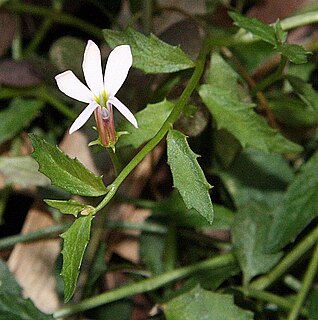
Lobelia purpurascens, commonly known as white root or purplish pratia, is a flowering plant in the family Campanulaceae of eastern Australia. It is a small herbaceous, scrambling plant with white to pale pink flowers.
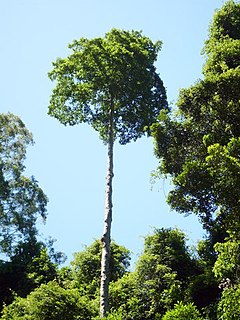
Elaeocarpus obovatus, commonly known as hard quandong, blueberry ash, whitewood, grey carabeen, freckled oliveberry or gray carrobeen, is a species of flowering plant in the family Elaeocarpaceae and is endemic to eastern Australia. It is a tree with buttress roots at the base of the trunk, egg-shaped to lance-shaped leaves with the narrower end towards the base, racemes of white flowers, and blue, oval fruit.

Bossiaea buxifolia, commonly known as matted bossiaea, is a species of flowering plant in the family Fabaceae and is endemic to south-eastern Australia. It is a prostrate to weakly erect shrub with elliptic to egg-shaped or almost round leaves and yellow, red and purplish flowers.
Hibiscus cravenii is a species of flowering plant in the mallow family, Malvaceae, that is endemic to the Northern Territory in Australia.

Pomaderris aspera, commonly known as hazel pomaderris, is a species of flowering plant in the family Rhamnaceae and is endemic to south-eastern Australia. It is a shrub or small tree with elliptic to lance-shaped or egg-shaped leaves and greenish-yellow flowers.

Lobelia anceps, commonly known as angled lobelia, is a small herbaceous plant in the family Campanulaceae it grows in several states of Australia, New Zealand, South America and South Africa. It is a small, perennial herb with blue to purple flowers.

Vexatorella amoena, also known as the Swartruggens vexator is an evergreen shrub of up to about 1 m (3 ft) high, that is assigned to the family Proteaceae. It has entire, inverted egg-shaped, bluish grey, leathery leaves of 1½–3 cm (0.6–1.2 in) long and 5–11 mm (0.20–0.45 in) wide on a distinct stalk, and globular flower heads of about 2 cm (0.8 in) across with pale pink flowers with extended, thick-tipped styles at the tip of the branches. The plants are flowering from September to November. It is an endemic species that is restricted to the Western Cape province of South Africa.

Brachyscome graminea, commonly known as grass daisy, is a perennial herb in the family Asteraceae and is endemic to Australia. It has mostly mauve-pink or purple daisy-like flowers and a yellow centre.

Bossiaea decumbens is a spreading, prostrate shrub in the pea family (Fabaceae), and is endemic to Victoria. It has alternate, variable shaped leaves and yellow pea flowers with red splotches from spring to late summer.

Diplolaena andrewsii, is a species of flowering plant in the family Rutaceae and is endemic to the west coast of Western Australia.
Otholobium accrescens is an upright, largely herbaceous subshrub assigned to the Pea family. It has up to three stems that carry upright branches in leaf axils near the ground, and have alternately set inverted egg-shaped leaves and lax heads consisting of 12-21 pea-like flowers on long peduncles in the axils of the lower leaves. It differs from most other Otholobium species by the calyx that continues to grow after flowering and the leaf that consists of just one leaflet. It is an endemic of the Eastern Cape province of South Africa near Loerie. It probably flowers August to January.

Pomaderris brevifolia is a species of flowering plant in the family Rhamnaceae and is endemic to the south of Western Australia. It is a slender shrub with silky-hairy young branchlets, wedge-shaped, heart-shaped or egg-shaped leaves with the narrower end towards the base, and clusters of ten to twenty cream-coloured to pale pink flowers.
Pomaderris briagolensis is a species of flowering plant in the family Rhamnaceae and is endemic to Victoria, Australia. It is a shrub with hairy branchlets, egg-shaped or oblong leaves and panicles of white to rust-coloured flowers.
Lechenaultia brevifolia is a species of flowering plant in the family Goodeniaceae and is endemic to inland south-western Western Australia. It is a tufted, sparsely-branched subshrub with crowded, narrow, fleshy leaves and white and blue, tube-shaped flowers.
Lasiopetalum adenotrichum is a species of flowering plant in the family Malvaceae and is endemic to the Fitzgerald River National Park in the south of Western Australia. It is an erect shrub with hairy foliage, narrow egg-shaped to lance-shaped leaves and groups of white to cream-coloured and dark reddish-purple flowers.
Lasiopetalum angustifolium, commonly known as narrow leaved lasiopetalum, is a species of flowering plant in the family Malvaceae and is endemic to coastal areas of south-western Western Australia. It is a low spreading or dense, compact shrub with narrowly egg-shaped to narrowly elliptic leaves and compact groups of pink to purplish flowers.
Pomaderris coomingalensis is a species of flowering plant in the family Rhamnaceae and is endemic to Queensland. It is a shrub with hairy young stems, egg-shaped or elliptic leaves, and clusters of cream-coloured or yellow flowers.

Lobelia browniana is a species of flowering plant in the family Campanulaceae and is endemic to eastern Australia. It is an erect, glabrous, annual plant with narrow leaves and one-sided racemes of blue flowers with long, soft hairs in the centre.
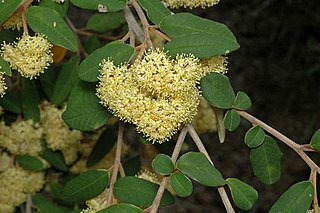
Pomaderris costata is a species of flowering plant in the family Rhamnaceae and is endemic to south-eastern continental Australia. It is a spreading shrub with densely hairy branchlets, egg-shaped to elliptic leaves, and panicles of cream-coloured or white flowers.

Lechenaultia filiformis is a species of flowering plant in the family Goodeniaceae and is native to northern Australia and New Guinea. It is a grasslike, ascending herb with scattered, narrow, fleshy leaves and pale purple-blue to creamy-white, tube-shaped flowers.

