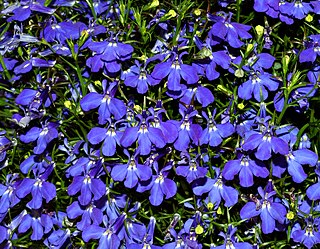
Lobelia is a genus of flowering plants comprising 415 species, with a subcosmopolitan distribution primarily in tropical to warm temperate regions of the world, a few species extending into cooler temperate regions. They are known generally as lobelias.

The family Campanulaceae, of the order Asterales, contains nearly 2400 species in 84 genera of herbaceous plants, shrubs, and rarely small trees, often with milky sap. Among them are several familiar garden plants belonging to the genera Campanula (bellflower), Lobelia, and Platycodon (balloonflower). Campanula rapunculus and Codonopsis lanceolata are eaten as vegetables. Lobelia inflata, L. siphilitica and L. tupa and others have been used as medicinal plants. Campanula rapunculoides may be a troublesome weed, particularly in gardens, while Legousia spp. may occur in arable fields.

Isotoma is a genus of annual and perennial herbs in the family Campanulaceae and are native to Australia and New Zealand.
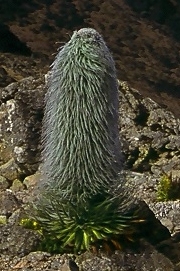
Lobelia telekii is a species of flowering plant in the family Campanulaceae, that is found only in the alpine zones of Mount Kenya, Mount Elgon, and the Aberdare Mountains of East Africa. It occurs at higher altitudes on well-drained sloped hillsides. It is a semelparous species, putting all its reproductive effort into producing single large inflorescence up to 3 metres (10 ft) tall, and then dying. Inflorescences of L. telekii also possesses a large pith-volume for internal water storage and marcescent foliage which could provide insulation. It secretes a polysaccharide into this reservoir, which may be useful for its survival in the cold climate. The plant is named after the Austro-Hungarian explorer, Count Sámuel Teleki.

Pratia is a genus of flowering plants in the family Campanulaceae, native to Asia, Australia and New Zealand. One study has said, "It is clear that the segregate genera Hypsela, Isotoma, and Pratia are no longer applicable to the New Zealand species of Lobeliaceae, and these are henceforth treated as Lobelia."

Giant lobelia is a common name for several plants in the genus Lobelia and may refer to:

Lobelia arnhemiaca is a herb found in Western Australia, Northern Territory and Queensland.

Lobelia anceps, commonly known as angled lobelia, is a small herbaceous plant in the family Campanulaceae native to Western Australia, New Zealand, South America and South Africa.
Lobelia archeri is a small herbaceous plant in the family Campanulaceae native to Western Australia, first described in 2010 by Neville Walsh.
Lobelia cleistogamoides is a small herbaceous plant in the family Campanulaceae native to Western Australia, and first described in 2007 by Neville Walsh and David Albrecht.
Lobelia dioica is a small herbaceous plant in the family Campanulaceae native to Western Australia.

Lobelia anatina, commonly known as Apache lobelia or south western lobelia, is a small herbaceous plant in the family Campanulaceae native to North America.
Lobelia douglasiana is a small herbaceous plant in the family Campanulaceae native to Kimberley region of Western Australia.
Lobelia fissiflora is a small herbaceous plant in the family Campanulaceae native to Western Australia, and first described in 2010 by Neville Walsh, David Albrecht and Eric Knox
Lobelia gibbosa, commonly known as tall lobelia, is a small herbaceous plant in the family Campanulaceae native to Western Australia.
Lobelia leucotos is a small herbaceous plant in the family Campanulaceae native to Western Australia.
Lobelia rarifolia is a small herbaceous plant in the family Campanulaceae native to Western Australia.
Lobelia rhytidosperma, commonly known as wrinkled-seeded lobelia, is a small herbaceous plant in the family Campanulaceae native to Western Australia.

Lobelia tenuior, commonly known as slender lobelia, is a small herbaceous plant in the family Campanulaceae native to Western Australia.

Lobelia winfridae, commonly known as little lobelia, is a small herbaceous plant in the family Campanulaceae native to Western Australia.
